
If a customer can decide, order and pay without speaking to anyone, that is ecommerce. If they have to call you to finish the order, you have a catalogue with a phone number.
Ecommerce is buying and selling goods or services over the internet. That is the entire definition. Someone ordering atta on an app at eleven at night is ecommerce. So is a workshop in Ludhiana reordering thread through a supplier portal, and so is a salon taking a Saturday appointment from a link in its Instagram bio.
The word covers enough ground that most explanations of it turn vague. This one goes the other way. What the term actually means, how an order moves through a business, which models are worth knowing, and what any of it looks like if you are trading in India.
What ecommerce actually means
The formal version: ecommerce, short for electronic commerce and often written e-commerce, is any transaction where the order is placed through a digital channel. Payment might happen online or at the door. The goods might travel by courier, by your own rider, or not travel at all if you are selling a service, a slot or a file.
Two things get mixed up here. An ecommerce website is the shop. An ecommerce business is everything behind it: sourcing, stock, payments, delivery, returns and the person answering the phone when a parcel goes missing. You can have a beautiful website and no business.
A test that holds up well: if a customer can decide, order and pay without speaking to anyone, that is ecommerce. If they have to call you to finish the order, you have a catalogue with a phone number. Both can make money. They are not the same thing to run.
How an order actually moves
Strip out the jargon and almost every online sale follows the same six steps.
Discovery. Someone finds you through search, an ad, a marketplace listing, a WhatsApp forward or a friend.
The product page. They read the price, the delivery estimate and the return policy, in roughly that order.
Cart and checkout. The point where most orders die, usually over an unexpected charge or a forced account signup.
Payment. UPI, card, netbanking, wallet, EMI, or cash collected at the door.
Fulfilment. Picking, packing, a label, a courier or your own rider, and a tracking link the customer will refresh more than you expect.
After the sale. Returns, refunds, exchanges, a support ticket, and eventually the second order.
The last step is the one businesses underestimate. Getting a first order is a marketing problem you can pay to solve. Getting a second one is an operations problem, and no amount of ad spend fixes a late parcel.
Where ecommerce happens
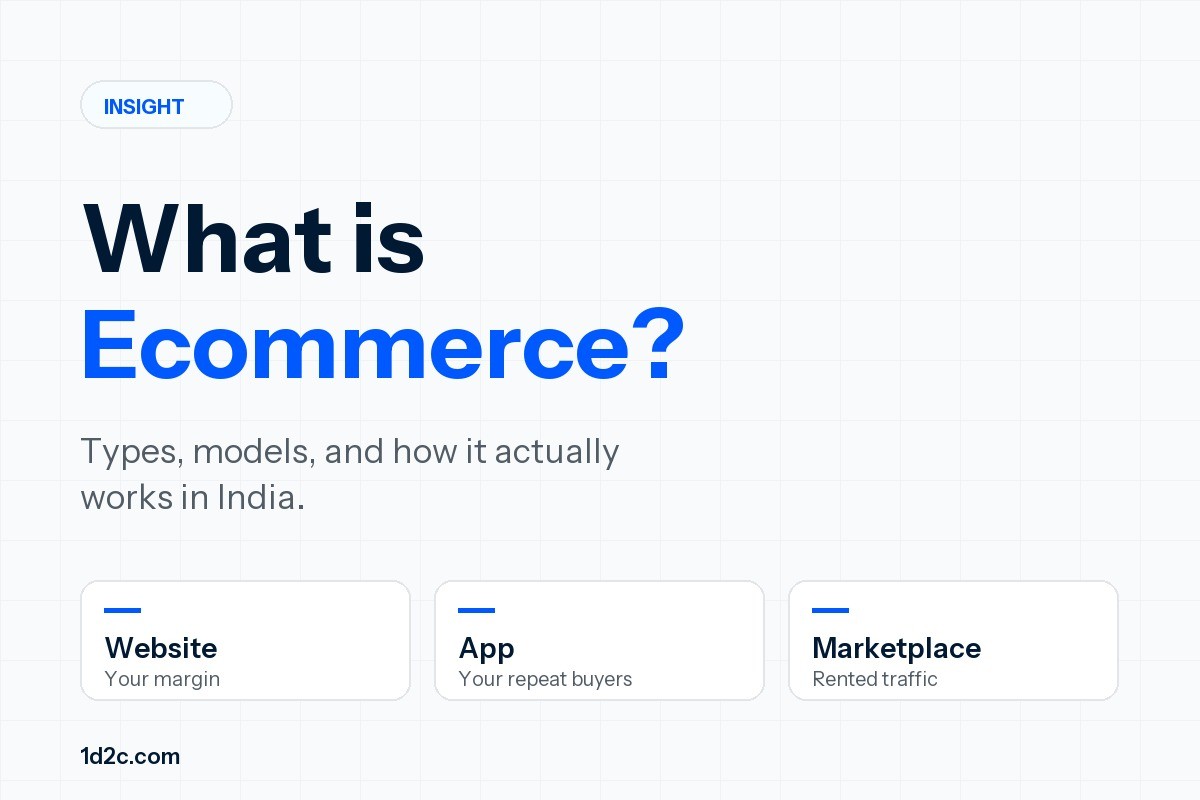
Ecommerce is not a website. It is a set of places a customer can buy from you, and most businesses end up on several.
Your own website, where you keep the margin and the customer data.
Your own app, which is where repeat buyers go once they have bought twice.
Marketplaces like Amazon, Flipkart, Myntra and Meesho, where the traffic is rented and the commission is real.
Social and chat, meaning Instagram, WhatsApp catalogues and the DMs where a surprising amount of Indian retail is still transacted.
Quick commerce, where the promise is ten to thirty minutes and the whole model rests on stock sitting close to the buyer.
Offline to online, where the shop already exists and the online channel is an extension of it rather than a replacement.
The business models, minus the alphabet soup
Most guides list eight acronyms. Four of them account for almost everything you will encounter.
B2C, business to consumer
A business sells to the public. A clothing label, a pharmacy, a grocery app. The volumes are high, the order values are low, and the fight is over repeat purchase.
D2C, direct to consumer
A brand that makes or owns its product and sells it without a retailer in between. The appeal is margin and the customer relationship. The cost is that you now own marketing, delivery and support yourself, which is a real job.
B2B, business to business
A business sells to other businesses. Bulk pricing, negotiated rates, GST invoices, credit terms, reorders that repeat monthly. Quieter than B2C and often more profitable, because the buyer is not shopping for fun.
Marketplace, or C2C
You do not sell anything. You host other sellers and take a cut. The work moves from stock to seller onboarding, quality control, pricing rules and payouts. Anyone running one discovers quickly that it is a different business from retail.
The remaining acronyms, C2B, B2G, C2G and the rest, are real. They are also rare enough that if you are in one, nobody needs to explain it to you.
How ecommerce businesses actually make money
The model you pick decides what you end up optimising for. Choose commission and you will spend your life recruiting sellers. Choose margin and you will spend it on sourcing.
Margin on goods. Buy or make at one price, sell at another. Simple, and brutal at low volumes.
Commission. You run a marketplace and take a percentage of what your sellers sell.
Subscription. A box every month, or a membership that buys free delivery and better prices.
Service fees. Bookings, installation, repairs, consultations. The customer is paying for time rather than a product.
Advertising. Once you have traffic, sellers and brands will pay for placement inside your own store.
Plenty of businesses run two of these at once. A marketplace that also sells its own private label is doing margin and commission in the same checkout.
What it takes to run one
The shop is the visible tenth of it. Underneath sits a stack that has to hold together on a bad day:
A catalogue and live stock counts, so you stop selling what you do not have.
Payments, which in India means UPI and cards and netbanking and usually cash on delivery too.
Delivery, whether that is courier partners, your own riders, or both depending on the pin code.
Returns and refunds, which need a process before you need it, not after.
Invoicing and GST, correct the first time, because fixing tax records later is miserable.
Support on whatever channel your customers already use, which is frequently WhatsApp.
Reporting honest enough to tell you which products and which channels are actually paying for themselves.
What is different about ecommerce in India
Most of what is written about ecommerce is written from an American desk, and a few things do not carry over.
It is a phone business
Not mobile-first as a design principle. Phone as the only device many customers own. That changes what a product page can weigh, how long a checkout can be, and whether an app is a nice extra or the main shop.
Payment is plural
UPI has changed the default, but cash on delivery has not disappeared, especially outside the metros and especially for a first order from a brand nobody has heard of. Refusing COD is a decision with a number attached to it.
Delivery is the product
In a market where three sellers list the same item at the same price, the one that arrives reliably wins. Serviceability by pin code, realistic promise dates and a tracking link that actually updates do more for repeat orders than another discount.
Speed became a category
Quick commerce turned thirty-minute delivery from a novelty into an expectation, at least in the large cities. Not every catalogue suits it. Furniture is never going to move that way. But it has reset what people think of as normal, and that expectation leaks into categories that cannot possibly meet it.
Language and location
Buyers in tier two and tier three cities are the growth, and they do not all shop in English. Regional language, local sellers and radius-based search matter more here than in a market where everything ships nationally in two days anyway.
What usually goes wrong
The store gets built before the supply chain, so the launch is a beautiful shop that cannot ship reliably.
Money goes to ads before anyone has fixed retention, which means paying twice for customers who leave anyway.
Delivery promises are set by marketing rather than by whoever has to keep them.
The app is treated as a checkbox, so it ships as a wrapped website and nobody keeps it.
Nobody owns returns, and the cost of them only becomes visible in the quarter it is too late.
How to start, in a sensible order
Decide what you sell and who to, narrowly enough that you can describe the buyer in a sentence.
Sort supply before demand. Know your cost, your lead time and what happens when something is out of stock.
Pick the channel that matches the buyer. A marketplace listing to test demand, your own store to keep margin, an app once people come back.
Set up payments and delivery properly, including the pin codes you cannot serve yet.
Write the boring pages. Shipping policy, returns, GST details. Buyers read these more than founders think.
Launch small and take real orders before spending on ads.
Then spend on marketing, once a second order is something your operation can survive.
Frequently asked questions
What is ecommerce in simple words?
Buying or selling things online. If the order is placed through a website, an app, a marketplace or a chat, it is ecommerce, whether the payment happens online or in cash at the door.
What are the main types of ecommerce?
B2C selling to the public, D2C where a brand sells its own product directly, B2B selling to other businesses, and marketplaces where a platform hosts many sellers and takes a commission. Other acronyms exist and rarely matter.
What is the difference between ecommerce and D2C?
Ecommerce is the activity. D2C is one way of doing it, where the brand that makes the product sells it straight to the buyer with no retailer in between.
Is selling on WhatsApp ecommerce?
Yes. The channel does not change the category. What it changes is the operations. Chat orders are easy to lose, hard to count, and close to impossible to report on once you are taking more than a handful a day.
How much does it cost to start an ecommerce business in India?
It ranges from almost nothing to a large number, and the platform is usually the smallest line. The real costs are stock, delivery, payment charges, returns and marketing. Anyone quoting you a single figure is quoting you for software only.
What is quick commerce?
Ecommerce with a delivery promise measured in minutes rather than days. It works by holding stock in small warehouses close to buyers, which makes it a real estate and inventory model as much as a technology one.
Where to go from here
If you are weighing platforms, we wrote a detailed comparison of 1D2C and Shopify covering apps, marketplaces, delivery and what each one really costs. Plans and pricing are on this page. And if you would rather talk it through with someone, the number at the top of this page reaches a person.