


The cheapest moment to find out your name is taken is before anyone has printed it. The most expensive is the morning the packaging arrives.
Most naming goes wrong in the same order. Somebody thinks of a name on a Tuesday. Everyone likes it. A designer draws it. Cards get ordered. Then, somewhere near the end, a person finally types it into a registrar and discovers the domain is parked, owned by a company in another country, and available for a number with five digits in it.
Naming is the cheapest decision you will make and one of the most expensive to undo. A logo can be redrawn. Your name sits in the domain, the email addresses, your app store listing, your invoices, your registered entity and every conversation anyone has ever had about you. It is also the first piece of ecommerce branding you commit to, and every other decision gets built on top of it.
So here is the practical order: what a name is actually doing, why short ones win, how to check availability before you get attached, and why a country domain can quietly cap how far you get to grow.
Why the name carries more weight than the logo
A logo is seen. A name gets spoken, typed, misheard, spelled out over a bad phone line, searched for, autocorrected and repeated by somebody who is recommending you to a friend. It travels in situations where no visual asset can follow it.

That has a practical consequence. Your name has to survive being said out loud by a person who has never seen it written down. If the listener cannot get to your website from hearing it once, the name is doing half a job.
Changing one later is also a different scale of problem. A new logo means new artwork and new print runs. A new name means a new domain, new email addresses for everyone, an app store listing that has to go back through review, updated legal and tax records, a fresh trademark position and every existing link pointing at an address that no longer resolves.
Shorter is better, and here is the reason
Short is not an aesthetic preference. Short buys you a series of small practical advantages, and they compound:
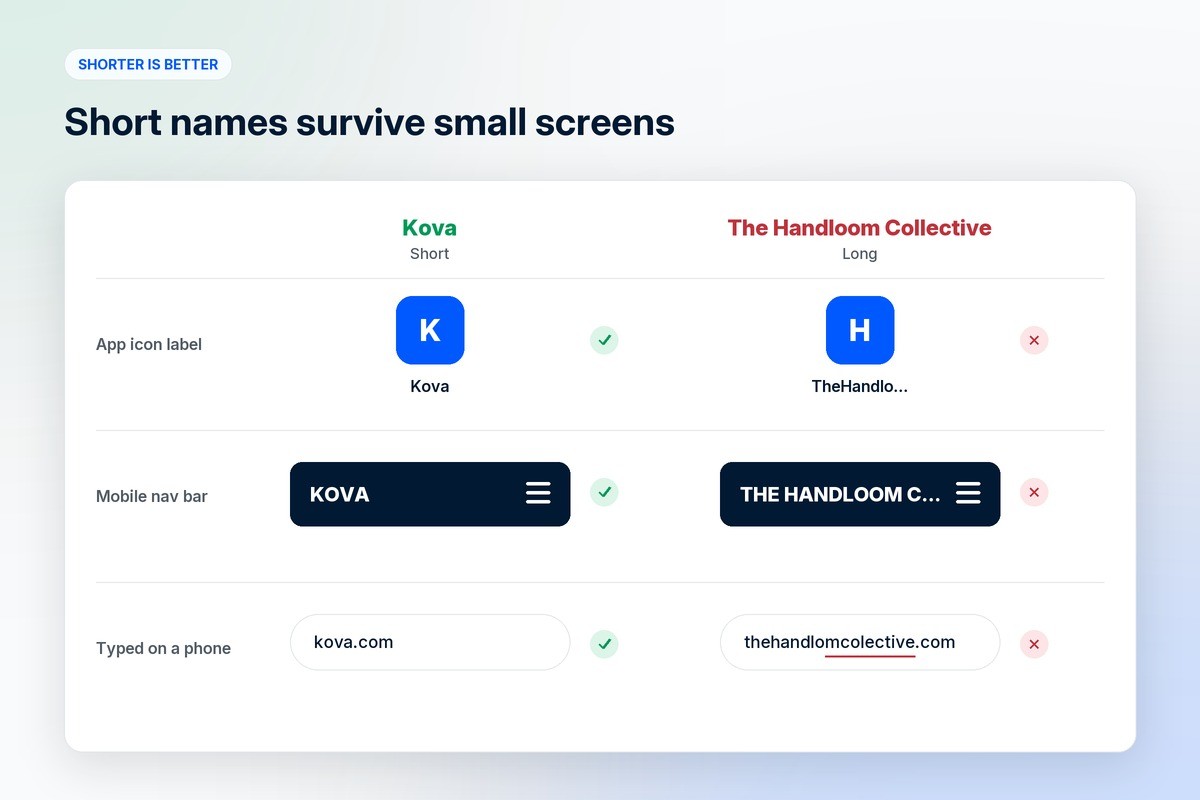
Fewer characters to type on a phone, and fewer chances to mistype one.
It fits under an app icon without being truncated, and fits on a nav bar on a narrow screen.
It fits on packaging at a size people can read from across a shop.
It survives being said quickly. Long names get shortened by customers anyway, and you would rather choose the short version than have one chosen for you.
It is easier to search for cleanly, and easier to check against existing trademarks.
A useful rule of thumb: two syllables, roughly ten characters or fewer, and exactly one obvious spelling. If you have to say the name and then immediately spell it, the name is not short. It is expensive.
The trap at the other end is going so short that the name becomes cryptic. A four-letter invented word nobody can spell after hearing it is worse than a slightly longer name that is unambiguous. Test it by saying it once to somebody and asking them to type it. Whatever they type is the real name.
Check the domain before you fall in love
Do this on the first day, before the shortlist becomes an emotional matter. Open a registrar, GoDaddy or any other, and type the exact name. It takes a minute per candidate and saves the sort of week nobody enjoys.
What to look for while you are there:
The exact-match .com. This is the one that matters most, because it is what people type by default and what they assume exists.
The obvious misspellings, so you know what you may want to register defensively later.
The handle on whichever social platforms you will actually use.
Whether somebody is already trading under that name in your category, which is a different question from whether the domain is free.
Say the domain is parked and listed for sale at a serious price. Treat that number as the price of the name rather than an insult. Sometimes it is worth paying. Often it is a signal to pick a different name while changing course is still free.
The tempting compromise is to bolt on a word. Adding get, try, shop, app or hq in front of a taken name gets you a domain today and a permanent tax afterwards, because a meaningful share of people will drop the prefix, land on whoever owns the clean version, and never realise they were looking for you. Hyphens have the same problem and are worse to say out loud.
Why a country domain can trap you
Country domains such as .in, .au, .co.uk and .de do a specific job. They tell a visitor that you are local, which is genuinely useful when local is what you are and what you intend to remain.
If you have any plan to sell beyond that one country, the calculation changes. A country domain signals a boundary. Customers elsewhere read it as a business that serves somewhere else, and payment or shipping assumptions get made before anyone has read a word of your copy. Some country domains also carry rules that a global business finds awkward, including requirements to have a local entity or a local presence to hold the domain at all.
The practical sequence is to secure the global domain first and add the country one afterwards if you want the local signal, pointing it at the same site. Doing it in that order costs very little. Doing it in reverse means coming back for the .com once you have traction, at which point the owner has looked you up and priced accordingly.
Suppose the .com is genuinely gone and nobody will sell it at a sane number. The modern alternatives are fine. A clean exact match on .co, .shop or .store beats a mangled .com every time. Pick one, use it everywhere, and put it on the packaging exactly as customers will type it.
A process that actually produces candidates
Write down what the business does in one plain sentence, and the one quality you want people to associate with it. Everything later gets judged against those two lines.
Generate far more options than feels sensible. Forty is a reasonable morning. Good names tend to arrive late in a list, after the obvious ones are out of your system.
Pull from more than one well: real words used slightly off-label, two short words joined, a word from another language, a person or place with meaning to the founders, or an invented word built from sounds you like.
Say every survivor out loud. A surprising number die at this step, usually because of an awkward consonant run or an accidental second meaning.
Cut anything that needs explaining. If the story behind the name is required for the name to land, customers will never hear it.
Take the last eight or ten candidates to a registrar before you show anyone, and cross off whatever is unavailable.
Sit with the final two for a few days. Names that irritate you on day three will irritate you for years.
Checks worth running before you commit

Say it on a phone call and have the other person type it without help.
Search it. See who already ranks for that word and whether you can realistically outrank them for your own name.
Run a trademark search in every market you expect to sell in, and take proper advice before you register anything. A name that is free as a domain can still be someone else’s mark.
Check what it means, and what it sounds close to, in the main languages of the markets you are targeting.
Look at it in lowercase, in caps, and squeezed into an app icon label.
Check the social handles you will actually use, not all of them.
Naming mistakes that cost real money
Falling in love before checking availability, which turns a naming decision into a negotiation.
Buying a country domain for a business that plans to sell internationally, then paying far more for the global one later.
Picking a name that describes exactly what you sell today, and finding it too narrow when the catalogue widens.
Choosing something so close to a competitor that a share of your marketing spend sends customers to them.
Using a name whose spelling has to be corrected every time it is said.
Frequently asked questions
Why does a brand name matter so much?
A name gets spoken, typed, searched and recommended in places a logo never reaches. If people cannot spell it or find it, every other part of the brand has to work harder.
How do I choose a good brand name?
Start with what the business does and one quality you want associated with it, generate far more candidates than you need, say them out loud, cut anything that needs explaining, then check domains and trademarks before you get attached to a favourite.
Does the length of a brand name matter?
Yes, more than most people expect. Short names are easier to type, easier to fit on packaging and app icons, and harder to mistype. Aim for two syllables and one obvious spelling, while avoiding anything so short it becomes cryptic.
Should I check the domain before choosing a name?
Always, and on the first day. Type each candidate into a registrar such as GoDaddy and check the exact-match domain, the likely misspellings and the social handles. It takes a minute per name and prevents the most expensive naming mistake there is.
Is a .in or .au domain bad for my business?
Not at all if you are deliberately serving that one country. It becomes a problem when you plan to sell internationally, because it signals a boundary to customers elsewhere, and some country domains also require a local entity or presence. Secure the global domain first and use the country one as an addition.
What if the .com is already taken?
Decide whether the owner will sell at a price you can defend. If not, either pick a different name while that is still cheap, or take a clean exact match on .co, .shop or .store. A tidy alternative extension beats a .com with a hyphen or an added word stuck to the front.
Can I change my brand name later?
You can, and it costs considerably more than changing a logo. A name sits in your domain, email addresses, app store listing, legal and tax records, printed material and every link anyone has ever shared. Treat it as a decision you make once.
Do I need a brand name before I start an e commerce business?
Settle it first. The name goes into your domain, your email, your store and your app listing on day one, so choosing it after you start an e commerce business means redoing all of them. It is the cheapest decision to make early and the most expensive to revisit.
When should I trademark my brand name?
Before you print packaging or spend on marketing, and in every market you plan to sell in. Take proper advice before you register, because a name that is free as a domain can still be someone else’s mark.
Where can I check if a brand name is available?
Check the domain at a registrar, search the trademark registry for each market you plan to sell in, look up the social handles you will use, and search the name to see who already ranks for it.
Where to go from here
Once the name is settled, the next decision is the mark that goes with it. We wrote about how to create a logo and what it costs to change one. For the wider picture of why any of this affects sales, there is why branding is important. And if you want the storefront, the apps and the marketing built as one thing, our plans are here.


