


Nobody buys from a brand they saw once. They buy from the one they kept running into, and that looked the same every time.
Picture two small stores selling almost the same candles. One last posted on its Instagram in March. The other posts most days: a new scent, a reel of the wick catching, a customer’s shelf, a packing video on a busy Friday.
A shopper finds both through an ad. Before paying a brand she has never heard of, she taps through to each profile. You already know which one gets the order.
What social media and ads do for an online store
Social media marketing for ecommerce is the work of posting, publishing reels and running paid ads on platforms like Instagram, Facebook and Google, so that people find a store, trust it and buy from it. The posts build the trust. The ads bring in new people and bring back the ones who nearly bought.
They are two halves of one job. Ads without a believable profile behind them waste money, because people click, check the page and leave. A good profile with no ads grows slowly, because only your existing followers ever see it.
Together they make up most of the digital marketing a new online store needs. Email and search matter too, but social media and online advertising are usually where a new brand’s first buyers come from.
Why daily posts build trust
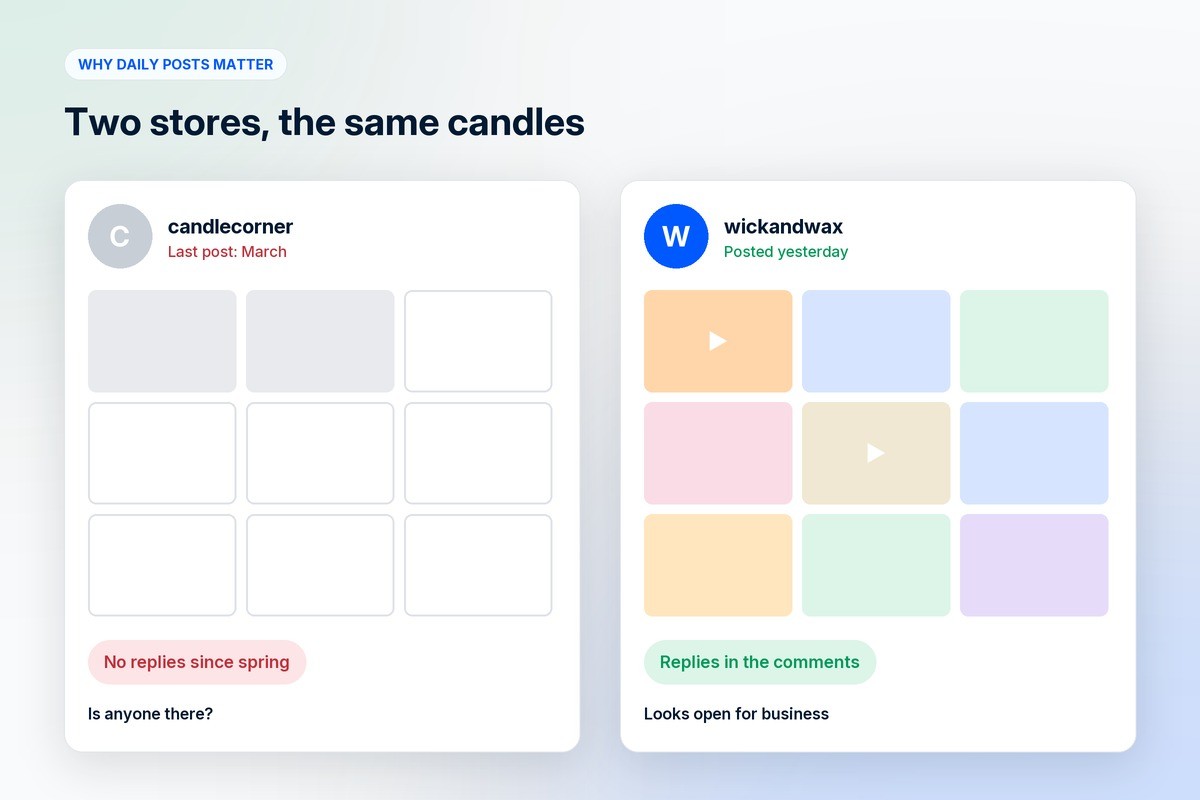
An active page is proof the store is real
A new online store asks a stranger to pay up front and wait for a parcel. The buyer’s first question is whether anyone is on the other side. A profile that posted yesterday, with real photos and replies in the comments, answers that faster than any “secure checkout” badge.
Showing up often makes you familiar
Most people don’t buy the first time they see a product. They see it again in a story, then in a reel, then in a friend’s share. By the time they are ready, yours is the brand they remember, and familiar feels safe.
Posts answer questions before they are asked
How big is it next to a hand? What does the fabric look like in daylight? How does it arrive? A steady run of posts answers those questions in advance, which means fewer doubts at checkout and fewer returns after it.
Why reels reach further than your follower count
Followers see your posts. Strangers see your reels. Instagram says that in Reels, “the majority of what you see is from accounts you don’t follow”. For a small store, that is the cheapest way to reach people who have never heard of it.

A reel that sells a product usually gets these right:
Show the product in the first second. Not a logo, not an intro. People decide whether to keep watching almost at once.
Show it being used. A dress moving, a lamp switched on in a dark room, a sauce going onto food.
Keep to one idea. One product, one benefit. Save the full range for your store.
Make it work with the sound off. Plenty of people scroll on mute, so put the key words on screen.
End with somewhere to go. The product name, the price, or a pointer to the link in your bio.
How Meta Ads turn attention into orders
Meta Ads run across Facebook, Instagram, Messenger and WhatsApp from one account. For a store, they do three jobs.
Finding people who don’t know you yet
You choose who sees an ad by location, age, interests and behaviour, or let Meta’s system look for people who resemble your existing buyers. That is how a new brand reaches relevant people from its first week, without waiting to build a following.
Showing people the product they looked at
Catalogue ads pull from your product list and show each person items that match what they did in your store. Meta’s own guide explains that the Meta pixel, Conversions API and app SDK share events such as add to cart or purchase to match products with each person’s behaviour. In practice, someone who left a pair of trainers in the cart sees those trainers again the next day.
Starting a conversation instead of a page visit
Some buyers want to ask a question before paying. Click-to-WhatsApp ads open a chat with your store, and instant forms collect a name and number without leaving the app. Both suit higher-priced products, where a quick answer closes the sale. We cover the chat side in our guide to WhatsApp for ecommerce.
How Google Ads catch buyers who are already looking
Meta reaches people while they scroll. Google reaches them at the moment they search. Someone typing “linen shirt for men” has already decided to buy one. The only question is from whom.

Search and Shopping ads
Search ads show text above the results for the phrases you bid on. For most stores, Shopping ads matter more: Google explains that they show a product photo, title, price and store name before anyone clicks. The people who do click already know what it costs, so fewer of them bounce.
Remarketing and YouTube
Google can also show ads to people who visited your store before, on Search, on YouTube and across partner websites. It is the same idea as Meta’s catalogue ads, aimed at someone who is researching rather than scrolling.
Meta Ads or Google Ads?
Meta Ads | Google Ads | |
|---|---|---|
Reaches people | While they scroll, before they search | While they search for the product |
Works best for | New, visual or impulse products | Products people already search for |
Main formats | Reels, stories, carousels, catalogue ads | Search, Shopping, YouTube, Performance Max |
Builds trust by | Familiar, repeated presence in daily feeds | Showing up in results for a real search |
A sensible order is to start with one, get it paying for itself, then add the other. If your product is visual or new, start with Meta, since nobody searches for something they don’t know exists. If people already search for what you sell, start with Google.
Where stores waste money on social media and ads
Boosting posts at random. A boosted post with no clear goal buys likes, not orders. Run campaigns aimed at sales or leads.
Sending ad clicks to the homepage. If the ad shows a blue shirt, the click should land on that blue shirt, not on your whole catalogue.
Running ads without tracking. Without the pixel or app events, you can’t tell which ad produced which order, so you can’t move money to what works.
Stopping after a week. Ad systems need time and data to learn who buys. Judging a campaign on its first few days usually ends it too early.
An empty profile behind a good ad. People click, find three posts from last year, and leave.
Posting in bursts. Twenty posts in one week and none the next looks less reliable than one post a day.
How to get started
Fix the profile first. A clear bio, a link to your store, and a couple of weeks of posts before any money goes into ads.
Pick a posting rhythm you can keep. Daily is ideal. Three times a week that you actually keep beats daily for a fortnight and then silence.
Make reels from what you already do. Packing orders, making the product, unboxing, a customer’s photo. None of it needs a studio.
Install tracking before you spend. Connect the Meta pixel or app events and Google’s conversion tag to your store, so every order is counted.
Start with one campaign and one goal. Sales or leads, not reach. Give it a budget you can leave running for a few weeks.
Review weekly and change one thing at a time. Swap the creative, the audience or the offer, but not all three together, or you won’t know what worked.
How 1D2C handles social media and ads
1D2C builds a brand’s own website and store apps, and marketing is part of the same service. Our team writes, designs and publishes your posts and reels on Instagram and Facebook every month, and runs your Meta ads. The Social Media & Ads plans range from 30 posts and 2 AI reels a month up to 300 posts and 30 reels for brands scaling fast.
If you would rather buy this as one of your ecommerce services than hire a team, that is what these plans are for. The store, the apps and the marketing come from the same people.
The Meta pixel and app events are built into your 1D2C store and apps, so you can see which ad led to which order, on the web and in the app. And because the same team handles your branding, the posts, the ads and the store look like one brand.
Frequently asked questions
Why does an online store need both social media and ads?
Posts and reels make a store look real and familiar to people who find it. Ads bring in new people and bring back the ones who nearly bought. Each makes the other cheaper.
How often should an online store post on social media?
As often as you can keep up, and at a steady pace. Once a day is a good target for a growing store. If that is too much, pick a smaller number and hold it, because a consistent rhythm matters more than bursts.
Are reels better than posts for selling?
They do different jobs. Reels reach people who don’t follow you yet, so they are better for discovery. Posts and carousels are better for detail, such as sizes, prices and reviews, for people who have already found you. A store needs both.
Should I start with Meta Ads or Google Ads?
Start with Meta if your product is visual, new or bought on impulse, because people won’t search for something they don’t know exists. Start with Google if people already search for what you sell. Add the second channel once the first pays for itself.
How much should a small store spend on ads?
There is no universal right number. Choose a monthly budget you can leave running for a few weeks without panicking, because campaigns need time to learn. Then judge it on cost per order and repeat buyers, not on likes.
Do I still need social media if I run ads?
Yes. Ads send people to your profile and your store. If the profile looks abandoned, many of them leave without buying, and you have paid for every one of those clicks.
What is the difference between social media marketing and online advertising?
Social media marketing is the unpaid part: your posts, reels, stories and replies. Online advertising is the paid part, such as Meta Ads and Google Ads, where you pay to reach people who would not otherwise see you. Stores that do well run both, because ads work better with a real profile behind them.
How do I get started with social media and ads for my store?
Fix the profile first, post on a rhythm you can keep, make reels from what you already do, install tracking, then start with one sales campaign and one retargeting campaign.
The short version
Posts and reels make a store look real and familiar. Meta Ads find new buyers and bring back the ones who nearly bought. Google Ads catch the people already searching. Run them with tracking in place and a consistent brand behind them, and each one makes the others cheaper.
If you want this handled for your store, see our Social Media & Ads plans or talk to us. For the trust side of the story, read why branding is important. For the hands-on version, there is how to set up Meta ads for D2C brands.
Platform features described above were checked on Instagram’s, Meta’s and Google’s own pages in September 2026. Ad products change often, so check each platform’s help pages before planning a campaign. For how this fits the wider picture, see what digital marketing is and how the channels work together. For the organic half in more depth, see D2C social media marketing. On the organic side, consistency does most of the work: why regular posting matters. On the paid side, where you press the button matters: Meta Ads Manager vs the Instagram boost.


