

A follower who came only for the discount code costs you twice. Once to acquire, and again every time you have to discount to keep them.
Most D2C brands measure social media by follower count because it is the number sitting at the top of the screen. It is also the number with the loosest relationship to revenue. Plenty of brands with forty thousand followers sell less than brands with four thousand, and the difference is almost never the posting schedule.
What follows is seven tactics that move both numbers at once, in the order a small team should attempt them. Each one is about turning attention into an order rather than into a like.
1. Make the feed shoppable, so nobody has to go looking
The most common leak in D2C social media marketing is a good post with no route to checkout. Someone sees the product, wants it, and then has to find a profile, tap a link, land on a homepage and search for the thing they already saw. A share of them give up at every step.
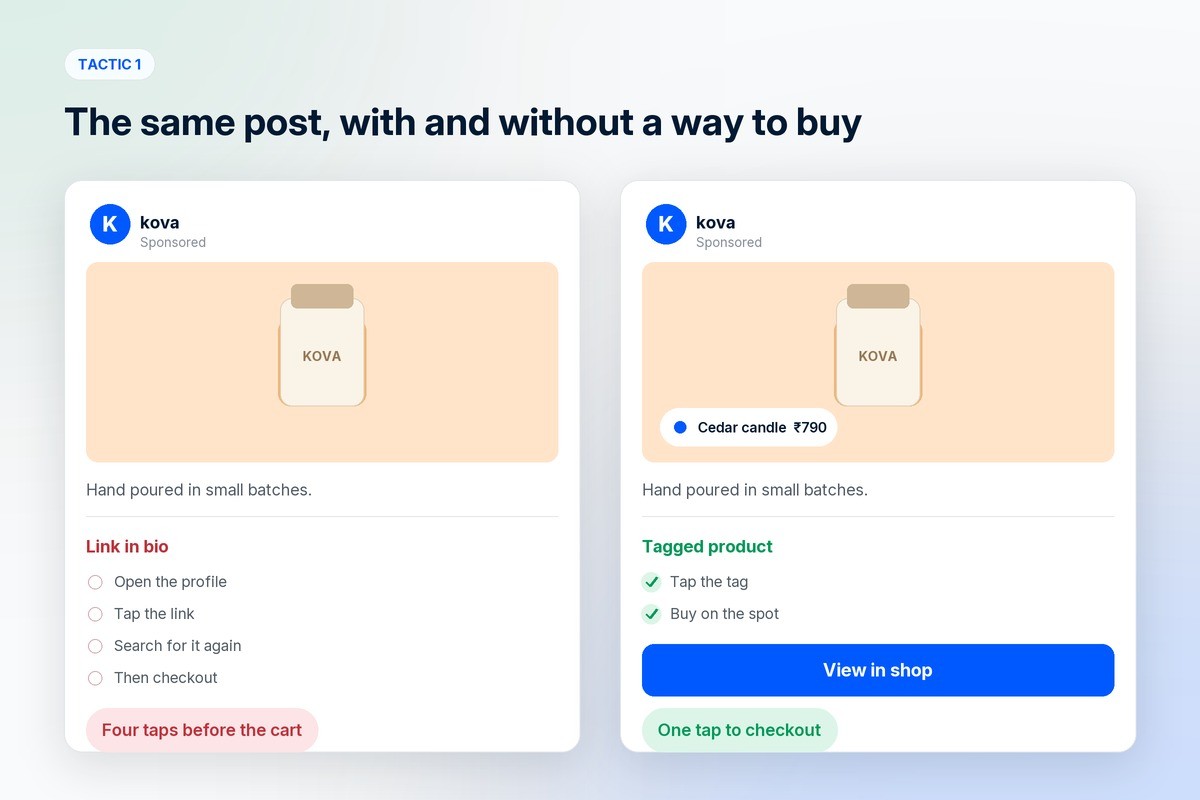
Close the gap. Tag products in posts where the platform supports it, keep the bio link pointing at a collection that matches what you are currently posting rather than the homepage, and make the first comment on a product post the direct link. If your buyers prefer messaging, let the post open a chat instead of a browser.
This is unglamorous and it usually produces the single biggest lift available, because it fixes demand you have already paid to create.
2. Show the product being used, not the product on white
Catalogue photography sells on a product page, where somebody has already decided to look. It performs badly in a feed, where it reads as an advertisement and gets scrolled past as one.
What works instead is the product in a hand, in a kitchen, on a commute, mid-use, shot the way everything else in the feed is shot. The goal is to look native to the platform rather than imported from a catalogue, because the feed is a stream of personal content and anything that announces itself as marketing is treated as an interruption.
A practical rule: if a post could run as a billboard without changes, it is probably wrong for social.
3. Turn customers into the content engine
The brands that post consistently without burning out are rarely producing everything themselves. They are collecting it.
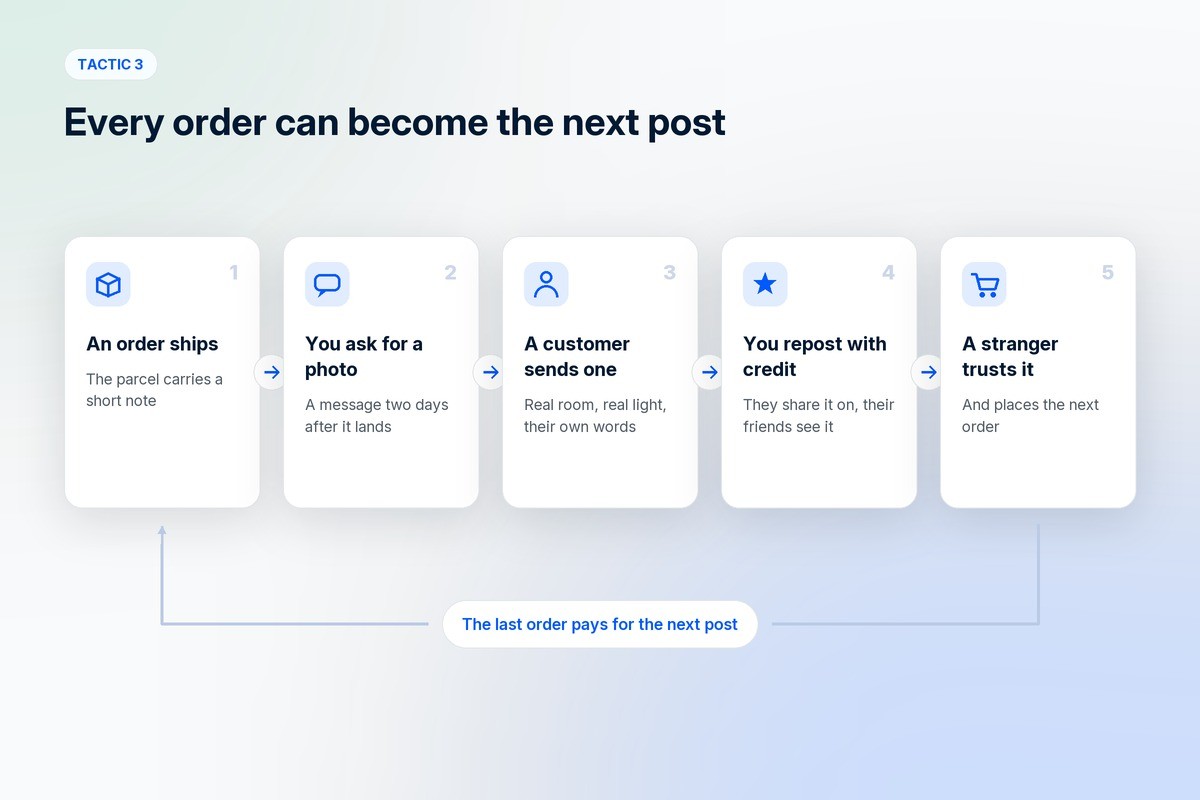
Ask for photos and videos at the point of delivery, when satisfaction is highest, rather than weeks later.
Make it easy to send: a reply to the order confirmation, a WhatsApp message, a tagged post.
Get written permission to reuse anything you repost, once, in plain language.
Repost generously and credit visibly, because that is what makes the next customer send theirs.
Customer footage outperforms brand footage for the same reason unpolished posts outperform polished ones. It carries evidence that somebody other than you has taken the risk already.
4. Give people a reason to follow that is not a discount
Discount-led follower growth is the easiest kind to buy and the least useful kind to own. A follower acquired by a giveaway follows for the giveaway, ignores everything afterwards, and either unfollows or waits for the next code. You end up paying twice: once for the acquisition, then again in margin every time you need them to buy.
A better reason to follow is anything that stays useful between purchases. How to care for the material. What the sizing actually runs like. What you are making next and why. A recurring format people recognise. Followers who came for that convert at normal prices and stay through quiet months.
5. Treat comments and DMs as a sales channel, because that is what they are
A comment asking the price is further down the funnel than anything an ad can buy, and most brands answer it a day later with a link to the homepage.
Answer fast, answer in the thread, and answer the actual question with the actual number. Then move the conversation somewhere you can complete it. Messaging platforms carry a large share of considered purchases, which is why WhatsApp ecommerce works so well for anything needing a size, a quote or a question settled before somebody commits.
If one person asks publicly, assume a hundred wanted to know. Those answers are also your next week of content.
6. Repeat what worked instead of chasing new ideas
Most teams retire a post the moment it has been published, then spend the next week inventing something new. Reach does not work that way. Only a fraction of your audience saw the thing that worked, and almost none of the people who will follow you next month have seen it at all.
When a post performs, take it apart and run it again: the same idea with a different opening line, a different first frame, a longer cut, a version for a different format. You are looking for the version of a proven idea that reaches the next slice of the audience, which is cheaper than finding a new idea and far more reliable.
The teams that post consistently for years are rarely more creative than everyone else. They are just less precious about reuse.
7. Put a face in front of the camera
Accounts with a recognisable person attached grow faster than accounts that are purely product photography, because people follow people more readily than logos. For a D2C brand this does not require an influencer budget.
The founder explaining why a decision was made, filmed on a phone.
Whoever packs the orders showing what goes into a parcel.
A customer who already posts well, sent product and left alone to make what they want.
A small creator in your category, paid for a few pieces you can also run as ads.
Start with whoever is already willing, rather than waiting for a budget. Content made by one person with a phone and a reason to care usually beats content made by a committee with a brief.
How to tell whether it is working
Followers are a lagging and noisy measure. These say more:
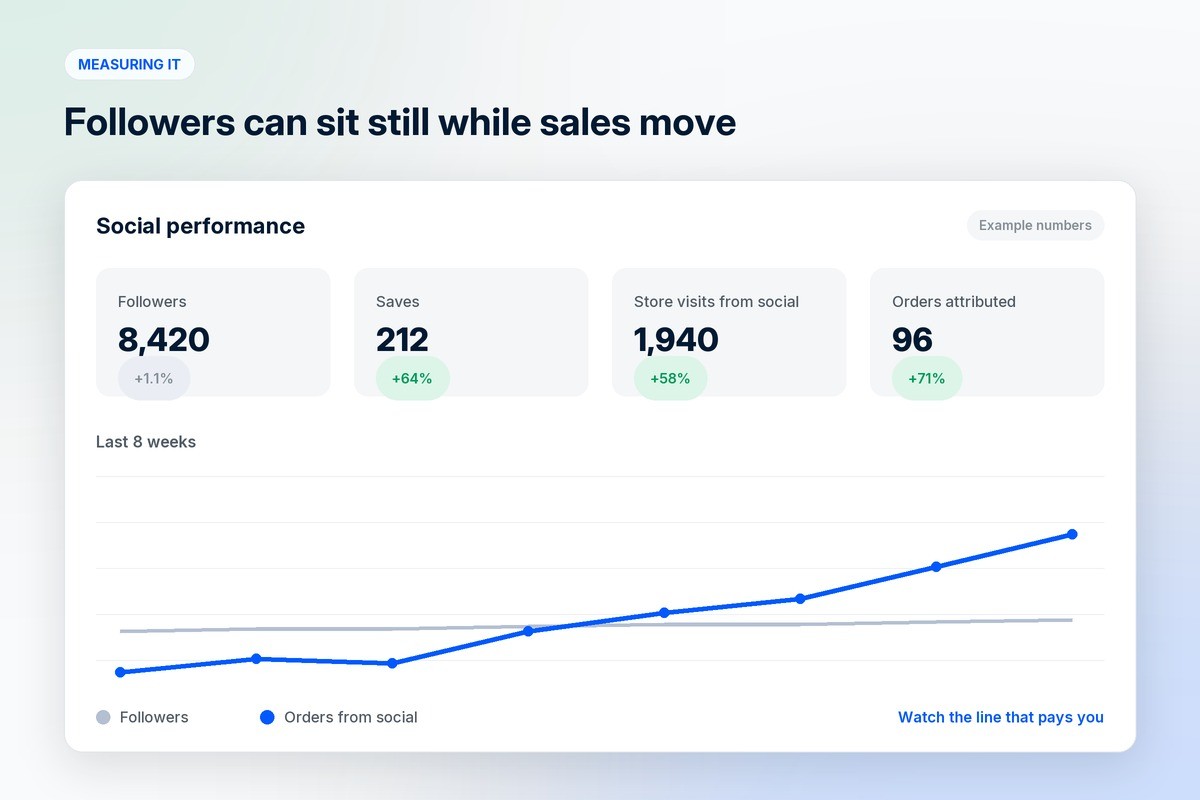
Orders that arrived through profile and bio links, tracked properly rather than guessed at.
Enquiries in DMs and comments, and the share of them that turn into orders.
Branded search volume, which rises when people are seeing you and looking you up later.
Saves and shares per post, which predict reach far better than likes do.
Repeat purchase rate among customers who follow you, compared with those who do not.
If follower count climbs while none of these move, the account is growing an audience that was never going to buy. That is worth knowing early, because it is usually a content problem rather than a reach problem.
Mistakes that cost the most
Posting on five platforms badly instead of one properly.
Buying followers or running giveaways with no connection to the product.
Treating organic social as free. It costs time, and time is the scarcest thing in a small team.
Letting the ad account and the organic account look like two different brands.
Going quiet for a month and expecting the reach to be waiting when you come back.
Frequently asked questions
What is D2C social media marketing?
Using Instagram, Facebook and other social platforms to help a brand that sells direct get found, earn trust and turn followers into orders on its own store.
Why does social media matter for D2C brands?
A D2C brand has no shop window and no retailer to introduce it. Social media is where most people first see the product, check that the brand is real and ask questions before they buy.
How often should a D2C brand post on social media?
Often enough to stay familiar and consistently enough to keep doing it. Three or four posts a week on one platform, sustained for a year, beats daily posting for six weeks and then silence. Pick the frequency you can hold through a busy season.
Do followers actually matter for a D2C brand?
They matter as a measure of how many people you can reach without paying each time, and not much beyond that. Ten thousand followers who came for a giveaway are worth less than a thousand who came for the product. Judge the account on orders, enquiries and branded searches instead.
Which platform should a D2C brand start with?
The one where your customers already are, and where your product is easiest to show. Visual products do well on Instagram and short video. Considered or technical purchases often do better where conversation is possible. Starting on one and doing it properly beats spreading thin.
Is organic social media marketing enough without ads?
It can build a brand and it rarely builds volume quickly. Organic compounds slowly and costs time instead of money. Ads buy reach immediately and stop when you stop paying. Most D2C brands need both, with organic giving the ads something credible to land on.
How long before social media marketing produces sales?
Direct sales from a shoppable post can appear in the first week. The compounding effect, where people already know you before the ad arrives, takes a few months of consistency. Judging it monthly is how most accounts get abandoned just before they start working.
Should I pay influencers or make my own content?
Start with your own, because you will learn what your audience responds to and pay nothing to find out. Bring in creators once you know which messages work, and buy the right to run their best pieces as ads, which is usually where creator content earns its fee.
Who should run social media for a small D2C brand?
Someone close to the product, often the founder at first, because they can answer questions and appear on camera. As posting and DMs grow, a dedicated person or an agency can take over the routine work.
How do I know if social media marketing is working?
Track orders and revenue that start from social, not likes and followers. Watch link clicks to your store, DMs that turn into orders and how many buyers come back.
Where to go from here
This sits inside the wider picture of what digital marketing is and how the channels feed each other. For the paid side, there is social media and ads for ecommerce and a practical guide to setting up Meta ads. For turning conversations into orders, see WhatsApp integration. If you would rather this was run for you alongside the storefront and the apps, our plans are on the pricing page. None of it works without a rhythm, which is why regular social media posting matters.