

A quiet account is not a pause in the conversation. It is a month of competitors talking to your customers.
Look at a brand account that stopped. The last post is from March. It has decent engagement, a reply the brand never answered, and under it a comment asking whether they are still shipping.
That is what a quiet account communicates. The brand reads it as a marketing pause. Everyone else reads it as nobody being home. A customer deciding between you and a competitor checks the profile, sees March, and makes a reasonable assumption about what happens after they pay.
Posting regularly is boring advice, and it is the advice that separates accounts that produce orders from accounts that produce nothing. Here is what it is actually doing.
Familiarity is the whole mechanism
People buy from brands they recognise. Recognition comes from repetition, and repetition is a function of how often you appear.
Someone who has seen your product eleven times over two months reacts differently to your ad than someone meeting you for the first time. The product has not changed. Their sense of risk has. A brand they have seen before feels like a brand that will still exist when the parcel needs returning.
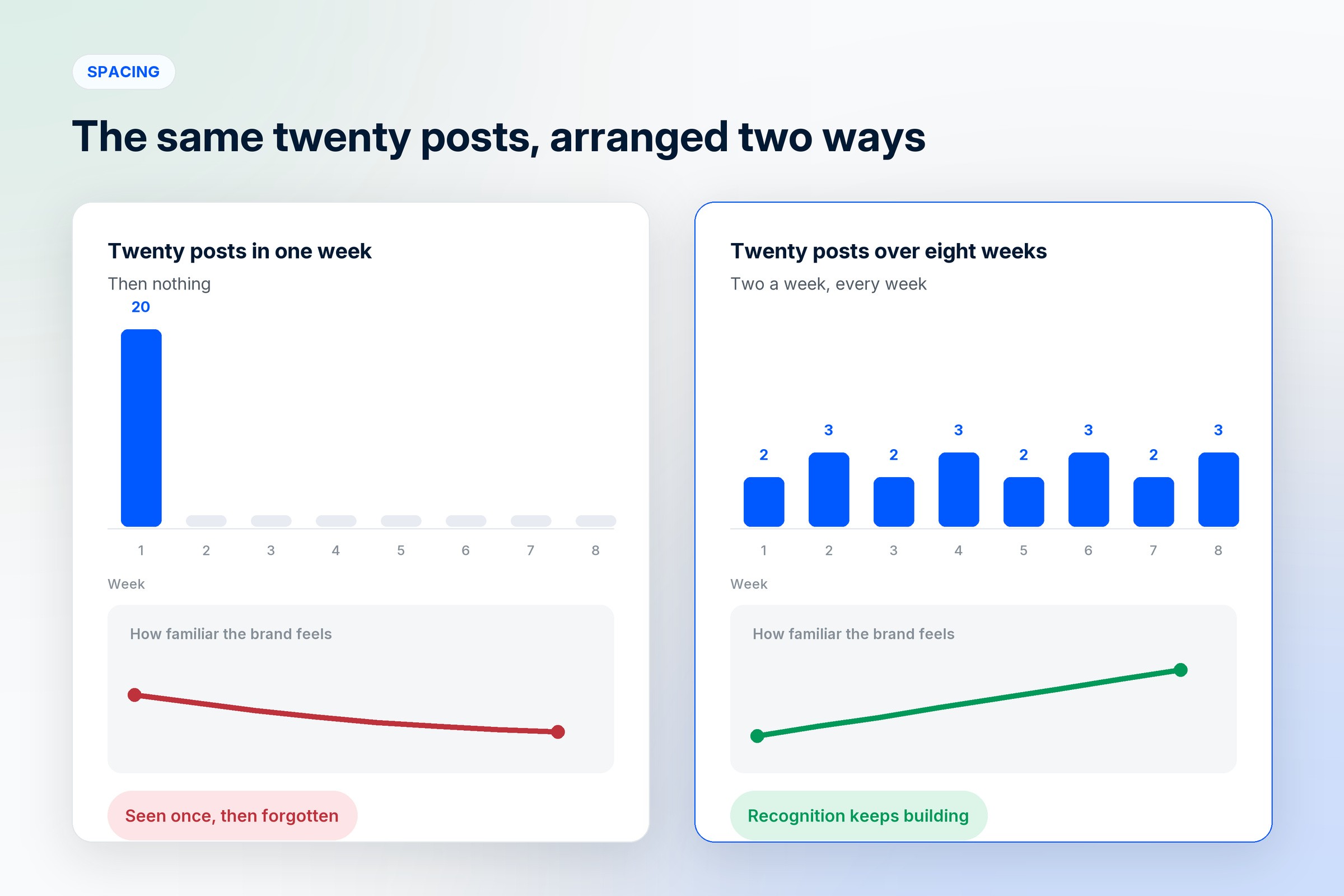
This is why a burst of twenty posts in one week does less than twenty posts spread over two months. The same effort, arranged differently, produces a very different result, because familiarity is built by spacing rather than volume.
The algorithm rewards the habit, not the post
Every feed has to guess whether your next post is worth showing. The strongest hint it has is what happened to your last few.
An account that posts weekly gives the system a steady supply of evidence: this content gets saved, this one gets skipped, this audience responds on Thursday evenings. An account that posts once a quarter is a cold start every time, so each post has to re-earn its distribution from almost nothing.
The practical effect is that your tenth consistent post reaches more people than your first, without being better. You are not gaming anything. You are giving a ranking system enough data to stop guessing.
What you are really building is a library
Each post is a small asset that keeps working after the day it is published.
A reel from four months ago still appears in search on the platform. A carousel explaining how your sizing works still answers that question for someone who finds it tomorrow. A post where a customer tagged you is still proof that a stranger bought something and liked it.
An account with two hundred posts is a catalogue of answers, objections handled and evidence collected. An account with nine posts is a landing page that happens to be on Instagram. The library is the compounding part, and the only way to get one is to keep adding to it on a schedule you can hold.
What regular actually means
Regular means a rhythm you will still be keeping in eight months, not a number somebody quoted at a conference.
Three posts a week sustained for a year will beat daily posting that stops in March. Pick the frequency at the bottom of your capacity, not the top, because the cost of stopping is higher than the benefit of a good week.
One platform done properly beats four done occasionally. Spreading three posts a week across four networks gives each of them less than one, which is indistinguishable from silence.
Stories, lives and comments count towards the rhythm even when a main post does not go out. Being present is the point.
And the schedule matters more than the calendar date. Posting every Tuesday and Friday is easier to sustain and easier for an audience to notice than posting eight times in random bursts.
What stopping actually costs
Accounts do not pause. They decay, and three things happen at once.
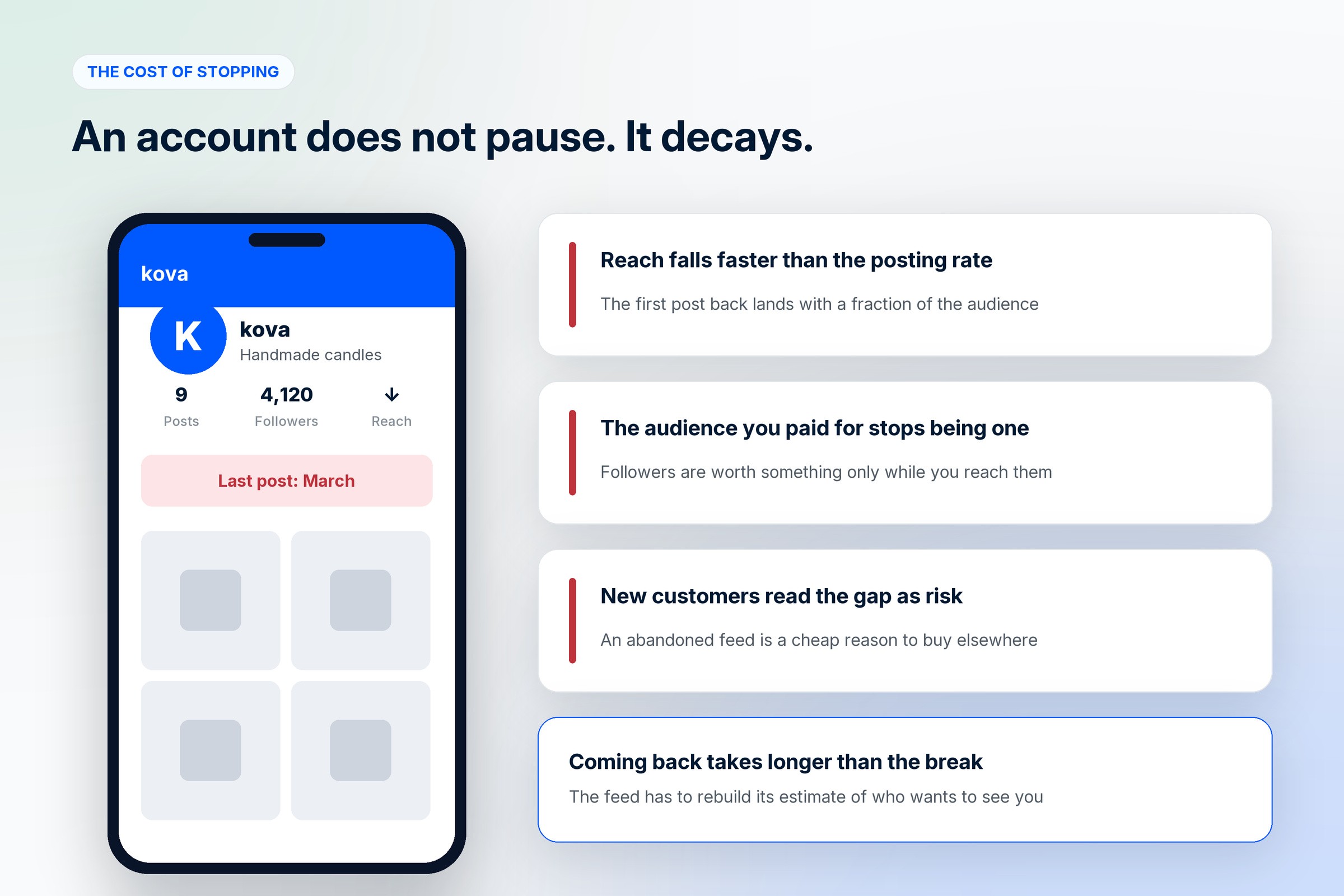
Reach falls faster than the posting rate does. Coming back after two months quiet, the first post lands with a fraction of the audience it used to, because the system has to rebuild its estimate of who wants to see you.
The audience you already paid for stops being an audience. Followers acquired through ads and effort are only worth something while you are reaching them. Silence turns an asset into a number on a profile.
New customers read the gap as a risk signal. For a brand nobody has heard of, an abandoned feed is evidence, and it is the cheapest reason in the world to buy from someone else.
How to post regularly without running out of ideas
The reason brands stop is rarely motivation. They stop because every post starts from a blank page, and a blank page twice a week is exhausting.

Build four or five formats and rotate them. The product in use. A customer photo. A question from your DMs answered. Behind the making. One opinion about your category. Once a format exists, posting becomes filling a template rather than inventing something.
Shoot in batches. An afternoon with the product and a phone produces a month of raw material. The cost of posting is almost all in setup, so doing setup once a month instead of eight times a month is most of the problem solved.
Keep a running list of questions customers actually ask. Every support message is a post somebody else wanted to read.
Repost what worked. A post that performed six months ago will reach mostly new people today, and almost nobody remembers seeing it.
Write next week's captions while you have the photos open. The gap between having content and having a post is usually one sentence nobody wrote.
How to tell whether the consistency is paying off
The follower count is the least useful number here, because it moves slowly and it does not spend money.
Watch reach from people who do not follow you, which tells you whether the platform is still circulating your posts. Watch saves and shares, which predict whether a post keeps working after today. Watch how many people arrive at the store from your profile in a month, and how many branded searches you get, since people who meet you on social often buy after searching your name instead of tapping a link.
Then give it a quarter. Consistency pays back on a timescale that makes monthly reviews misleading, and most accounts are abandoned about two months before they would have started working.
Mistakes that break the habit
Posting only when there is something to sell. An account that appears only during a sale trains people to ignore it between sales.
Chasing a format you hate. If you dread making it, you will stop, and the best format is the one you will still be making in a year.
Treating silence as neutral. A quiet month is not a pause in the conversation. It is a month of competitors talking to your customers.
Letting comments sit. Replying is part of posting. An unanswered question under a product post is a lost order with a timestamp.
Frequently asked questions
Why is regular social media posting important for a brand?
Because recognition is built by repetition. Customers buy from brands that feel familiar and currently active, platforms circulate accounts that post consistently, and every post keeps working after publication. A brand that posts regularly accumulates all three, and one that posts occasionally gets none of them.
What happens if a brand stops posting?
Reach falls faster than the posting rate, the audience you spent money to build stops being reachable, and new customers read the gap as a sign the business might be inactive. Coming back takes longer than the break, because the platform has to rebuild its estimate of who wants to see you.
How often should a brand post on social media?
At a frequency you can hold for a year. Three times a week on one platform, kept up, will beat daily posting that collapses after six weeks. Pick the number at the bottom of your capacity rather than the top.
Who should be doing the posting in a small business?
Whoever is closest to the product and the customers, which in a small brand is usually the founder. The content that works is specific, and specifics come from the person who knows why the stitching is done that way or which size people order most.
When does consistent posting start to show results?
Direct sales from a shoppable post can appear immediately, but the compounding effect takes a few months of steady posting. Judge it quarterly. Most accounts are abandoned shortly before the point where the earlier posts start doing their work.
Where does consistent posting fit next to paid ads?
It makes the ads cheaper to convert. An ad sends a stranger to check your profile, and what they find there decides whether they trust you enough to buy. Paid reach buys the visit; the feed decides what happens next.
Where to go from here
For what to post rather than how often, we wrote about D2C social media marketing and the tactics that turn followers into orders. For how organic and paid work together, there is social media and ads for ecommerce, and the wider picture is in what digital marketing is.
If posting regularly is the part that keeps slipping, that is usually a capacity problem rather than a strategy problem. Our marketing plans cover the content and the campaigns alongside the store itself, so the posting happens whether or not anyone on your team has a free afternoon. They are on the pricing page. When you do put money behind a post, use Ads Manager rather than the boost button.