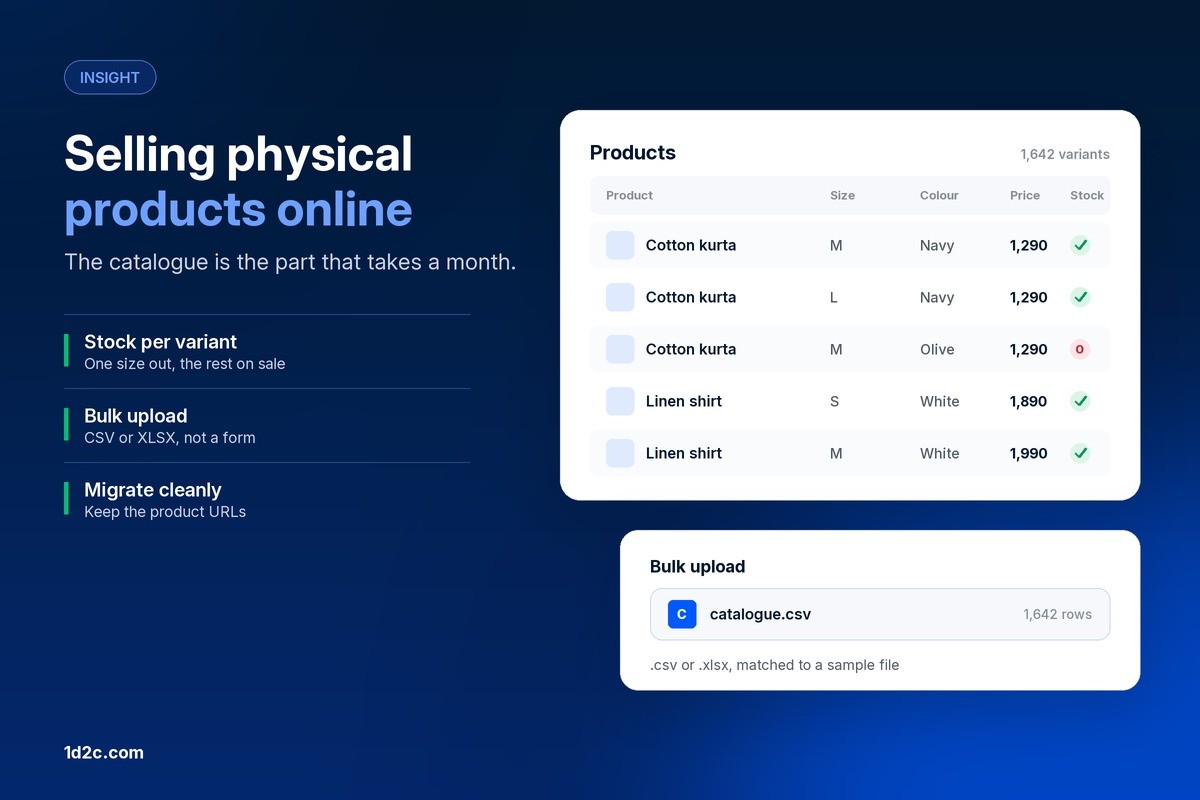


Nobody buys from a brand they have met once. Digital marketing is the work of being met repeatedly, in places that feel unrelated to each other, until buying stops feeling like a risk.
Digital marketing is everything you do to get found, remembered and trusted online, and then to turn that into orders. Search, content, social media, advertising, email and messaging all sit inside it. So does the product page somebody lands on afterwards.
For a shop on a high street, a lot of that work is done by the building. People walk past it, see the lights on, watch other customers go in, and form an opinion before anyone says a word. An online business has none of that. Every signal a customer uses to decide whether you are real has to be manufactured, and digital marketing is the name for manufacturing it.
This covers what the term actually includes, why electronic commerce depends on it more than most businesses do, how the pieces build trust rather than just traffic, and what to do first if you are starting with a small team and a smaller budget.
What digital marketing actually includes
The term is broad enough to be useless on its own, so it helps to break it into the jobs it does. Most of marketing and digital marketing comes down to six channels:
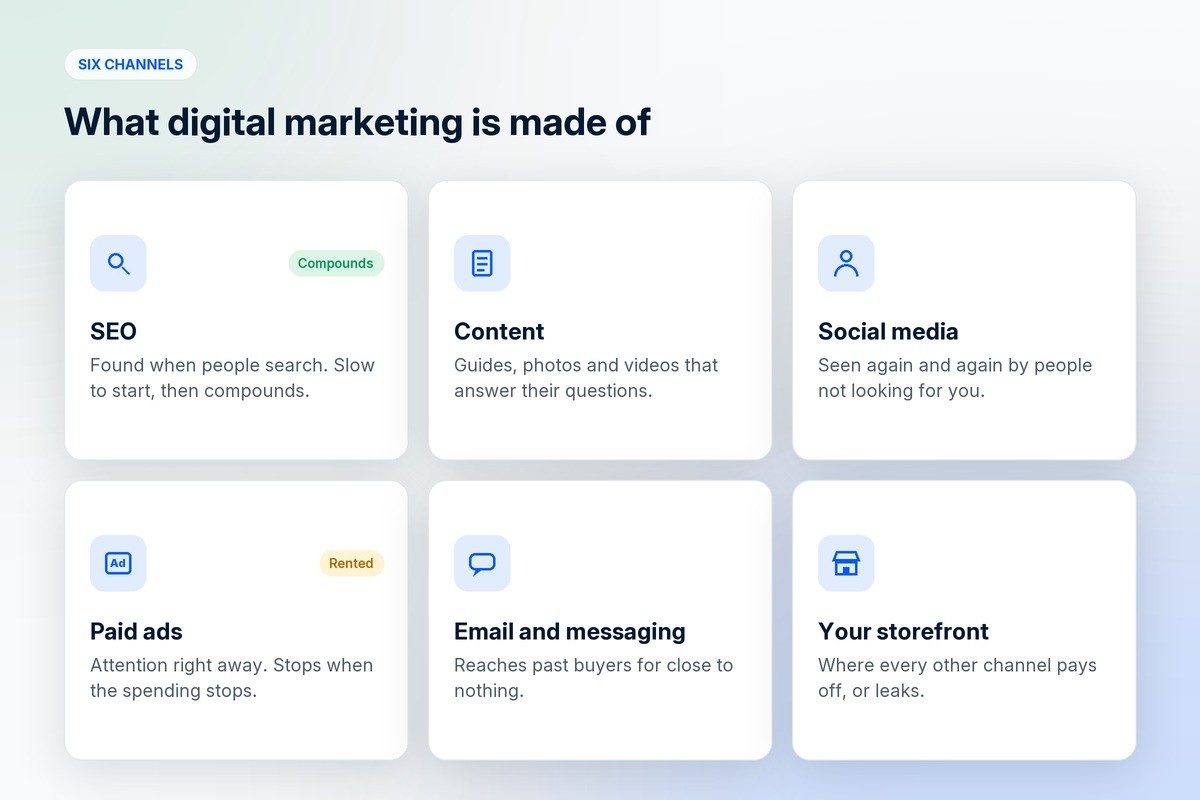
Search engine optimization, which is the work of showing up when somebody types a question you can answer. Slow to start and the only channel that compounds.
Content, meaning the articles, guides, photographs and videos that answer those questions once somebody arrives.
Social media, where a brand gets seen repeatedly by people who were not looking for it.
Paid advertising, which buys attention immediately and stops the moment you stop paying for it.
Email and messaging, which is how you reach people who already bought, at a cost close to nothing.
The storefront itself. An ecommerce website that loads slowly or hides the delivery date will undo every other channel feeding it.
Those last two get left out of most definitions, which is a mistake. Sending expensive traffic to a weak ecommerce web site is the most common way to lose money in this discipline. Plenty of e commerce websites are paying for clicks their own product pages then throw away.
Why ecommerce depends on it more than other businesses
A business e commerce operation has no footfall, no window and no shop assistant. Discovery, persuasion and reassurance all have to happen through a screen, usually in under a minute, often on a phone held in one hand.
There is also the problem of being one of many. Online commerce sites compete in a context where the next option is a tab away and the price comparison takes four seconds. A physical shop has geography protecting it. An ecommerce shop website has nothing except whatever reason you have given somebody to prefer you. That is as true of Shopify stores as of anything custom built.
And the economics are unforgiving in a specific way. Paid traffic costs the same whether it converts or not, so the gap between a business that has done the groundwork and one that has not shows up directly in what each order costs to win.
How digital marketing builds trust, not just traffic
Traffic is the easy half. You can buy it this afternoon. Trust you cannot. Trust is what decides whether any of it turns into money, and the channels contribute to it differently.
Social media is proof that somebody is home
Most people check a brand’s social profile before a first order, and they are not going there to be entertained. They are checking whether the business is active, whether real customers appear in the comments, and whether anyone answers them. A page that stopped posting eight months ago answers a question the brand did not want asked.
Content answers the questions that stop a sale
Sizing, materials, delivery times, what happens if it breaks, whether it suits a particular use. Content marketers earn their keep here, because every question answered before checkout is an objection that never becomes an abandoned cart. This is also the work that search rewards, which is why content and SEO are usually the same project.
Search engine optimization in digital marketing
Ranking for your own brand name matters more than most founders expect, because a meaningful share of people who see an ad will search the name rather than click. What they find at that moment decides the sale. SEO and digital marketing are often treated as separate budgets by agencies, and the split rarely survives contact with how customers actually behave.
Advertising buys attention, and repetition does the rest
Digital marketing and advertising are not the same thing, though the words get used interchangeably. Ads are one channel inside the discipline. Their real contribution to trust is frequency: a brand seen five times feels established in a way the same brand seen once does not, regardless of what the fifth impression said.
How the channels work together
Treated as separate line items they underperform. Treated as one sequence they compound, because each one does a job the next one depends on.
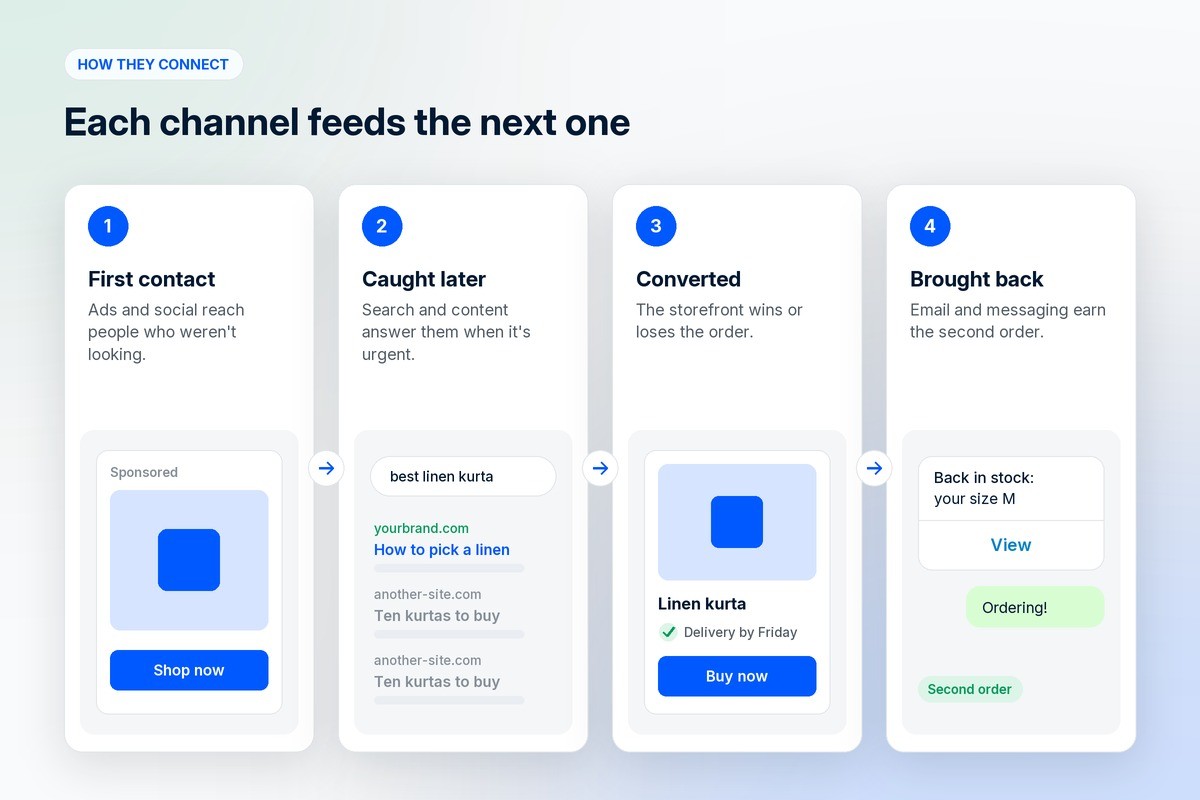
Ads and social create the first contact with people who were not looking for you.
Content and search catch them later, when the problem becomes urgent and they start typing questions.
The storefront converts, or fails to, on the strength of photographs, delivery promises and a checkout that does not surprise anyone.
Email and messaging bring back the people who already bought, which is where the margin actually lives.
A sensible marketing strategy decides which of those is the weak link this quarter and fixes that one, rather than spreading a small budget evenly across all four and wondering why nothing moved.
What to do first with a small budget
Fix the storefront before buying traffic. Photographs, delivery dates, returns policy, page speed, a checkout without forced account creation.
Claim and complete the basics: your own brand search results, business profiles, and the social accounts you will actually maintain.
Pick one social channel and post consistently rather than three badly. Consistency is the signal, not volume.
Write the ten pages that answer the questions your customers already ask you. These serve both content and search, and they never stop working.
Start paid small, with tracking in place first, and only once the pages it points at are worth the click.
Set up email and messaging for people who have bought, which is the cheapest revenue in the whole list and usually the last thing anyone builds.
In-house, freelance, or an agency
Three ways to get this done, and the right answer depends on stage rather than ambition.
In-house suits businesses with enough volume to keep somebody busy, and works best when that person sits close to the product rather than reporting from a distance.
Freelancers work well for defined pieces: a performance marketer running paid, a content marketer producing the articles, a designer on creative.
A digital marketing agency makes sense when you need several disciplines at once and cannot hire for all of them. The risk is paying for activity rather than outcomes, so agree on what is being bought and how it gets measured before signing anything.
If you are evaluating digital marketing services, ask for the reporting you will receive, who is doing the work day to day, and what happens to your accounts and data when the relationship ends. The last one catches people out more than it should.
Measuring it without fooling yourself
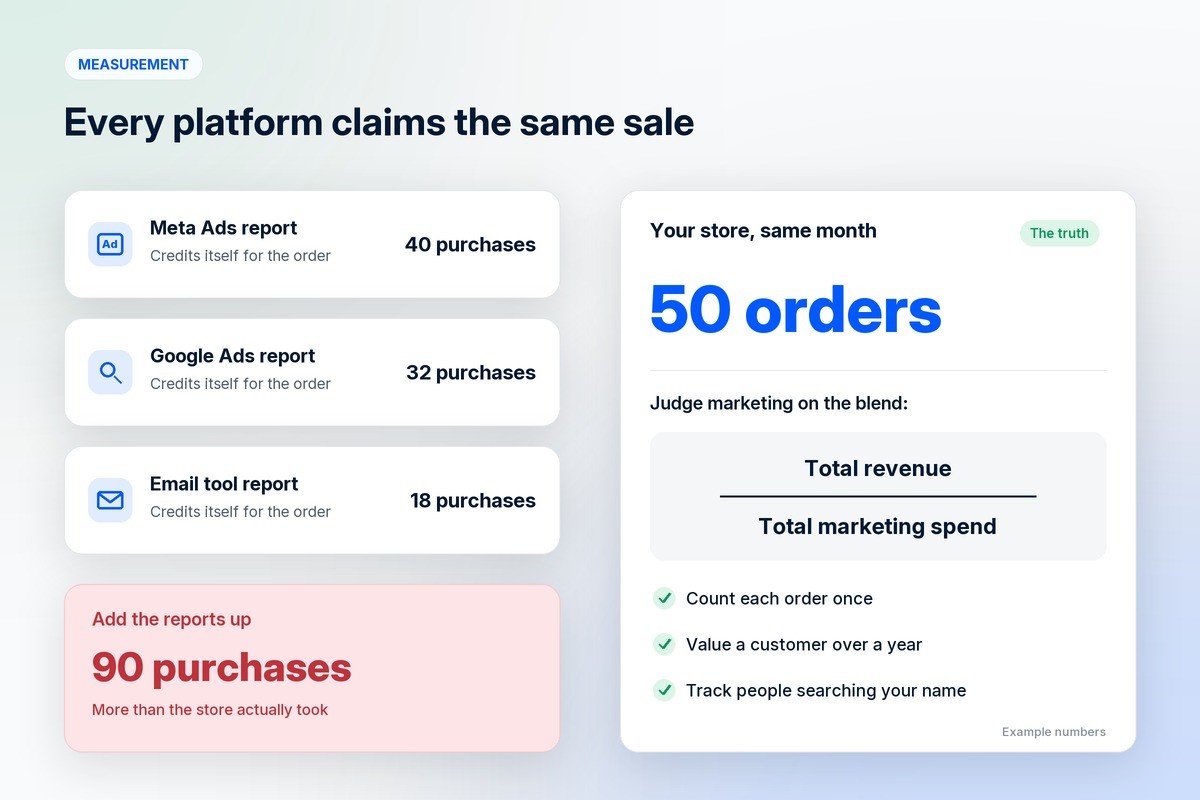
Compare total revenue against total marketing spend for the period, not the per-channel figures each platform reports about itself.
Know what a customer is worth over a year, because almost every channel looks unaffordable when judged on the first order alone.
Track branded search volume over time. When it rises, the awareness work is landing even if nothing else shows it yet.
Watch repeat purchase rate. It is the clearest evidence that trust is being built rather than rented.
Give search and content two quarters before judging them. Judging a compounding channel on a monthly report is how most of them get cancelled just before they start working.
Common mistakes
Buying traffic to a storefront that was not ready for it.
Treating SEO, content and ads as three unrelated budgets managed by three parties who never speak.
Posting for the sake of a schedule, with nothing to say.
Judging every channel on last-click attribution, which systematically overpays the channel a customer touched last.
Abandoning a channel at the point where it was about to start returning.
Frequently asked questions
What is digital marketing in simple terms?
Everything you do online to get found, remembered and trusted, and then turn that into sales. It covers search engine optimization, content, social media, paid advertising, email and messaging, along with the storefront those channels send people to.
Why is digital marketing important for an ecommerce business?
An online store has no footfall. Every buyer has to find it, trust it and decide to order through a screen, so search, content, social media, ads and messaging do the work a shop front and a salesperson would.
What is the difference between marketing and digital marketing?
Digital marketing is the part that happens through connected devices and can be measured directly. Marketing is the wider discipline, including pricing, product, packaging and anything offline. The strategy behind both should be the same one.
What is search engine optimization in digital marketing?
The work of being found when somebody searches for a problem you solve, by publishing pages worth ranking and making them readable to search engines. SEO digital marketing is slow to start and compounds, which is the reverse of paid advertising.
Do I need a digital marketing agency, or an agency near me?
Not necessarily either. Most of this work is done remotely, so a digital marketing agency near me is a weaker filter than it sounds. What matters is whether they have handled your category, who does the work daily, and how results get reported. Proximity only helps when the job needs filming in your warehouse or your shop.
How long does digital marketing take to work?
Paid advertising produces results in days and stops when you stop paying. Content and search take two to three quarters to show up meaningfully and then keep returning. Any plan that depends entirely on the fast half is renting an audience rather than building one.
Is social media alone enough for an ecommerce business?
Rarely. Social media builds familiarity and proves you are active, which is necessary and not sufficient. Without search, a storefront that converts and a way to reach past buyers, it means starting from zero every month.
Where can I learn digital marketing for free?
The platforms publish their own training and most of it is decent at the basics. Google’s Digital Garage covers the fundamentals, and Meta and the major email tools run comparable courses. Treat them as a vocabulary lesson rather than a strategy, because every one of them teaches the channel it sells.
How do I start digital marketing with a small budget?
Fix the storefront first, claim your brand search results and social profiles, then pick one or two channels you can keep up with. Add paid ads once tracking is in place and the store converts the traffic it already gets.
Where to go from here
For the channels in detail, we wrote about social media and ads for ecommerce, a practical guide to setting up Meta ads, and WhatsApp integration for the messaging side. None of it pays back without the thing underneath, which is why branding is important. If you would rather this was run for you alongside the storefront and the apps, our plans are on the pricing page. For the organic side on its own, there is D2C social media marketing and the tactics that turn followers into orders. If your ads already produce leads that go nowhere, see Meta ads lead quality. The habit behind the organic channel is covered in why regular social media posting matters.