


If a persona cannot change the creative, the product page or the channel, it is decoration.
Most personas are a stock photo, an invented name, an age range and a line about loving yoga and travel. They get made in a workshop, put on a slide, and never open again, because nothing in them tells anyone what to do differently on Monday.
A useful user persona is a working document that changes decisions. Which creative you shoot. Which objection the product page answers first. Which channel gets the budget. If a persona cannot change at least one of those, it is decoration.
This is how to build one before you start spending on marketing, using data you already have.
What a user persona is
A user persona is a short profile of one type of customer, built from evidence, that stands in for a group when you make decisions.
For an ecommerce brand the useful version holds five things: who they are in one line, what they are actually trying to achieve, what stops them from buying, where they already spend attention, and the words they use for the problem. Age, income and a fictional name are optional, and they are the parts people spend the most time on.
A persona is not a market segment. A segment is a group you can target, such as women aged 25 to 34 in Bengaluru. A persona is why that group buys, which is the part that writes your ad.
Why build the persona before you spend on marketing
Because every marketing decision downstream is a guess until it exists.
Targeting is a guess. You can buy an audience of thirty-year-olds who follow fitness pages, but without knowing what they are trying to fix you cannot tell whether yours is the right thirty-year-old.
The creative is a guess. The brief for a photograph or a reel comes from the moment the product solves. Without that moment, you get product-on-white and a discount.
The product page is a guess. The first three lines should answer the objection that stops most people, and you cannot rank objections you have never collected.
The channel is a guess, and the most expensive one. Reaching a buyer where they are already paying attention is cheaper than teaching them to pay attention somewhere new.
Doing this first is the difference between a campaign that tests an idea and one that tests nothing.
Where the data comes from when you have no research budget
You do not need a research agency. For a brand with even a handful of orders, the evidence is sitting in places nobody looks.
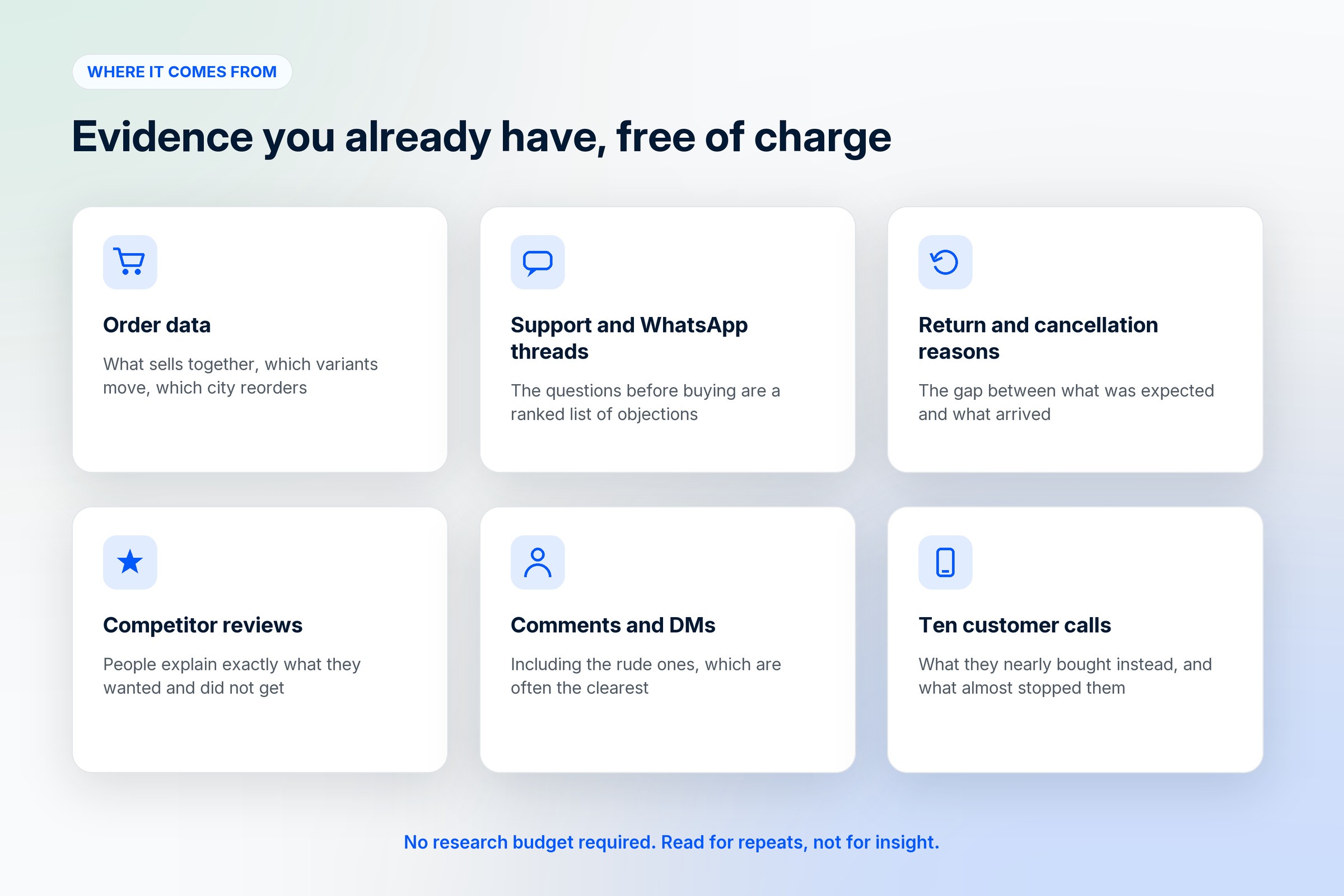
Your order data. What sells together, which variants move, which city keeps reordering, what an average basket contains.
Your support and WhatsApp threads. The questions people ask before buying are a ranked list of objections, in the customer's own words, free of charge.
Your return and cancellation reasons. The gap between what people expected and what arrived.
Reviews, yours and your competitors'. Competitor reviews are the most underused source in ecommerce, because people explain exactly what they wanted and did not get.
Comments and DMs on your posts and ads, including the rude ones, which are often the clearest.
Ten conversations. Call ten recent buyers and ask what they nearly bought instead and what almost stopped them. An afternoon of this beats a quarter of speculation.
Search and ad data, once you have any. The phrases people typed before they arrived are the vocabulary your pages should use.
If the brand is brand new, borrow: competitor reviews, category forums, and the ten conversations, which you can have with people who fit the description even before they are customers.
The five questions a persona has to answer
Keep it to one page. If it does not fit, it has become a document nobody reads.
Who is this, in one line. "A salaried woman in her thirties setting up her first flat" is enough. The line should be specific enough that someone could picture them and recognise them in a comment.
What are they trying to achieve. Not "buy a candle". Make the new flat feel finished and calm after work. The job is what the ad should show.
What stops them. Price against an unfamiliar brand, uncertainty about size or quality, a bad experience with a similar purchase, not trusting delivery. Rank these, because the order decides what your page says first.
Where is their attention already. Which platform, which creators, which shops, which times of day. This decides channel before budget.
What words do they use. Their phrasing, not your product names. These become titles, ad copy and search terms.
How to build one in an afternoon
Pull the raw material. Export orders, open the last two hundred support messages, and copy competitor reviews into a document.
Read for repeats rather than for insight. Tally the questions, the complaints and the reasons given. The frequent ones matter.
Group by motivation, not by demographics. Two buyers of the same age who want different things are two personas. Two buyers twenty years apart with the same job to be done are one.
Write the one-pager for each group, answering the five questions, with a real quote under each claim. The quote is what stops a persona drifting back into invention.
Name it after the job, not a person. "First-flat setup" is more useful in a meeting than "Priya, 32".
Decide what it changes this week, in writing. One creative brief, one page edit, one channel decision.
A filled example
Persona: First-flat setup.

One line. Salaried, late twenties to mid thirties, moved into a rented flat in the last six months, furnishing it slowly out of monthly salary.
The job. Make a bare flat feel like theirs without a renovation budget, in evenings and on weekends.
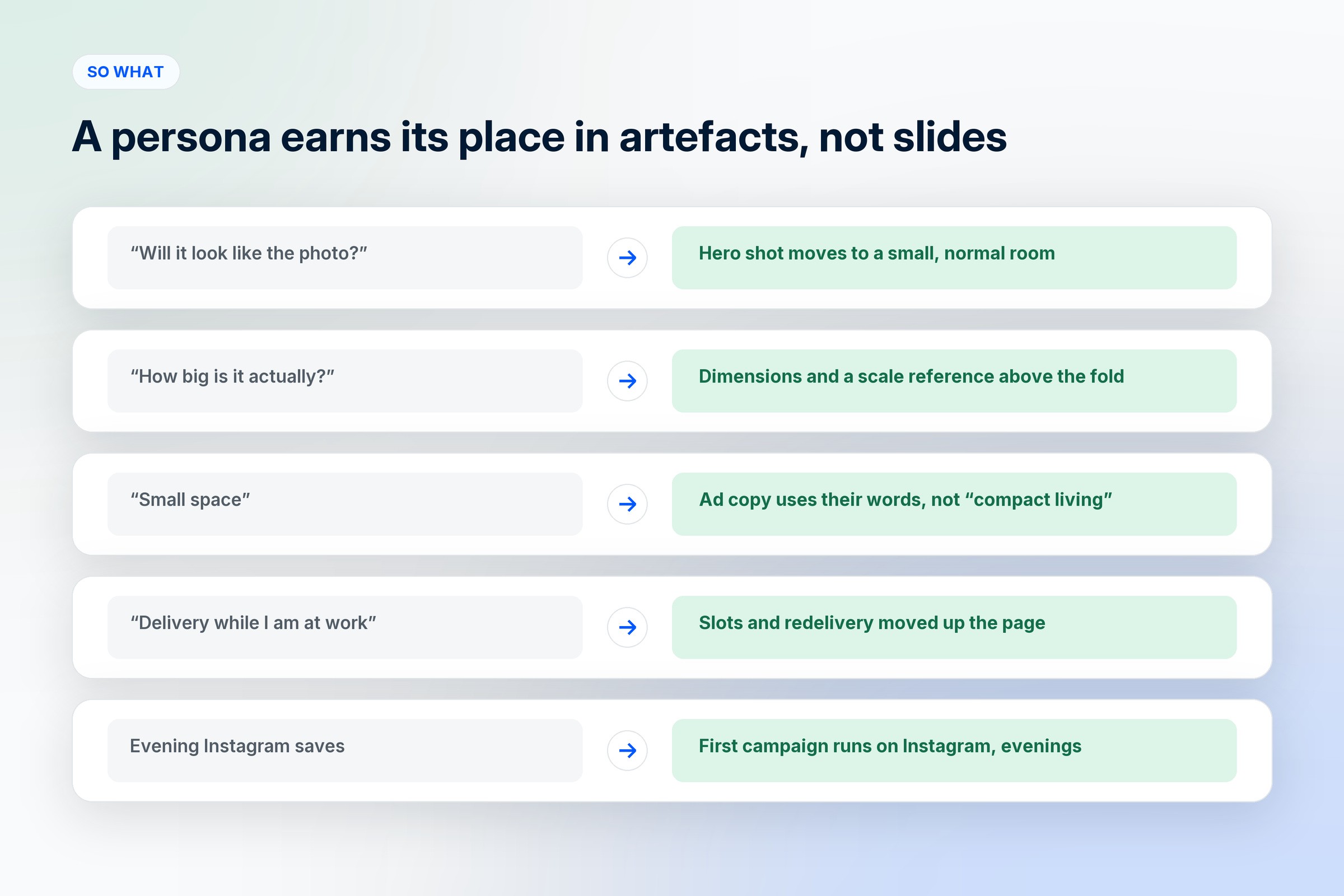
What stops them. Whether it will look like the photograph. Whether the size works in a small room. Paying upfront to a brand they have not heard of. Delivery arriving while they are at work.
Attention. Instagram saves and reels in the evening, Pinterest for ideas, a WhatsApp group with friends furnishing at the same time, marketplace apps for price checks.
Their words. "Cosy", "budget friendly", "small space", "does it look cheap in person", "how big is it actually".
What this changes. The hero photograph becomes the product in a small, normal room rather than a styled studio. The product page leads with dimensions and a scale reference. The ad copy uses "small space" rather than "compact living". Delivery slots and a redelivery promise move up the page. The first campaign runs on Instagram in the evening.
That last paragraph is the persona. The rest is supporting material.
Turn the persona into decisions
A persona earns its place when it shows up in artefacts rather than slides.
Creative brief. One line: show the job being done, for this person, answering this objection.
Product page order. Objections in the order the persona ranks them, in the words the persona uses.
Channel and timing. Start where the attention already is, at the hours it is there.
Offers. A first-order incentive for a trust problem, a bundle for a size or completeness problem, free returns for a fit problem. The objection picks the offer.
Messaging after the sale. What this person needs to hear two days later, which is usually reassurance and how to use the thing well.
How many personas, and when to update them
Two or three for a small brand. One is usually an oversimplification and five is a filing system nobody maintains.
Update when the evidence does: after fifty new orders, after a product launch, after any change in where your traffic comes from. A persona built from last year's buyers describes last year's business.
Mistakes that make personas useless
Inventing demographics. Age and income are easy to write and rarely change a decision. Objections and language change several.
Making one for everyone. A persona meant to cover all buyers describes none of them well enough to act on.
Confusing a persona with a targeting segment. The segment is how you reach them in an ad account. The persona is why they buy, and it survives when the targeting options change.
Writing it once. An unmaintained persona is worse than none, because people still quote it.
Stopping at the document. If no creative brief, page edit or channel decision came out of it, the work has not finished.
Frequently asked questions
What is a user persona in marketing?
A short, evidence-based profile of one type of customer that stands in for a group when you make decisions. For ecommerce the useful version covers who they are, what they are trying to achieve, what stops them buying, where their attention already is, and the words they use.
Why should I create a user persona before marketing?
Because targeting, creative, the product page and the channel all derive from it. Without a persona, each of those is a guess, and paid traffic turns an unanswered question into a bill.
How do I create a user persona step by step?
Pull your order data, support messages, returns reasons and competitor reviews; read for repeated patterns; group buyers by what they are trying to achieve rather than by age; write a one-page profile answering the five questions with real quotes; then write down the creative, page and channel decisions it changes this week.
What should a user persona include?
One line on who they are, the job they are hiring the product for, their ranked objections, where their attention already is, and their own vocabulary. Supporting quotes for each. Demographics only where they change a decision.
Who should build the user persona in a small business?
Whoever reads the customer messages, which in a small brand is usually the founder. The person answering DMs already knows the objections; the persona just writes them down in a form other people can use.
When should personas be updated?
When the evidence changes: after a batch of new orders, a product launch, or a shift in where traffic comes from. Treat it as a living document rather than a one-off workshop.
Can I create a user persona without customer interviews?
Yes, from support threads, reviews, returns reasons and search terms. Interviews make it sharper and ten short calls are usually enough, so they are worth doing once there is anyone to call.
Where do user personas fit with ads and social media?
They come first. The persona decides which objection the creative answers and which platform gets the budget, which is why building it before the campaign is cheaper than discovering it inside one.
Where to go from here
Once the persona exists, it should steer the rest. For the organic side, there is D2C social media marketing, and for paid, how to set up Meta ads for D2C brands. If you are still defining the brand around it, why branding is important covers what the persona is supposed to support.
1D2C gives you most of the raw material in one place: orders and repeat behaviour, WhatsApp conversations with buyers, and campaign data connected to the store, so the persona is built from what customers actually did rather than from a workshop. Plans and regional pricing are on the pricing page.


