


The app is the easy part. The business turns out to be about who carries the bag two kilometres in under ten minutes.
The app is the easy part. You can have a quick commerce storefront, a dark store catalogue and a ten-minute promise on screen in a fortnight.
Then an order arrives at 9:40pm and somebody has to physically carry a bag of atta two kilometres in under ten minutes, and the whole business turns out to be about that, not about the app.
Six things decide whether a quick commerce build works. The first one is the one that surprises people, so it goes first.
1. Can you actually get it delivered, today, in your city?
This is the question to answer before writing a line of code, because the answer decides your radius, your promise and your margin.

Plenty of companies advertise exactly what you need. Shadowfax markets hyperlocal and quick commerce with 30-minute delivery. Shiprocket has a product called Quick for local deliveries, along with dark store services. Borzo lists API integration for businesses. Porter publishes API integrations and an enterprise offering.
The gap, as of October 2026 and in our own experience integrating for small brands, is between the product page and what a new account with low volume can actually switch on this week. Coverage differs city by city and often pin code by pin code. Self-serve API access is rare; most of these conversations go through a sales team, a minimum volume expectation and a contract. Several of the quick-delivery products are still rolling out rather than finished. None of that makes them bad services, and the larger ones work well at scale. It does mean a founder in month one often cannot simply sign up and start dispatching through an API.
Treat it as a local question with a local answer, and test it before you build around it.
Three routes work in practice.
Use a customer-facing app manually. Porter and Rapido both take bookings from a normal phone, and a person in your shop books a rider per order and pastes the tracking link into the customer's WhatsApp. It is unglamorous and it works from day one, at perhaps a minute of staff time per order. Most quick commerce brands we have seen start here.
Get API access from a provider that serves your area. This is worth doing once volume makes the manual step painful. Ask three specific questions before you commit: which pin codes are live today, what the rider assignment time looks like at your peak hour, and whether you get a webhook for status changes or have to poll.
Run your own local fleet. Two or three riders on salary or per-delivery pay, managed through your own rider app. This is more work and more control, and the maths often favours it inside a small radius, because you are not paying a platform margin on every trip. 1D2C includes a delivery app for your own riders, with radius-based assignment so an order goes to someone near the pickup point rather than across town.
Most brands end up with a mix: own riders for the dense core, a booking app for the edges and the evening peak.
2. Your catalogue is a dark store, not a shop window
Normal ecommerce can be a little optimistic about stock. Quick commerce cannot, because the customer is standing in their kitchen expecting the thing in ten minutes.
Stock has to be live at the location level, not for the business as a whole. A store that shows an item as available when the shelf is empty produces a refund, an apology and a customer who does not come back.
Substitutions need a rule before you launch. If the 1kg pack is gone, can the picker send two 500g packs, and does the customer approve that or just receive it?
Keep the range tight. Quick commerce is a few hundred fast-moving items picked in two minutes, not a catalogue of four thousand. Every extra product slows the pick and adds a way to be wrong.
3. The radius decides the promise, so set it last
The promise on your homepage should be an output of the delivery you actually have, rather than a number you chose because a competitor uses it.
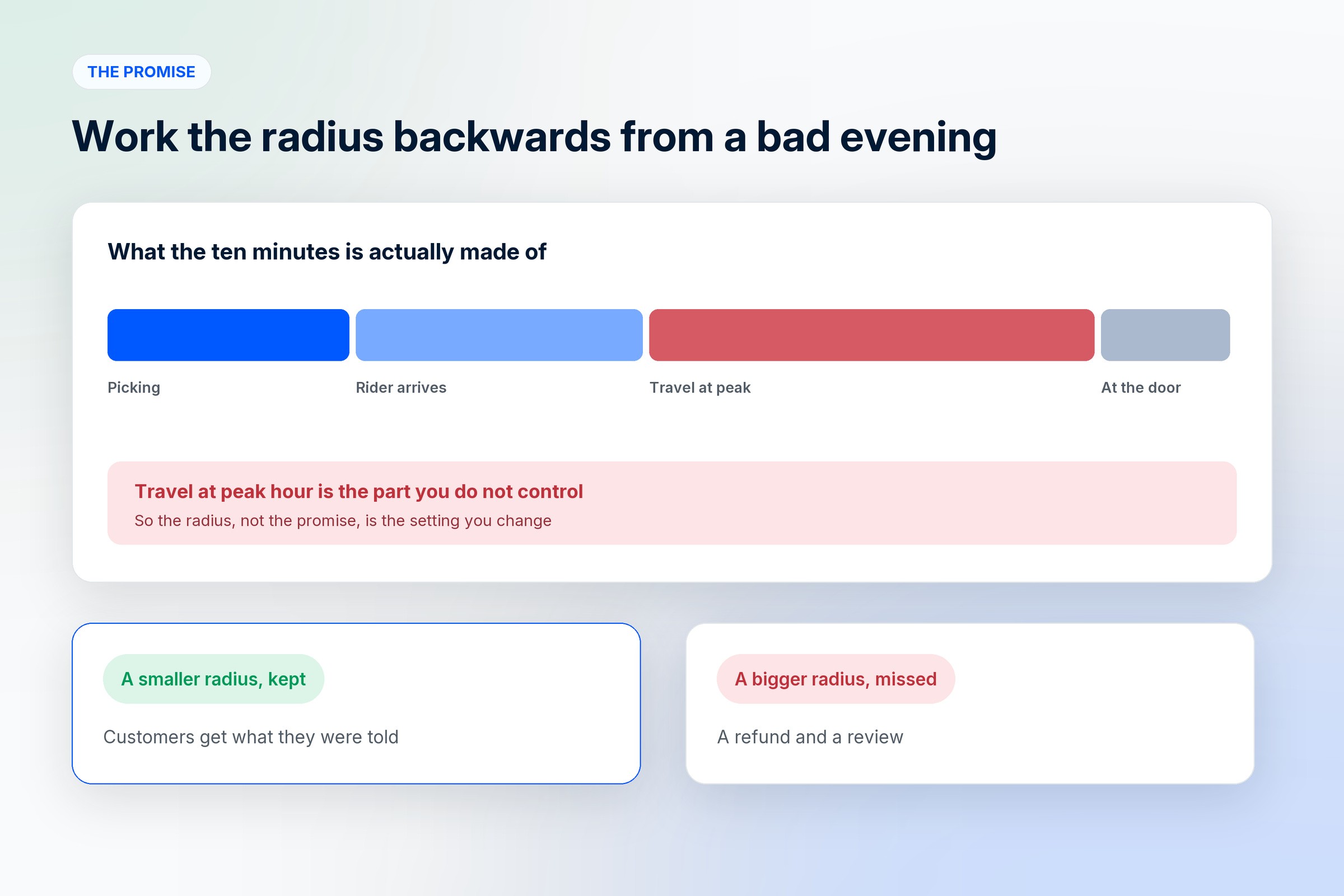
Work it backwards from the slowest real case: order placed, picker finds the items, rider arrives, rider travels at peak-hour traffic, customer answers the door. Measure the parts you can, guess the rest high, then set a radius that keeps the total under your promise on a bad evening rather than a good one.
Smaller radius, kept honestly, beats a larger one that misses. In 1D2C the radius is a setting rather than a rewrite: radius-based search so buyers only see stores that can reach them, and radius-based rider assignment so dispatch picks someone nearby.
4. Assignment and batching, which is where the money is
The difference between a quick commerce business that works and one that bleeds is usually how many orders a rider carries per trip.

One order per trip almost never pays at small-basket prices. Two or three orders going the same direction can. That means your system needs to hold an order for a short, deliberate window, group it with its neighbours, and assign the group to one rider.
Decide the rules on paper first. How long will you hold an order before dispatch, which is a trade between speed and economics. What counts as the same direction. Which orders never wait, such as anything with a time commitment attached.
5. The unit economics of a ten-minute order
Do this arithmetic before the build, because it decides whether the model works at all.
Write down the average basket value, the gross margin on it in rupees rather than percent, the cost of one delivery, the cost of picking and packing, and the payment fee. What remains is contribution per order, and in quick commerce it is often negative at launch on small baskets.
The levers are few and worth knowing in advance: raise the basket with a minimum order value or bundles, lower the delivery cost with batching or your own riders, or charge for delivery below a threshold. Most new operations need at least two of those.
6. What happens when it goes wrong, because it will
Quick commerce fails in public and fast, so the recovery path has to exist before launch.
The missing item. Partial refund, replacement on the next order, or a rider going back, and who decides which.
The late order. A real notification rather than silence, because customers forgive delay much more readily than they forgive not being told.
The unreachable customer. How long the rider waits, what happens to perishables, who pays.
Support in the moment. These conversations happen on the phone or on WhatsApp while the customer is annoyed, not in a ticket queue the next morning. A customer's message opens a free service window on WhatsApp, and answering inside it costs nothing, which is covered in our post on WhatsApp without automation.
Start manual, then automate
The order that works for most new operators: deliver manually through a booking app, learn your real timings and your real basket, then automate the parts that hurt.
You will discover things no plan contains. That most orders come in a two-hour evening window. That one pin code is twice the trouble of the rest. That your ten-minute promise should have been twenty, and that customers are perfectly happy with twenty when it is honest.
Build the automation around what you learned rather than around what the category does in a different city.
Frequently asked questions
What should I check before building a quick commerce app?
Whether you can actually deliver in your area today, how live your stock is at store level, what radius your real delivery times support, how you will batch and assign orders, your contribution per order, and what you do when something goes wrong. Delivery first, because it decides the rest.
Why is quick commerce delivery hard to arrange for a new business?
Because the market is fragmented and coverage is local. Several providers advertise hyperlocal or quick delivery, but what a new, low-volume account can switch on this week varies by city and pin code, and API access usually goes through a sales conversation rather than a self-serve signup. Test your own area before you design around any provider.
How do I handle quick commerce delivery without an API?
Book each delivery manually in a customer-facing app such as Porter or Rapido, and send the tracking link to the customer. It costs about a minute of staff time per order and works from day one. Move to an API or your own riders when that minute starts to hurt.
Who should run their own delivery fleet?
Operators with a dense, small radius and predictable volume. Two or three riders of your own often beat per-trip platform pricing inside a few kilometres, and you control the experience. It needs rider management, pay and cover for sickness and holidays.
When should a quick commerce business automate dispatch?
Once manual booking is costing real time every evening, or once batching is the difference between making and losing money per order. Before that, the manual version teaches you the rules the automation will need.
Where does quick commerce usually lose money?
On single-order trips with small baskets. Delivery cost per order is the number to attack, through batching, a minimum order value, or your own riders inside the core radius.
Is quick commerce viable for a small business?
In a small area, with a tight range of fast-moving items and honest timings, yes. Competing with a funded platform on a city-wide ten-minute promise is a different and much harder business.
Where to go from here
For the model itself, there is what quick commerce is and how it works. For the storefront and the apps, see our quick commerce website builder guide. If the delivery side is the part you are solving, the buyer, seller and rider flow is in from buyer to delivery.
1D2C supports this shape of business directly: instant orders alongside scheduled bookings, radius-based search so buyers only see stores that can serve them, radius-based rider assignment, a delivery app for your own fleet, and the option for sellers to deliver themselves. Plans and regional pricing are on the pricing page.
Provider capabilities above were taken from Shadowfax's, Shiprocket's, Borzo's and Porter's own public pages in October 2026, and the practical notes are our own experience integrating for small brands in the same period. All of these services change quickly, so check current coverage for your own city and pin codes before you plan around any of them.


