

The ad budget bought a conversation. The inbox threw part of it away while everyone was asleep.
Twenty-three unread messages at nine in the morning. The oldest came in at 11:40 the previous night and says "is this available in blue?". By the time anyone types a reply, that person has been awake for two hours, has already bought something in blue from an account that answered at midnight, and your message arrives as an interruption rather than an answer.
Nobody did anything wrong. Somebody was asleep, which is the normal condition of a small team at midnight. The problem is that WhatsApp charges by the conversation and rewards speed, so an inbox that only works during office hours quietly loses money in ways that never appear as a line item.
The 24-hour window is the whole economy
WhatsApp's pricing works on message categories rather than a flat subscription. There are four: marketing, utility, authentication and service.
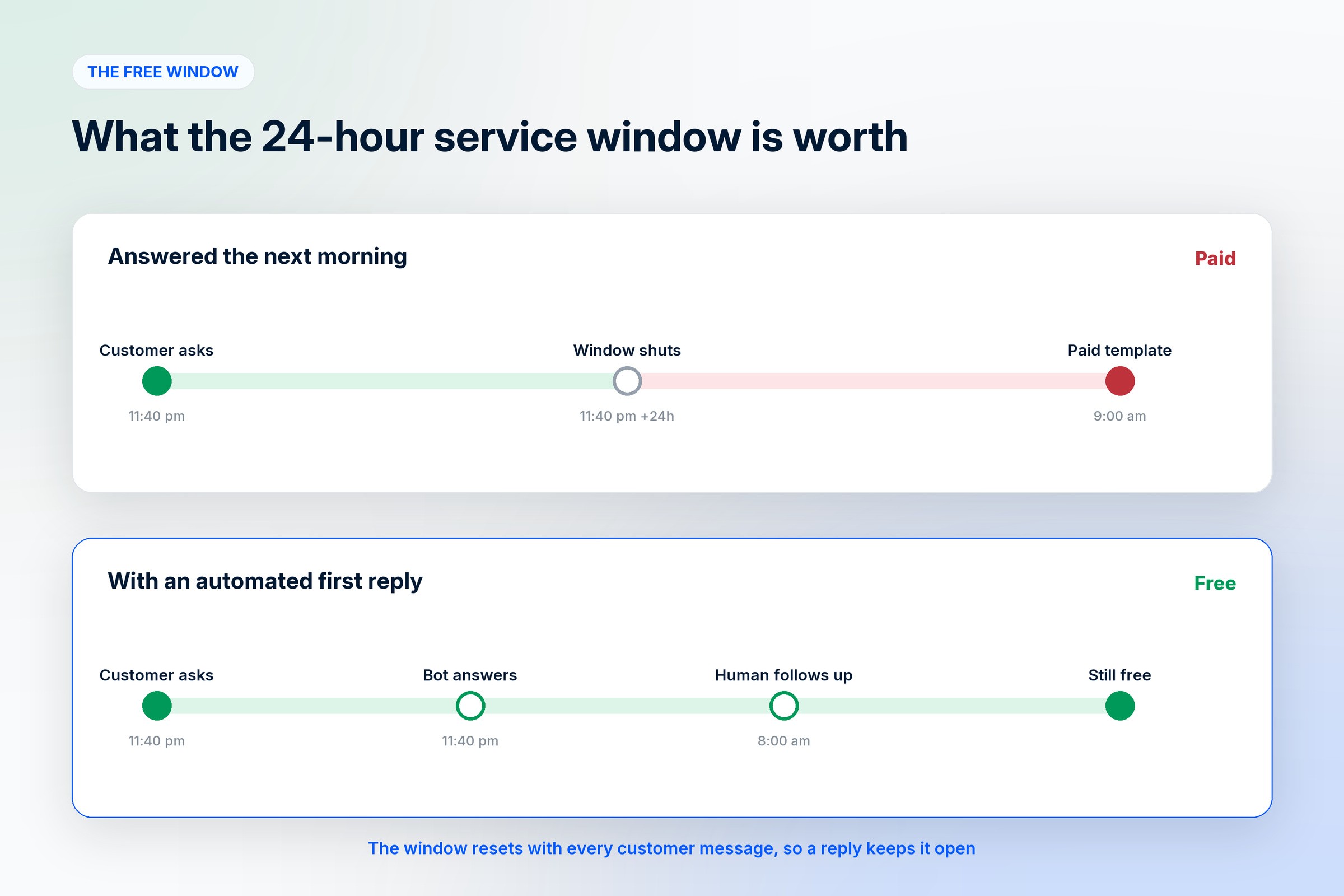
The part that matters is how service messages are priced. In WhatsApp's own words, when users message a business "this opens a 24-hour customer service window during which businesses can respond with service messages, at no charge", and that window "resets with each user message".
Read what that means commercially. Every question a customer sends opens a free lane to answer them, and the lane stays open while the conversation keeps going. Let the window close and the lane is gone. To restart the conversation you now send a template, which falls into a paid category, and you pay for a message the customer would have received free a day earlier.
A manually run inbox closes those windows all night, every night, and reopens them the next morning at full price.
Ads that click to WhatsApp give you 72 free hours
This one is worth more than it sounds, especially for brands running Meta ads.
WhatsApp's pricing page says that when customers message you from an ad that clicks to WhatsApp or from a Facebook Page call-to-action button, "for the following 3 days (72 hours), all of your messages are not charged".
So the sequence for most brands is: pay Meta for the click, receive the message at 10:15pm, sleep through roughly ten of the seventy-two free hours, reply in the morning, and then pay again later to re-engage a lead whose attention you already bought once. The ad budget bought a conversation. The inbox threw part of it away.
An automated first reply inside that window costs nothing and keeps the lead warm until a person is available.
What running it by hand actually costs
Three leaks, none of which show up in a report.

Expired windows. Every overnight question becomes a paid template tomorrow, or more often becomes nothing at all, because following up feels awkward after twelve hours.
The night shift you do not have. Buyers browse in the evening. A catalogue is open at 11pm and a shop is not, which is the entire reason people shop on their phones. An inbox that answers only between ten and six is closed during the hours your customers are actually deciding.
The same twelve questions. Price, size, delivery time, whether you ship to a particular city, whether something is in stock, how to return it. A person retypes these hundreds of times a month, slowly, between other work, and each slow answer is a small chance for the buyer to lose interest.
An away message is not automation
The WhatsApp Business app does have automated messages. A greeting for new contacts, an away message for off hours, and quick replies an agent still has to choose and send.
They are useful and they are not automation in any meaningful sense, because they cannot answer anything. "Thanks for your message, we will reply during business hours" tells a customer at 11pm exactly what they already suspected. The question stays unanswered, and the free window keeps running down.
WhatsApp seems to agree about where this is heading. Its own Business app page now markets an AI agent with the line "Never miss a conversation. Your AI agent answers questions, captures leads and drives gift sales all directly in the chat thread". The platform is telling you what the gap is.
What automation should actually do
Automation here means rules that fire without a person, on three kinds of trigger.
Something the customer says. A keyword like "price", "track", "return" or a greeting routes to the right answer or the right person immediately.
Any incoming message. A first response inside seconds, which both answers the easy case and keeps the free window alive while a human gets to it.
A time or a schedule. Order updates, a reminder about a cart left behind, a follow-up two days after delivery asking whether everything arrived properly.
None of that needs intelligence. It needs to exist, and in most small businesses it does not.
What an AI chatbot adds that rules cannot
Rules break the moment someone phrases a question in a way nobody anticipated, which is most of the time.
An assistant connected to your catalogue can answer about the products that are actually live, with the prices they actually have, at midnight. Connected to orders, it can tell a specific buyer where their specific parcel is without a person opening a dashboard. Given a document of your policies, it can answer the returns question the same way every time, which is more consistency than a tired human at the end of a shift manages.
In 1D2C the chatbot takes its knowledge from your own material: text you write, and files you upload such as a policy PDF or a product guide. It can see your active products and categories, and only the matched buyer's own latest orders. It never sees another customer's data.
The handoff is the part people get wrong
The common failure of chatbots is refusing to get out of the way.
Everyone has met a bot that loops through its menu while a person types "I want to speak to someone" for the fourth time. That experience costs more goodwill than the automation saves.
The rule worth enforcing: the moment a human replies in a conversation, the bot stops. In 1D2C a human outbound reply suppresses AI replies in that thread for six hours, so your team can take over mid-conversation without racing the assistant or switching anything off.
Where automation goes wrong
Automating the wrong direction. Automate answers to questions people ask you. Do not automate unsolicited marketing templates to everyone on your list, which is the fastest way to collect blocks and lose the number.
Pretending the bot is human. Say it is an assistant. People are far more forgiving of a machine that says what it is.
No escape hatch. Every automated thread needs an obvious way to reach a person, offered early rather than after three failures.
Setting it up once and never reading it. The transcript of what the bot could not answer is the most useful document in the business, and almost nobody opens it.
What to automate first
In order, because the first two produce most of the return.
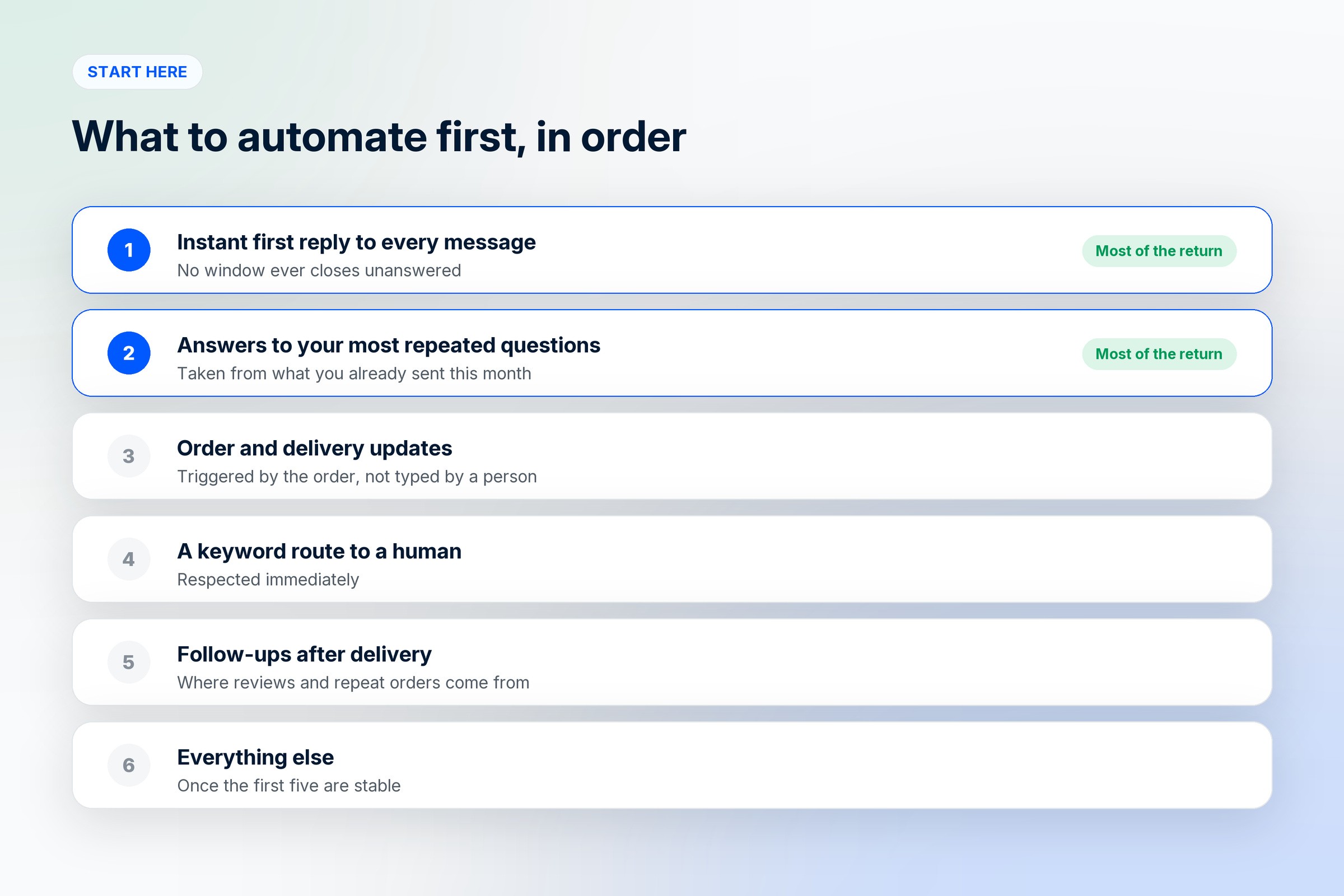
An instant first reply to every incoming message, so no window ever closes unanswered.
Answers to your most repeated questions, taken from the messages you have already sent this month.
Order and delivery updates triggered by the order itself rather than typed by a person.
A keyword route to a human, respected immediately.
Follow-ups after delivery, which is where reviews and repeat orders come from.
Everything else, once the first five are stable.
Frequently asked questions
What is WhatsApp automation for a business?
Rules and an assistant that reply without a person being present. That covers instant first replies, keyword routing, order and delivery updates, cart reminders, and an AI assistant that answers from your catalogue, your orders and your own policy documents.
Why is running WhatsApp Business manually bad for growth?
Because WhatsApp gives you a free 24-hour service window that opens whenever a customer messages, and a manual inbox lets those windows expire overnight. The business then pays for a template to restart a conversation it could have had for nothing, loses evening buyers to faster sellers, and spends staff time retyping the same twelve answers.
How does automation save money on WhatsApp?
By replying inside the free windows rather than after them. Service messages sent inside the 24-hour window are free, messages in the 72 hours after someone contacts you from an ad that clicks to WhatsApp are free, and both of those windows are lost when nobody answers until morning.
Who still needs humans in the conversation?
Anyone handling a complaint, a refund, a bulk or wholesale enquiry, or a customer who asks for a person. Automation should carry the repeated questions and the out-of-hours gap, then step aside, which is why a human reply should silence the assistant.
When should a brand add an AI chatbot rather than simple rules?
Once the repeated questions stop fitting into keywords, which happens quickly. Rules handle "track my order". They fail at "it says delivered but I did not get anything, what now", which is the message that actually needs answering.
Where does the chatbot get its answers from?
From your own data rather than the open internet. In 1D2C that means your active products and categories, the matched buyer's latest orders, and the text or documents you upload, such as a returns policy or a product guide.
Where to go from here
For what WhatsApp can do for a store in general, we wrote about WhatsApp integration for ecommerce. If the conversations are coming from ads, the economics of those clicks are in the Instagram boost button post and in how to set up Meta ads for D2C brands.
1D2C includes the WhatsApp side as part of the platform rather than another subscription: automations on keywords, incoming messages and schedules, campaigns with approved templates, quick replies for your team, and an AI assistant that reads your catalogue, the buyer's own orders and the documents you give it. Plans are on the pricing page.
WhatsApp's message categories, the free 24-hour service window and the 72-hour free entry point were taken from WhatsApp's own Business Platform pricing page in October 2026. Pricing and categories change, so check the current page before budgeting.