


Seasonal marketing does not create demand. The calendar does that for you. Your job is to be ready, visible and in stock before the shoppers arrive.
A small candle brand in Pune sells a few orders a day for most of the year. Then October arrives. Diwali gifting orders start in the first week, corporate hampers follow, and by the week before the festival the founder is packing boxes at midnight with her mother and two cousins. A third of her annual revenue comes in six weeks. The brands that do well in those six weeks are rarely the ones with the best product. They are the ones that started planning in August.
Seasonal marketing is planning your promotions, content and offers around times of year when people already want to buy, such as festivals, holidays, weather changes, sales events and life moments like back to school or wedding season. Instead of trying to create demand from nothing, you meet demand that the calendar creates for you.
This guide covers why seasonal marketing works, the 2026 seasonal marketing calendar, strategies that turn a season into sales, seasonal marketing ideas you can use this year, and examples from brands that do it well.
What is seasonal marketing?
Seasonal marketing is any campaign tied to a specific time of year. It can be a Black Friday sale, a Diwali gift collection, a summer range, a Valentine’s Day bundle, a back-to-school offer or a monsoon care kit. What makes it seasonal is the timing: the campaign only makes sense, and only works, during that window.
Seasons fall into a few types:
Festivals and holidays: Diwali, Christmas, Eid, Lunar New Year, Raksha Bandhan, Thanksgiving, Hanukkah
Gifting days: Valentine’s Day, Mother’s Day, Father’s Day, Teachers’ Day
Shopping events: Black Friday, Cyber Monday, Singles’ Day (11.11), Amazon Prime Day, end-of-season sales
Weather seasons: summer, monsoon, winter, spring cleaning
Life and industry moments: back to school, exam season, wedding season, tax season, the new year fitness rush
Sporting and cultural events: the cricket season, football tournaments, the Olympics, award shows
Moments a brand creates for itself, such as an anniversary sale or an annual product drop
Why seasonal marketing works
People are already looking
Before Diwali or Christmas, huge numbers of people are actively searching for gifts. That is the core of seasonal marketing. You do not have to persuade them to buy something. You only have to persuade them to buy it from you. That makes every rupee or dollar of ad spend work harder, as long as you are early enough to be seen.
A deadline makes people decide
“Order by 20 December for Christmas delivery” is the most honest urgency there is. Shoppers who would browse for weeks make up their minds when the date is real.
It gives you something new to say
A brand that posts the same product photo every week runs out of reasons to be noticed. Seasons give you a fresh story every few weeks: new packaging, a limited edition, a gift guide, a festive photoshoot.
It brings back old customers
Someone who bought from you last Diwali is the easiest sale you will make this Diwali. Seasonal campaigns are the most natural reason to message past buyers without it feeling like spam.
The 2026 seasonal marketing calendar
These are the main moments for an ecommerce brand selling in India and internationally. Dates for festivals that follow lunar calendars move every year, so check the exact day for your region before you schedule anything.
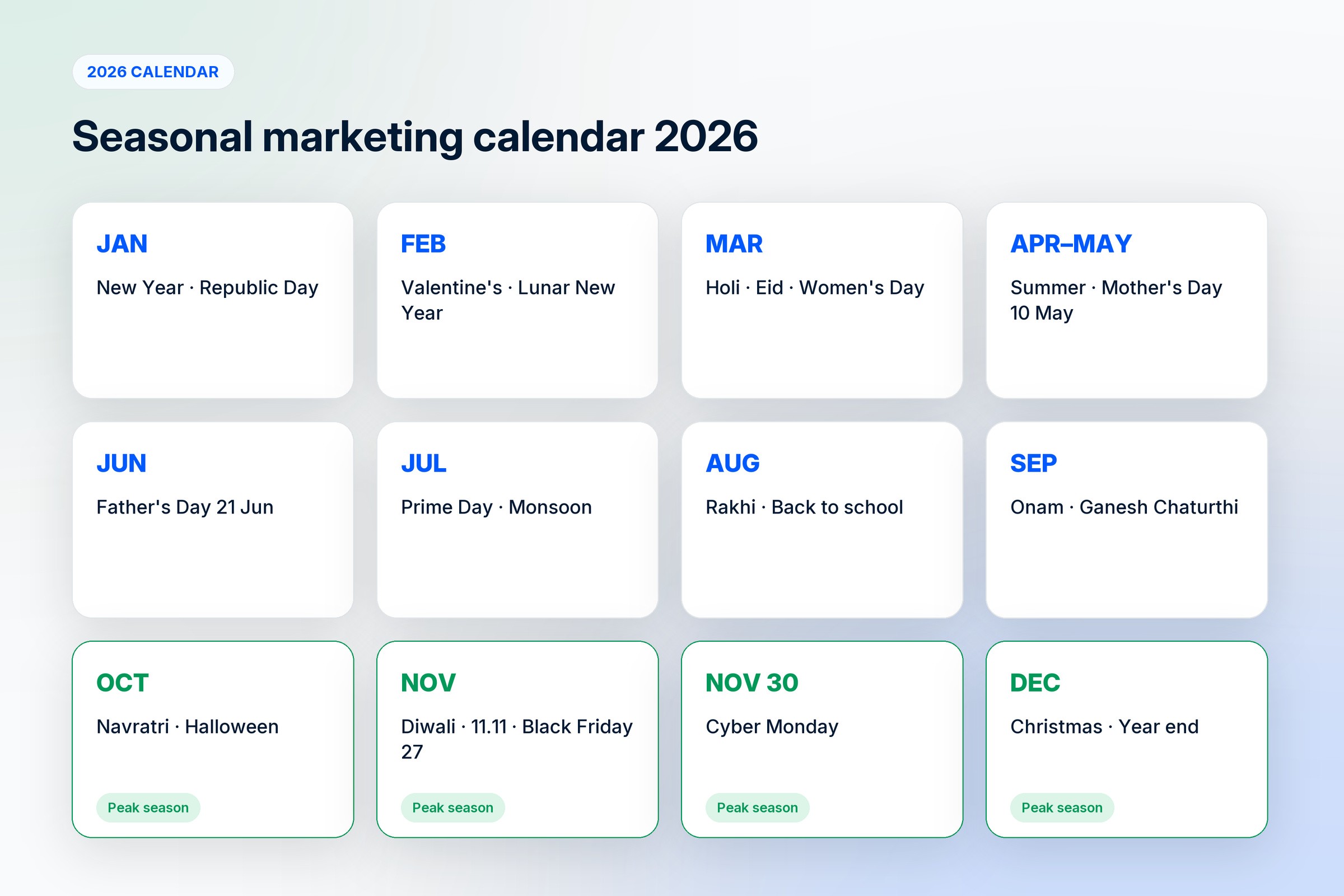
January: New Year resolutions, winter sales, Republic Day sales in India (26 January)
February: Lunar New Year, Valentine’s Day (14 February), the start of Ramadan
March: Holi, Eid al-Fitr, International Women’s Day (8 March), end of the financial year in India
April and May: summer ranges, Akshaya Tritiya, Mother’s Day (10 May in the US and India; Mothering Sunday in the UK falls in March)
June: Father’s Day (21 June in the US, UK and India), monsoon begins in India, mid-year sales
July: Amazon Prime Day (usually mid-July), monsoon ranges, end-of-season sales
August: Raksha Bandhan, Independence Day sales in India (15 August), back to school
September: Onam, Ganesh Chaturthi, Teachers’ Day in India (5 September), the start of festive planning
October: Navratri, Dussehra, Halloween (31 October), festive sales on Indian marketplaces
November: Diwali, Singles’ Day (11 November), Black Friday (27 November), Cyber Monday (30 November), wedding season begins
December: Christmas, Hanukkah, year-end sales, New Year’s Eve
You do not need all of them. Pick the four to six moments that matter most to your buyers and your products, and do those properly.
Seasonal marketing strategies that turn a season into sales
1. Start six to eight weeks before the date
The biggest mistake in seasonal marketing is starting the week of the event. By then, ad costs are at their highest, delivery slots are full and shoppers have already chosen. Plan products and stock eight weeks out, start content and email list building six weeks out, and begin ads three to four weeks before the day.

2. Build a dedicated seasonal collection page
Send seasonal traffic to a page made for it: “Diwali gifts under ₹1,000”, “Christmas gifts for him”, “Monsoon essentials”. A focused collection usually converts better than your home page, and it can rank in search for seasonal queries if you publish it early and keep the same URL every year.
3. Make the delivery cut-off impossible to miss
Put the last order date for festival delivery on the banner, the product page, the cart and every message. It is the most effective seasonal message you have, and it prevents the angry “it didn’t arrive in time” reviews.
4. Change the offer as well as the price
Discounts are the easiest seasonal lever and the one every competitor pulls. Gift wrapping, a free greeting card, a limited-edition colour, a bundle, a free gift above a basket size or faster delivery often sell as well as a discount and protect your margin.
5. Message past buyers first
Your existing customers are the cheapest seasonal sales you will get. Send them early access to the collection on WhatsApp or email before you open it to everyone. A WhatsApp broadcast with a gift guide and a direct link to the collection usually beats a cold ad.
6. Refresh ad creative for the season
Seasonal ads should look seasonal: festive backgrounds, gift wrapping, people giving and receiving. Launch them early so the ad platforms have time to learn. Our guide to setting up Meta ads for D2C brands explains why the first week of a campaign is mostly learning, which is another reason not to start late.
7. Follow up after the season
The campaign is not over when the festival ends. Thank buyers, ask for reviews, and give first-time seasonal buyers a reason to order again in January. That is how a seasonal spike becomes a customer base.
Seasonal marketing ideas for 2026
Good seasonal marketing ideas do not have to be expensive. Here are twelve that work for small and growing brands.

Gift guides by budget and by recipient: “for her”, “for dad”, “under ₹500”
A limited-edition product or colour that only exists for the season
Ready-made gift bundles, so the buyer does not have to choose
A countdown on the site and in Instagram Stories to the delivery cut-off
A photo or reel contest using your product, with a prize for the best entry
Festive packaging and a handwritten-style note in every order
Early access for past customers and app users, a day before everyone else
Corporate gifting packs for Diwali and the year end, sold directly to companies
A weather-led range: monsoon care, winter skin, summer cotton
A donation from each seasonal order to a local cause, explained honestly
Seasonal blog posts and guides that answer what people search before buying, such as “Diwali gift ideas for colleagues”
A “year in review” email for loyal customers in December, showing what they bought from you
Seasonal marketing examples from brands that do it well
The best seasonal marketing examples share one thing: the season changes the story that surrounds the product.
Starbucks Pumpkin Spice Latte
Starbucks brings back the Pumpkin Spice Latte every autumn for a limited time, and its return has become a seasonal event of its own. The lesson: a product that only exists for part of the year gives people a reason to come back on a date, and a reason to talk about it when it does.
Starbucks holiday cups
The same company’s red holiday cups change the packaging, not the coffee. Customers post photos of the new design each year. For a small brand, seasonal packaging is one of the cheapest ways to make an ordinary product feel like a gift.
Spotify Wrapped
Every December, Spotify sends each listener a summary of their year in music, designed to be shared on social media. It is a seasonal campaign built entirely from the customer’s own data. Any store can do a smaller version: a year-end email showing what a customer bought, or a thank-you to your most loyal buyers.
Amazon Prime Day
Amazon created a shopping season in July, a month with no major holiday, and turned it into an annual event. It shows that you do not have to wait for the calendar. A yearly anniversary sale or an annual product drop, held on the same date each year, becomes a season your customers expect.
Cadbury Celebrations at Diwali
Cadbury positioned its Celebrations gift boxes as a Diwali gift, as an alternative to the traditional box of sweets. The product is chocolate; the marketing is about the festival and the act of giving. For a seasonal campaign, sell the occasion first and the item second.
Singles’ Day (11.11)
Alibaba turned an informal day for single people in China into one of the largest shopping events in the world. Like Prime Day, it shows a brand can create a season. It also shows the risk: when everyone discounts on the same day, attention and ad costs peak together.
Common seasonal marketing mistakes
Starting in the final week, when ads cost the most and shoppers have decided
Running out of stock on the best-seller three days before the festival
Promising delivery dates your courier cannot meet
Discounting everything, every season, until customers never pay full price
Using a festival you do not understand, in a way that offends the people who celebrate it
Forgetting the follow-up, so seasonal buyers never order again
Frequently asked questions
What is seasonal marketing?
Seasonal marketing is planning promotions, content and offers around times of year when people already want to buy, such as festivals, holidays, shopping events, weather changes and life moments like back to school or wedding season.
Why is seasonal marketing important?
Because demand is already there. During a festival or shopping event, people are actively looking for gifts and deals, deadlines push them to decide, and past customers are more open to hearing from you. A small brand can make a large share of its annual sales in a few weeks.
How do you create a seasonal marketing strategy?
Choose the four to six seasons that matter most to your customers, then plan each one six to eight weeks ahead: products and stock, a seasonal collection page, content, messages to past buyers, ads and a clear delivery cut-off. Follow up after the season to turn new buyers into repeat customers.
When should you start seasonal marketing campaigns?
Start planning about eight weeks before the date, publish content and build your list around six weeks before, and launch ads three to four weeks before. Starting in the final week means higher ad costs and fewer shoppers still deciding.
Who should use seasonal marketing?
Almost any business that sells to consumers, and especially gifting, fashion, food, beauty, home and electronics brands. Service businesses use it too, for example salons before weddings and festivals or tutors before exam season.
Where should you run seasonal marketing campaigns?
On your own website or app with a dedicated collection page, on social media, through Meta and Google ads, and by WhatsApp and email to past customers. Marketplaces run their own seasonal sales too, but your own channels keep the customer for next year.
What are some seasonal marketing examples?
Well-known examples include Starbucks’ Pumpkin Spice Latte and holiday cups, Spotify Wrapped every December, Amazon Prime Day in July, Cadbury Celebrations as a Diwali gift and Alibaba’s Singles’ Day on 11 November.
What are good seasonal marketing ideas for small businesses?
Gift guides by budget, ready-made bundles, limited-edition products, festive packaging, early access for past customers, countdowns to the delivery cut-off and corporate gifting packs. Most cost little and protect your margin better than a big discount.
Keep reading
Seasonal campaigns are one part of a wider plan. For how they fit with SEO, social and ads, read what digital marketing is. For the day-to-day posting that keeps your audience warm between seasons, see why regular social media posting matters. And if you would like a store, apps and campaigns run in one place before your next big season, 1D2C’s plans are on the pricing page.


