


Launch is a project. Restocking is a business. That is where a shop either becomes a brand or stays a hobby.
The store goes live on a Tuesday. You post about it, your friends buy something, and by Friday the orders stop. Nothing is broken. This is simply what week one looks like for almost every ecommerce brand, and it is the point where most of them quietly stall.
Starting an ecommerce brand is two jobs. The first is getting everything ready, which we covered in seven things to do before you start an ecommerce brand. The second is the ninety days after launch, when a live store slowly turns into a brand with customers who come back. This post is about the second job, because it is the one nobody prepares for.
Start with the thing you want to be known for
Before the logo, before the theme, write one sentence: who this is for and what it does better than what they buy now.

"Cotton shirts for men who find most formal wear too stiff" is a sentence you can design against, write ads from and say out loud at a wedding. "Premium quality fashion at affordable prices" is what every store says, and it tells a buyer nothing.
The sentence is not marketing copy. It is the decision that makes every later decision faster, from which products to stock to which photographs to shoot. If this part feels abstract, why branding is important covers what a brand actually does to your numbers.
Pick a first product that can carry a brand
A new ecommerce brand needs one product people can describe to someone else.
That usually means something with an obvious hook: a material, a process, a problem it fixes, a price that makes no sense for what you get. Six variations of an ordinary thing gives a buyer nothing to repeat.
Keep the range small at launch. A narrow catalogue is easier to photograph well, cheaper to stock, faster to reorder and simpler to explain. You can widen it once you know which thing sells, and you will be wrong about which one that is.
What you actually need live on day one
Less than most people build.
A storefront with your domain, your name and photographs that look like the same brand took them. A small catalogue with honest descriptions and real stock. A checkout that works on a phone. Shipping, returns, contact and privacy pages, which nervous first-time buyers read more often than anyone expects.
That is enough to take orders. The app, the loyalty scheme and the quiz funnel are all month-six problems. If you need the build sequence itself, create ecommerce covers what to make and in what order.
Place one test order yourself, pay for it with a real card, then cancel and refund it. Finding out your refund flow is broken while a customer waits is a bad way to learn.
Your first hundred customers come from people, not ads
New brands run ads too early, and ads to an unknown brand with no reviews are the most expensive traffic you will ever buy.
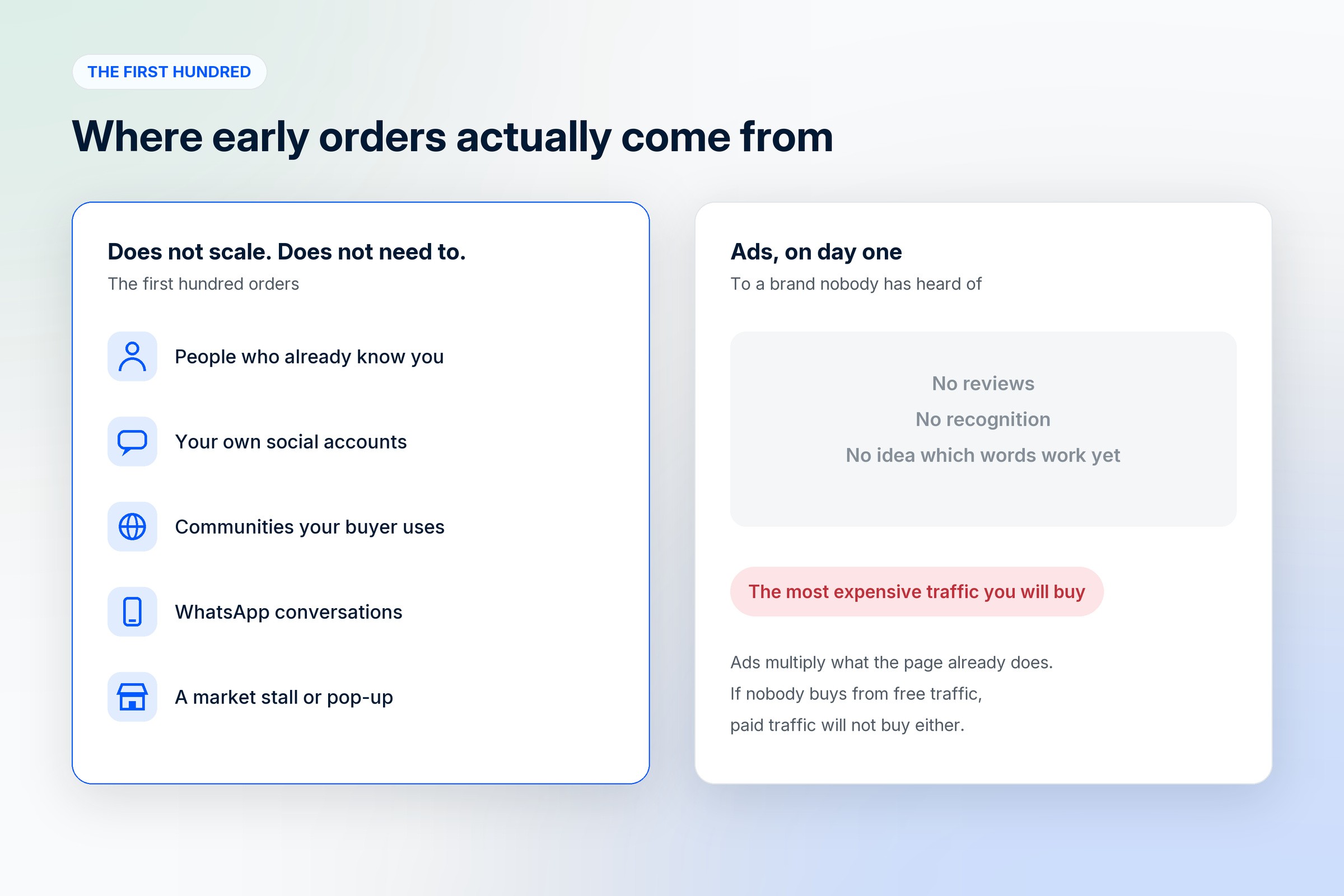
The first hundred orders usually come from places that do not scale and do not need to. The people who already know you. Your own social accounts, posting the making of the product rather than the product. Communities where your buyer already spends time, where you participate as a person rather than dropping a link. WhatsApp conversations with people who ask questions. A local market or pop-up, which produces more learning per hour than any analytics dashboard.
This is also when you learn the words customers use for your product, which are almost never the words you use. Those words become your product titles and your ad copy later.
What to learn from the first twenty orders
Twenty orders will teach you more than twenty thousand impressions.
Watch where people hesitate. The questions arriving in your DMs are the things your product page failed to answer. Write the answer into the page, and watch the question stop coming.
Watch what they order together, which tells you what to bundle and what to photograph together.
Watch the sizes, variants and colours that move, because this decides your first restock and the money you will have tied up for months.
Ask three buyers, in a message rather than a survey, what nearly stopped them from buying. The answers are usually boring and fixable: unclear delivery time, no size chart, a price that seemed high without context.
Turn buyers into an audience you own
A customer who bought once and left no way to reach them is a customer you will buy again later, through an ad.
Collect the channels you own as the orders arrive. A phone number and WhatsApp consent. An email address. An app install later, once there are enough repeat buyers to justify one. Those three cost nothing per message and work when the ad budget is empty.
WhatsApp is the strongest of them early, because a customer's message opens a 24-hour service window in which your replies are free, and that window resets each time they write. Answer in minutes rather than the next morning and the whole conversation costs nothing. More on this in WhatsApp without automation.
Push notifications belong to the app, which is why the app is worth building later rather than never, once people are coming back.
When to start spending on ads
Once the page converts the traffic you already send it.
Ads do not fix a product page that fails. They buy more people to show it to, which is a faster way to confirm what you already know. If visitors from your own social posts are not buying, paid visitors will not buy either.
When you do start, the two things that matter more than targeting are a purchase event reaching your ad account and a creative that shows the product in use. Our guide to setting up Meta ads for D2C brands covers the first month, and the Instagram boost button post explains why the easiest button is the expensive one.
Keep the first budget small enough to be wrong with.
The first restock is the real test
Launch is a project. Restocking is a business, and this is where the brand either becomes one or stays a hobby.
You will discover your actual lead time, the gap between selling out and having stock again, and whether your margin survives a second production run at a sensible quantity. Brands that sell out and reappear eight weeks later lose most of the momentum they just built.
Order the second run before the first one looks finished, using the size and colour mix the first twenty orders showed you rather than the mix you guessed.
What to measure in the first ninety days
Four numbers, weekly, written down somewhere you will actually look.

Orders, in a plain count rather than revenue, because revenue hides a discount habit.
Conversion rate on the product page, which tells you whether the problem is traffic or the page.
Repeat purchase rate after thirty and sixty days, which is the single clearest sign that you have a brand rather than a shop.
Contribution per order after product cost, delivery and payment fees. Not gross revenue, which has fooled a lot of founders into scaling something that loses money per sale.
What usually kills a new ecommerce brand in year one
Running out of cash with stock in a warehouse. Stock is money that has stopped moving, and a wide catalogue at launch is the most common way to tie it all up.
Spending on ads before the page converts.
Changing everything weekly. The brand that renames itself twice in six months never gets the benefit of anyone remembering it.
Going quiet. Posting hard for three weeks and then disappearing undoes most of the recognition it built, which is why regular posting matters more than clever posting.
Competing on price with marketplaces, which can always go lower than you and are happy to.
Frequently asked questions
How do I start my own ecommerce brand?
Write one sentence about who it is for and what it does better, pick a small range of products that are easy to describe, put a storefront live with honest photographs and working checkout, get the first hundred orders from people rather than ads, and use what those buyers tell you to fix the page and plan the first restock.
What is the difference between an ecommerce store and an ecommerce brand?
A store sells things. A brand is the reason someone picks you when the same thing is available cheaper somewhere else, and the reason they come back without an ad. The store is built in days; the brand is built by what happens around every order.
How much money do I need to start an ecommerce brand?
Most of it goes into stock and photography rather than software. A platform subscription is a small, predictable cost, while your first production run, your packaging and the ads to find early customers are the numbers that decide how long you can keep going.
Who should start an ecommerce brand?
People who have a product they can explain in one sentence and the patience for the ninety days after launch. It suits makers, people with a supply advantage, and anyone who has already sold the product by hand and wants to stop doing it one message at a time.
When should I start running ads for a new ecommerce brand?
Once the product page converts visitors you send to it for free. Ads multiply whatever the page already does, so launching them over a page nobody buys from mostly buys you a clearer picture of the same problem.
Where do the first customers of an ecommerce brand come from?
From people rather than algorithms. Your own network, your own social accounts, communities your buyer already uses, WhatsApp conversations and offline events. These do not scale, which is fine, because their job is to produce the first hundred orders and the lessons inside them.
Can I start an ecommerce brand while working a job?
Yes, and many do. The constraint is response time rather than hours, since early buyers ask questions and wait. Automating the common answers and the order updates covers the hours you are unavailable.
Do I need an app to start an ecommerce brand?
No. Start with the website, because it takes one tap from an ad or a search result. An app earns its place once customers return regularly, since its real value is push notifications to people who already buy.
Where to go from here
For the groundwork before launch, read seven things to do before you start an ecommerce brand. For what to build and in what order, there is create ecommerce, and for the naming decision, how to choose a brand name.
1D2C is built for this stage: a branded storefront and native apps under your own name, bulk product import so a catalogue is hours rather than weeks, WhatsApp and push notifications for the customers you have already won, and marketing plans that run the campaigns when you would rather be making the product. Plans and regional pricing are on the pricing page.
Platform capabilities described here are 1D2C's as of October 2026, and the WhatsApp service window rule was taken from WhatsApp's own pricing page in the same month.


