


Quick commerce is the corner shop rebuilt for the phone: the same everyday items, ordered in two taps, at the door before you would have finished the walk.
It is 9.40 on a weeknight in Bengaluru. Someone realises there is no coffee for the morning, opens an app, taps twice and pays. Fourteen minutes later a rider is at the door with the coffee, a loaf of bread they added on the way and a lemon they did not strictly need. Nobody in that flat thinks of it as ecommerce. It is just how the corner shop works now.
Quick commerce, often called q-commerce, is a type of ecommerce that delivers everyday products to customers within minutes, usually 10 to 30, from small stores or warehouses located close to where they live. It sits between a corner shop and an online store: you order on an app like any ecommerce purchase, but the item comes from a few kilometres away and arrives before you would have finished the walk to the shop.
This guide explains what quick commerce is, how quick commerce works from the moment someone taps “order” to the knock on the door, the business models behind it, and where it does and does not make sense.
What is quick commerce?
Quick commerce is ecommerce designed around speed and proximity. Instead of shipping from a large warehouse that serves a whole region, a quick commerce business keeps a limited range of fast-selling products in many small stores, each serving a few kilometres around it. A dedicated rider takes each order straight to the customer.
The products are the things people run out of: milk, bread, eggs, fruit and vegetables, snacks, cleaning supplies, personal care, medicines, pet food. Over time the range has grown to include phone chargers, gifts, flowers, beauty products and even small electronics, but the logic stays the same. If someone needs it today and would otherwise walk to a shop for it, it suits quick commerce.
You will see the model under several names: quick commerce, q-commerce, instant commerce, rapid delivery or 10-minute delivery. In India the best-known quick commerce apps are Blinkit, Zepto and Swiggy Instamart. Getir, Gopuff and Flink built similar services in parts of Europe and the US.
How does quick commerce work?
Every quick commerce order goes through the same chain. Each link has to take a few minutes at most, which is why the whole system is built differently from regular ecommerce.

1. The app checks where you are
When the customer opens a quick commerce app, it reads their location first. It then finds the store that covers that address and shows only what that store has in stock. Two people in the same city can see different products and different delivery times, because they are served by different stores.
2. The customer orders and pays
Baskets are small, so checkout has to be fast: a saved address, one-tap reorder and quick payment by UPI, card, wallet or cash on delivery. The app shows an estimated delivery time before the customer pays, and that number is a large part of why they ordered.
3. The order goes to the nearest store
The order lands on a screen or app inside the store as soon as it is paid. In most quick commerce businesses this is a dark store: a small warehouse closed to walk-in shoppers, laid out only for picking online orders. Some services use regular shops instead, with staff picking orders between serving customers at the counter.
4. Picking and packing take a couple of minutes
A picker walks the aisles with the order on a handheld device or phone, collects the items and packs them. Dark stores are arranged so the products that sell most are nearest the packing desk. A well-run store aims to have an order bagged within a few minutes of it arriving.
5. A rider is assigned
While the order is being packed, the system assigns a rider, usually the nearest one who is free. Riders wait at or near the store, because a rider who has to travel to the store first adds minutes the customer will notice.
6. Delivery to the door
The rider rides the last couple of kilometres, the customer tracks the order on the app, and the hand-off is often confirmed with an OTP or a photo. The rider heads back to the store for the next order. Short distances in both directions are what make the timing possible.
Quick commerce business models
Not every quick commerce company works the same way. There are three broad models, and the differences matter if you are thinking of starting one.
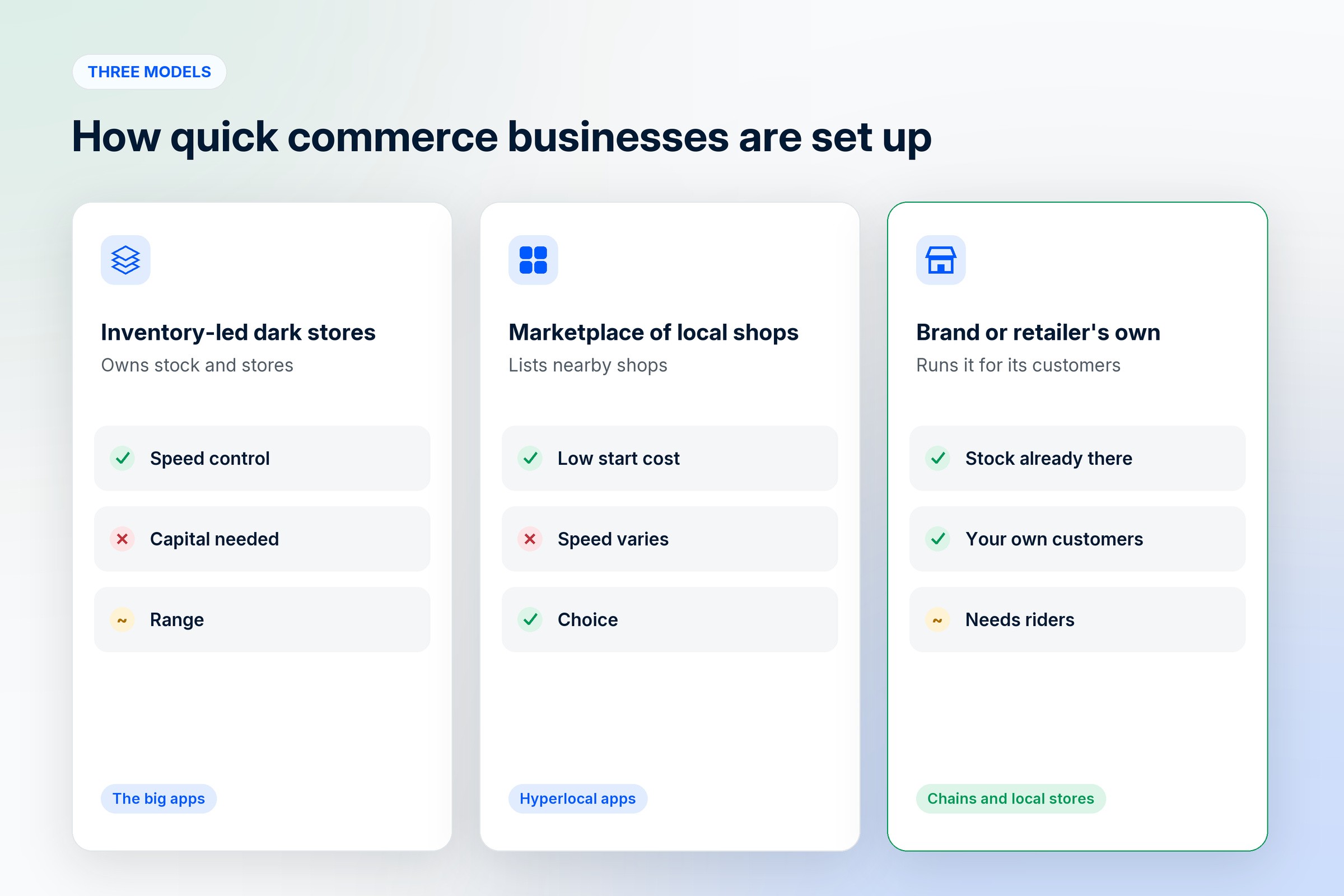
Inventory-led dark stores
The company buys its own stock and runs its own dark stores. This gives the most control over speed and range, and it is the model the large quick commerce apps are known for. It also needs the most money, because every new neighbourhood needs a new store, stock and riders before the first order comes in.
Marketplace of local shops
The platform does not hold stock. It lists nearby shops, such as grocers, pharmacies and bakeries, and either uses their staff or its own riders for delivery. It is cheaper to start and gives customers more choice, but delivery times depend on how quickly each shop responds. This is often called hyperlocal delivery when speed is not guaranteed.
A brand or retailer running its own
A supermarket chain, pharmacy group or single store runs quick delivery for its own customers, with its own app and riders. It already has the stock and the customer trust, so it only needs the technology and a delivery setup. This is the fastest-growing model among smaller businesses, because they no longer need to give aggregators a commission on every order.
Quick commerce vs ecommerce vs hyperlocal delivery
The three terms overlap, so it helps to put them side by side.
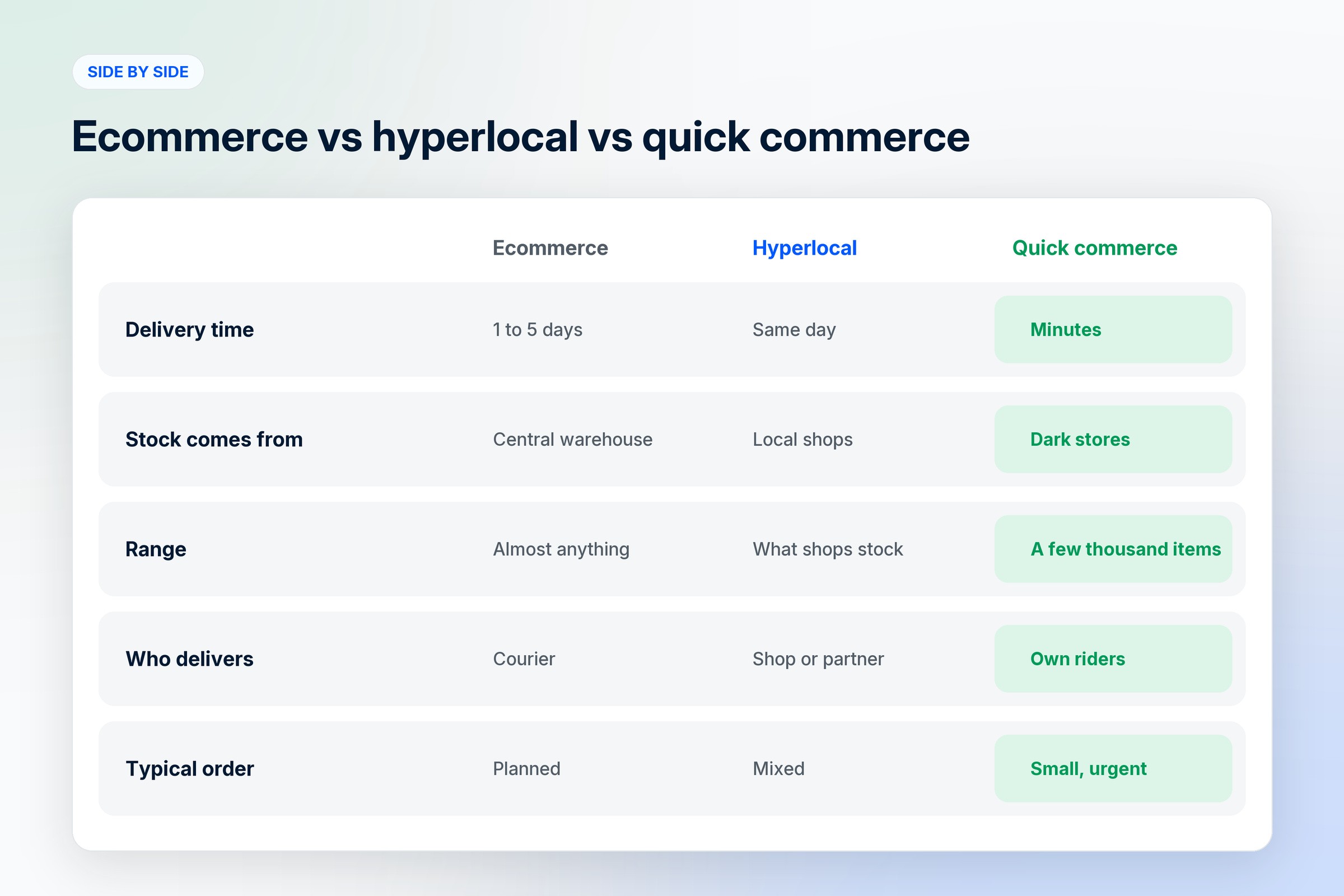
Regular ecommerce ships almost anything from a central warehouse, by courier, in one to several days. Hyperlocal delivery brings products from shops in your area, often the same day, but without a promise of minutes. Quick commerce is a stricter form of hyperlocal delivery: a limited range, stock held in dedicated stores, its own riders and a promise measured in minutes. For a wider look at the different kinds of online selling, see our guide to what ecommerce is.
Why quick commerce grew so fast
The habit came first. During the pandemic years, a lot of people got used to ordering essentials on their phones, and many did not stop once shops reopened. Quick commerce gave them something courier ecommerce never could: the speed of walking to a shop without the walk.
Dense cities helped. Quick commerce depends on many customers living close to each store, so a city where thousands of households live within two kilometres of one point is ideal. Cheap digital payments, especially UPI in India, removed the last bit of friction at checkout.
There is also a simple behavioural reason. People open a quick commerce app for one thing and add two more. Small, frequent baskets build a habit much faster than an online order placed once a month.
The challenges of quick commerce
Fast delivery is expensive, and the model has hard limits.
Thin margins. Each order is small, but each one still needs picking, packing and a rider. A store needs a steady flow of orders every hour to cover its rent, staff and riders.
Stock accuracy. With only a few minutes to pack, there is no time to discover a product is missing. Stock has to update as orders are placed, store by store.
Density. The model works in crowded neighbourhoods and struggles in spread-out suburbs or small towns, where a rider spends too long on the road for each order.
Rider safety and pressure. A promise of minutes should never become pressure on riders to ride unsafely. Responsible operators set realistic delivery times and radius limits instead.
Range. A dark store holds a few thousand products at most. People still need regular ecommerce or a big shop for everything else.
Can a small business do quick commerce?
Yes, and many already do it without calling it quick commerce. A pharmacy that delivers within the neighbourhood in half an hour, or a bakery that takes morning orders on an app and delivers by breakfast, is running quick commerce on a small scale.
What has changed is the software. A local business no longer has to build a customer app, a store app and a rider app from scratch. A quick commerce website builder gives it all three with its own name on them, plus delivery radius settings and rider assignment. 1D2C is one example: an all in one ecommerce platform with a branded website, buyer, seller and delivery apps, instant and scheduled orders, and no commission on orders. It runs for one store or as a multi vendor marketplace of local shops.
Frequently asked questions
What is quick commerce?
Quick commerce, or q-commerce, is a type of ecommerce that delivers everyday products within minutes, usually 10 to 30, from small stores or dark stores close to the customer. Groceries, snacks, personal care and medicines are the most common categories.
How does quick commerce work?
The app checks the customer’s location and shows what the nearest store has in stock. Once the customer pays, the order goes to that store, staff pick and pack it in a few minutes, the nearest free rider is assigned, and the rider delivers it to the door.
What is a dark store in quick commerce?
A dark store is a small warehouse that is closed to walk-in shoppers and used only to pick and pack online orders. It sits inside a residential area, so riders can reach most customers within a couple of kilometres.
Why is quick commerce popular?
It gives people the speed of a local shop with the convenience of ordering on their phone. Small, frequent orders and fast payments made it a daily habit, especially in dense cities.
Who are the main quick commerce companies?
In India, the best-known names are Blinkit, Zepto and Swiggy Instamart. Gopuff, Getir and Flink built similar services in parts of the US and Europe. Many supermarkets, pharmacies and local stores now run their own quick delivery as well.
When does quick commerce make sense for a business?
When customers buy the same items often, want them the same day, and live close together. It makes less sense for products people plan in advance or for areas where homes are spread far apart.
Where does quick commerce work best?
In dense urban neighbourhoods where many households live within a couple of kilometres of one store. Riders can make several deliveries an hour there, which keeps the cost of each delivery down.
What is the difference between quick commerce and ecommerce?
Ecommerce ships a wide range of products by courier, usually in one or more days. Quick commerce delivers a smaller range of everyday items in minutes, from stores near the customer, using its own riders.
How do quick commerce companies make money?
Mainly from the margin on products sold, plus delivery and handling fees, small-order fees and advertising paid by brands that want to appear higher in the app. Profit depends on getting enough orders per store per hour.
Keep reading
If you are thinking of launching your own instant delivery store, our guide to choosing a quick commerce website builder covers the features to look for and the steps to launch. For why buyer, seller and delivery apps belong on one system, read why your business needs buyer, seller and delivery apps.


