


Every question about a D2C ecommerce builder is really one question: will this still fit my brand in two years, or will I be migrating again?
Most questions about a D2C ecommerce builder are really one question asked in different ways: will this thing still fit my brand in two years, or will I be migrating again?
This is a long answer, arranged as the questions founders actually ask when they are choosing a D2C ecommerce builder. If you want the general version of this decision, our guide to choosing an ecommerce website builder covers the category as a whole. What follows is specific to selling direct.
What is a D2C ecommerce builder?
A D2C ecommerce builder is software that lets a brand build and run its own direct-to-consumer store without writing it from scratch. You get the storefront, the catalogue, the checkout and the admin, and you keep the customer relationship, because the sale happens on your own site and apps rather than inside somebody else's marketplace.
The D2C part is what separates it from a general ecommerce builder. Selling direct means the brand owns the storefront, the buyer's contact details, the order history and the decision about what happens after delivery. A builder aimed at D2C is judged on whether it protects those four things.
If the term itself is new, our explainer on what D2C means covers the model before the tooling.
How is a D2C ecommerce builder different from a general ecommerce website builder?
Every ecommerce builder gives you product pages and a checkout. The differences show up in what happens around the sale.
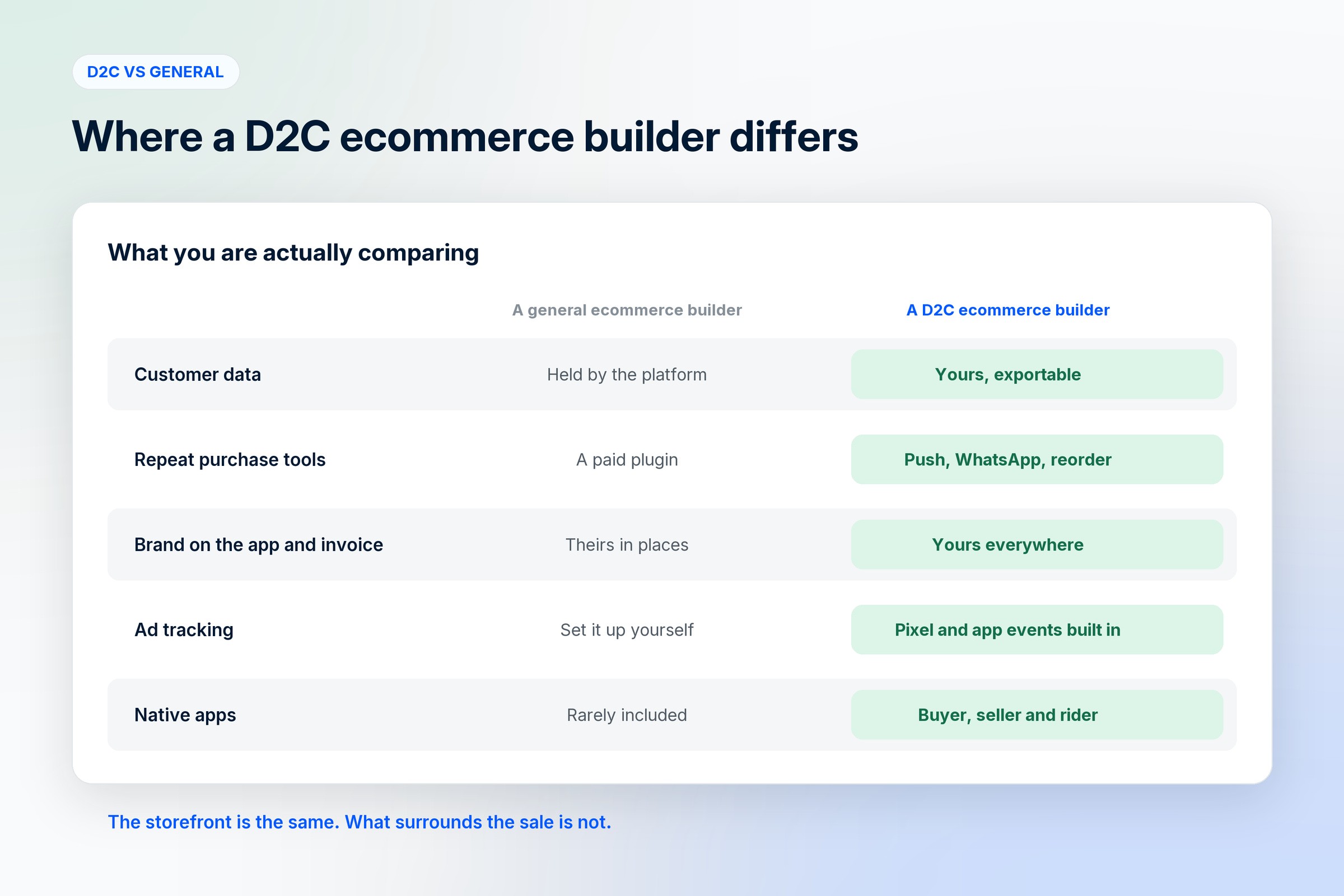
Customer data. A D2C ecommerce builder hands you the buyer's phone number, email and order history as your data, exportable. A marketplace keeps them. Some builders sit in between and make export awkward, which is worth testing before you commit.
Repeat purchase tooling. Direct selling lives on the second order. Push notifications, WhatsApp, saved carts and reorder flows matter more to a D2C brand than another theme.
Brand surface. Your name on the storefront, the app icon, the notification sender and the invoice. A builder that puts its own brand anywhere in that chain is renting you a shopfront.
Marketing attached to the store. Pixels, ad events and campaign tracking that connect spend to orders. Without them you are advertising blind, which is the expensive way to run a D2C brand.
What should a D2C ecommerce builder include?
Treat this as the shortlist you score each builder against.
A storefront you control, with your domain, your branding and product pages you can change without a developer.
A catalogue that handles real stock: variants with their own price and stock, bulk import so you are not typing a thousand rows, and categories that your filters can actually use.
A checkout with the payment methods your market uses, and tax handled the way your accountant needs it rather than the way the software finds convenient.
Native apps, or a clear path to them. A D2C ecommerce builder that stops at a website leaves your most loyal customers on a browser tab.
Customer data you can export without asking permission.
Marketing plumbing: a Meta pixel, app events, WhatsApp, push notifications, and campaign reporting you can read.
Operations: order management, delivery, returns and whatever your category needs, such as scheduled bookings or service appointments.
1D2C covers this set: a branded storefront, native buyer, seller and delivery apps, CSV or XLSX bulk upload with a sample file, price variants that each carry their own price, discount, unit and stock state, Razorpay and Cashfree payments, flat or per-product tax with the buyer's GST number where it applies, Meta pixel and app events, WhatsApp, and push notifications.
Do I need an app, or is a D2C ecommerce website enough?
Start with the website. Add the app when repeat purchases justify it.
An ecommerce website is where most first orders happen, because it is one tap from an ad or a search result and needs no installation. An app earns its place later, with people who already buy from you, because it gives you a home-screen icon and push notifications, which is the only free channel you own outright.
The honest threshold is repeat purchase rate rather than revenue. If most customers buy once a year, build the website properly and spend the rest on acquisition. If people come back monthly, the app pays for itself in notifications alone. There is more on this in our guide to choosing an ecommerce mobile app builder, including the App Store rule that decides who is allowed to publish your app.
How much does a D2C ecommerce builder cost?
Four numbers, and the subscription is rarely the biggest.
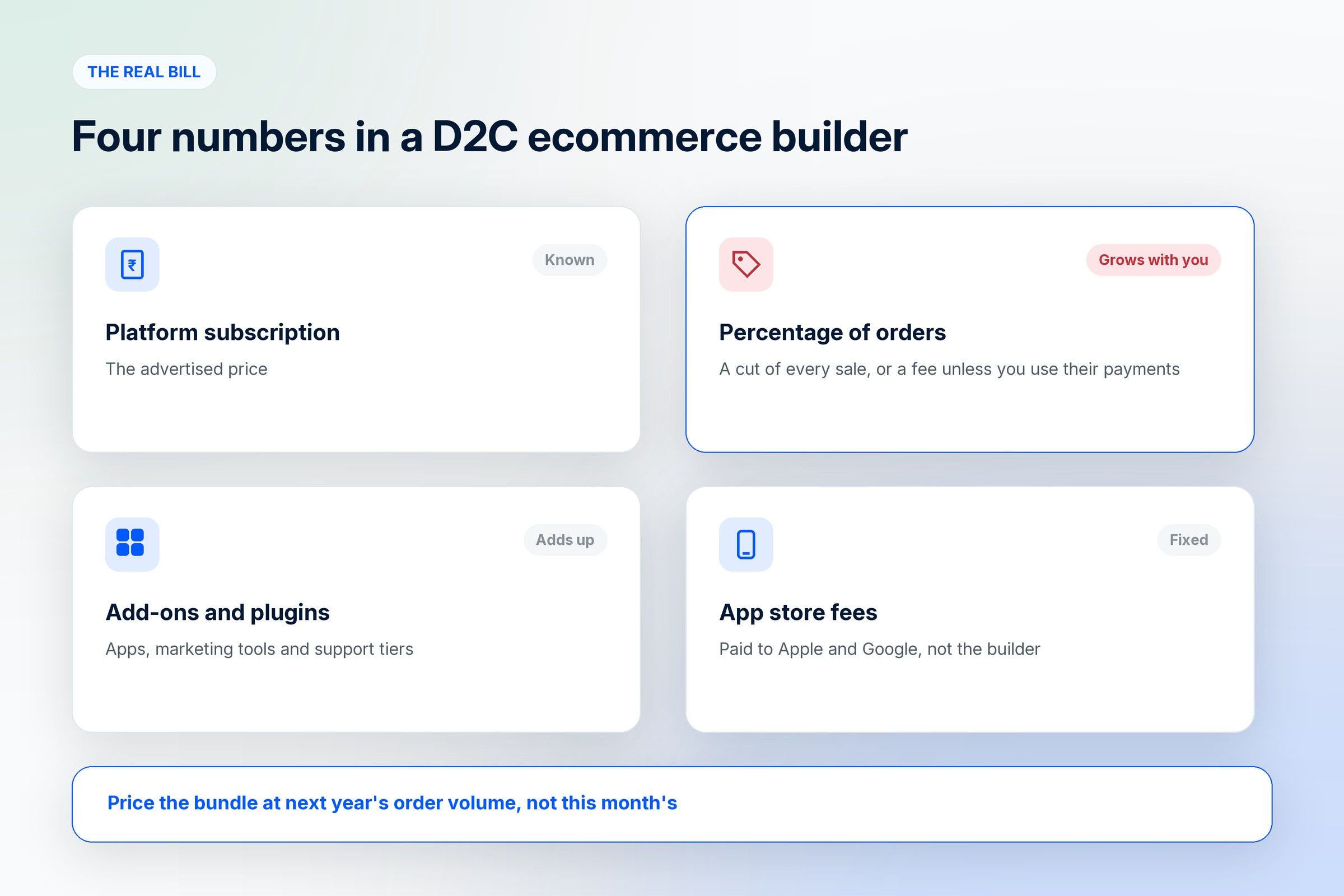
The platform subscription, which is the advertised price.
Percentage cuts, which are not. Some platforms charge a percentage of every order, or an extra fee unless you use their payment product. No 1D2C plan takes a percentage of your orders.
Add-ons. Apps, plugins, marketing tools and support tiers that turn a published price into a different real price. Price the bundle at the volume you expect in a year, not the one you have now.
Store fees if you publish apps, which go to Apple and Google rather than the builder.
1D2C's plans are sized by warehouses for single-vendor brands and by vendors for marketplaces, with Android and iOS arriving at different tiers. Current prices for your region are on the pricing page, because they vary by market.
How long does it take to build a D2C ecommerce store?
Days for the storefront, weeks for the catalogue, and a few more weeks if apps go to the stores.
The storefront is the fast part. Pick a theme, set your colours and logo, connect a domain. A brand that has its photography and copy ready can have a live D2C ecommerce website in a few days.
The catalogue is where the calendar actually goes, which surprises everyone. Photographs, descriptions, variants, prices and stock for every product. Bulk upload turns weeks into days, and it is the single most useful feature when you are starting.
App review adds its own time. First submissions are slower than updates because the developer account, privacy declarations and screenshots are all checked for the first time.
Can a D2C ecommerce builder run a marketplace with multiple sellers?
Some can, most cannot, and it matters more than it sounds because many D2C brands grow into hosting other sellers.
A marketplace needs seller accounts, seller-specific pricing, commissions, separate payouts and a way for each seller to manage their own orders. Retrofitting that onto a single-vendor builder is usually a migration rather than an upgrade.
1D2C handles both shapes from the same platform, including seller-specific pricing, a seller app for vendors, radius-based search so buyers see nearby sellers, and radius-based rider assignment for your own delivery team. Before you grow into it, read the risks of selling only on marketplaces, because the argument for owning the platform is the same argument for going direct in the first place.
Does a D2C ecommerce builder help me get orders, or only build the store?
This is the question most builder comparisons skip, and it is the one that decides whether the store earns anything.
A storefront is a destination with no traffic. The work that produces orders sits beside it: ads, content, email, WhatsApp and the measurement that tells you which of them paid. Most builders hand you a website and wish you luck.
What to look for: a Meta pixel and app events so purchases reach your ad account, WhatsApp for the conversations that close sales, push notifications for repeat orders, and reporting that ties spend to revenue. 1D2C connects these to the store, and our marketing plans cover running the campaigns and the creative as well, which is the part a founder usually has no time for.
How do I migrate an existing D2C store to a new builder?
Export first, map the fields, move in order, and keep your URLs.
Export everything from the current platform before you touch anything, and keep that file untouched as a backup.
Map old fields to new ones on paper. Options, variants and custom fields are where the mismatches live.
Move products, then images, then customers and orders. Customer lists usually matter more than historical orders.
Keep the product URLs working, or redirect them. This is the only part of a migration that costs search traffic if you get it wrong.
Test twenty products by hand before you switch the domain. The full process is in our guide to selling physical products online.
How do I choose a D2C ecommerce builder?
Six checks, in the order that saves the most pain.
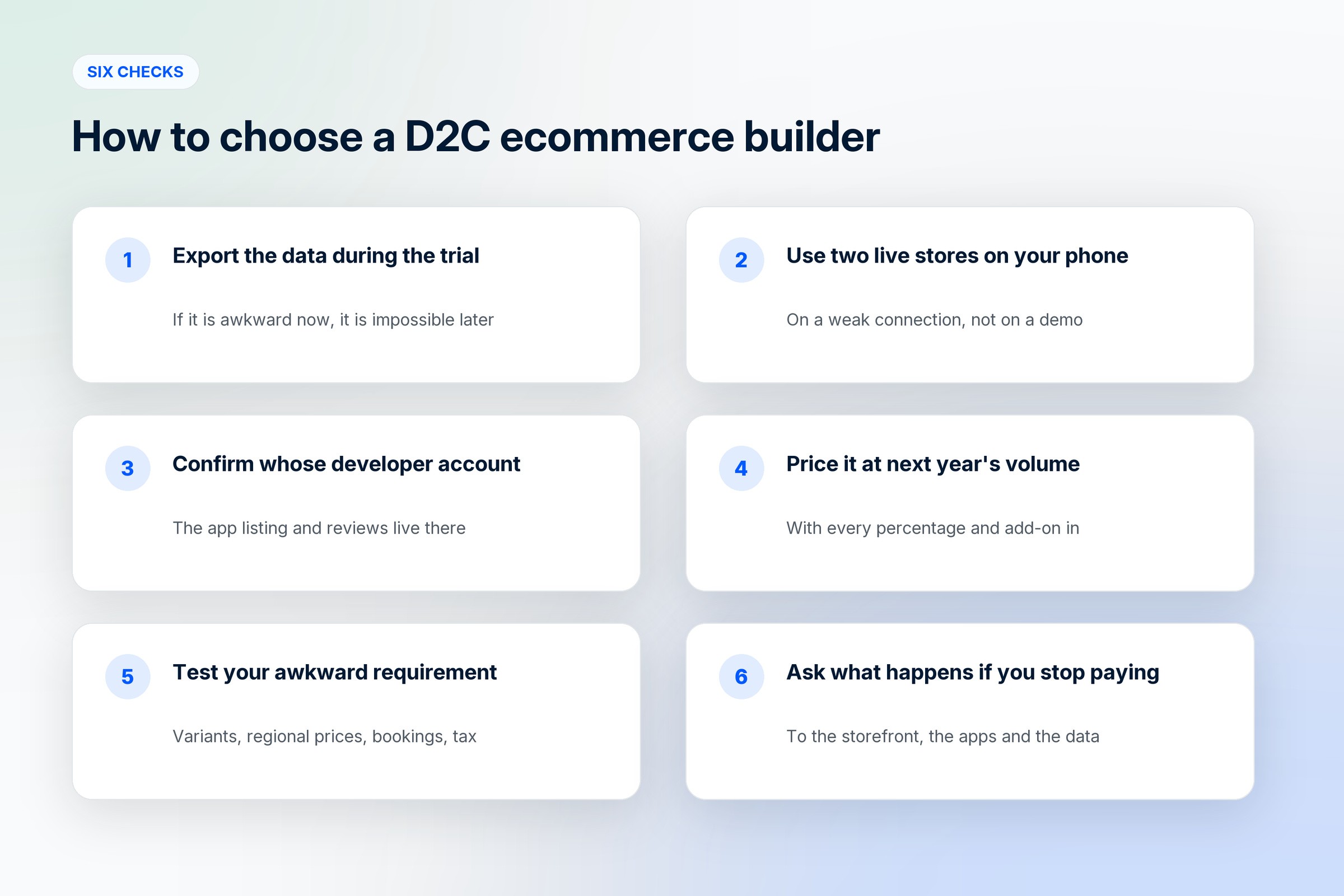
Ask for an export of customer and order data during the trial, not after. If it is awkward now, it will be impossible later.
Open two live stores built on the platform, on your phone, on a weak connection.
Confirm whose name is on the app listing and the developer account.
Price it at next year's volume with every percentage and add-on included.
Check your category's awkward requirement early: variants, regional pricing, subscriptions, bookings, GST or local tax rules, whatever yours is.
Ask what happens to the storefront, the apps and the data if you stop paying.
Frequently asked questions
What does a D2C ecommerce builder do?
Software that lets a brand build and run its own direct-to-consumer store, including the storefront, catalogue, checkout and admin, while keeping the customer relationship. The difference from a general ecommerce builder is that a D2C builder is judged on whether you own the storefront, the customer data and what happens after the sale.
Why do D2C brands need a dedicated ecommerce builder?
Because selling direct depends on repeat purchases and owned channels, which generic builders treat as afterthoughts. A D2C ecommerce builder is expected to cover push notifications, WhatsApp, ad tracking and exportable customer data as standard rather than as paid plugins.
How do I build a D2C ecommerce store?
Set up the storefront with your domain and branding, load the catalogue (bulk upload rather than forms once you pass about twenty products), connect payments and tax, publish apps from your own developer accounts if you need them, and connect your pixel and WhatsApp before you spend on ads.
Who is a D2C ecommerce builder for?
Brands that make or own what they sell and want the customer relationship, rather than resellers who are happy on a marketplace. It suits a founder-led brand with repeat purchases, and it suits a growing seller who expects to host other vendors later.
When should I move from a marketplace to my own D2C store?
Once marketplace fees, advertising costs and the lack of customer data cost more than running your own store. Most brands run both for a while, using the marketplace for discovery and the D2C store for margin and for the second order.
Where does the customer data live in a D2C ecommerce builder?
With you. Phone numbers, email addresses and order history should be yours and exportable in a standard format. Ask for a sample export before you sign, since this is the clearest test of whether a platform is a D2C ecommerce builder or a marketplace wearing one's clothes.
Which is better for D2C: a website builder, an app builder, or an all-in-one platform?
An all-in-one platform if you want the website, the apps and the marketing to share one catalogue and one customer record. Separate website and app builders mean two systems to keep in sync, which is manageable at twenty products and painful at a thousand.
Can a D2C ecommerce builder handle subscriptions, bookings or services?
Some can. 1D2C supports a service-based app type alongside product selling, plus scheduled bookings and instant orders, so appointment-led businesses use the same platform. Check this early, because it is the requirement most often discovered after a platform has been chosen.
Does a D2C ecommerce builder include native mobile apps?
Rarely by default, and this is where platforms differ most. 1D2C ships native buyer, seller and delivery apps under your brand. Apple's rules require apps built from a commercial template to be submitted by the brand itself, so expect to publish from your own developer account wherever you build.
Is a D2C ecommerce builder cheaper than custom development?
Almost always, and the gap widens over time. Custom development costs the build once and the maintenance forever, because operating systems, payment rules and store policies keep changing. A builder absorbs that maintenance into the subscription.
Where to go from here
If you are deciding between platforms, our comparison with Shopify covers where the models differ. For the general category, there is how to choose an ecommerce website builder, and for the app side, the ecommerce mobile app builder guide. If you are still at the model stage, start with what D2C means.
1D2C is built as a D2C ecommerce builder rather than a website tool with a shop bolted on: your storefront, native buyer, seller and delivery apps under your own name, a catalogue with real variants and bulk import, payments and tax, WhatsApp and push notifications, and marketing plans that run the campaigns alongside the platform. Plans and current regional pricing are on the pricing page.
Platform capabilities described here are 1D2C's as of October 2026, and app store rules were checked on Apple's own guidelines in the same month. Check the current pricing page for your region before budgeting.


