


Your customers already order groceries on their phones. The only question is whether those orders go through your app, with your name on it, or through someone else’s.
A grocery shop owner in Hyderabad watched his Sunday morning trade shrink for a year. The same families still lived on his street. They were ordering milk, eggs and bread on an app, and the order arrived from a dark store two kilometres away before the kettle boiled. He had better prices and he knew every customer by name. What he did not have was a way to take an order on a phone and get it to the door in twenty minutes.
A quick commerce website builder is software that lets a shop, chain or brand launch its own instant delivery store: a website and app where nearby customers order everyday items and get them within minutes, with stock, riders and payments managed in one place. It is the same idea as an ecommerce website builder, rebuilt around distance, speed and a delivery fleet instead of courier shipping.
This guide covers what quick commerce is, how a quick commerce platform differs from a normal online store, the features to look for before you choose one, and how to launch your own quick commerce app without building it from scratch.
What is quick commerce?
Quick commerce (often shortened to q-commerce) is ecommerce built for delivery in minutes rather than days. Orders are packed at a small local store or dark store close to the customer and taken the last few kilometres by a rider. Blinkit, Zepto and Swiggy Instamart made the model familiar in India; Getir, Gopuff and Flink did the same in parts of Europe and the US.
Groceries were the first category, but the model now covers pharmacy, pet supplies, flowers, electronics accessories, beauty products and hot food. Anything people need today, from a shop near them, fits.
How a quick commerce platform differs from a normal online store
A regular online store assumes the warehouse can be anywhere. The product ships by courier, and a delivery date three days out is fine. Quick commerce turns almost every one of those assumptions around.

Distance decides everything
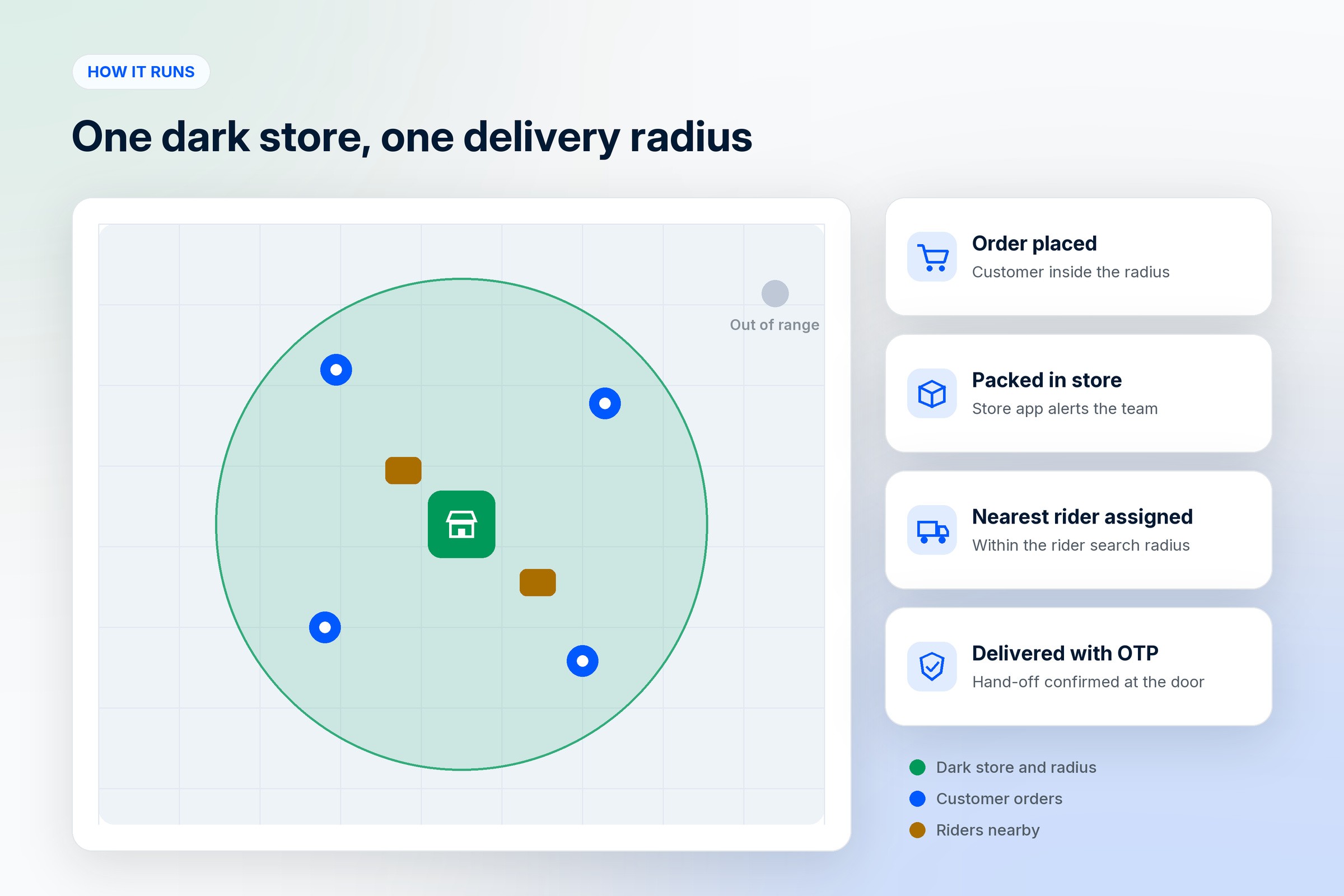
A quick commerce store only shows a customer the products that can actually reach them fast. That means the store, or each of your stores, needs a delivery radius, and the app has to check the customer’s location before it shows the catalogue. A product sitting in a dark store fifteen kilometres away is, for that customer, out of stock.
Stock has to be live
With courier ecommerce, a stock mistake means a delayed parcel and an apology email. In quick commerce it means a rider standing at the door with half the order. Stock needs to update as orders are placed, per store, not in a nightly sync.
You run your own delivery
Courier partners do not deliver in fifteen minutes. A quick commerce business needs its own riders, or a local partner, plus a delivery app that assigns each order to the nearest available rider and confirms the hand-off at the door.
Baskets are small and frequent
People order a few items several times a week. That makes repeat ordering, saved addresses, one-tap reorder and fast payment more important than a long product page. It also makes a mobile app worth far more than it is for a store people visit twice a year.
Who should build a quick commerce store?
You do not need to be a venture-funded start-up with a hundred dark stores. The businesses that do well with their own quick commerce app usually already have the hard part, which is stock and local customers:
Grocery stores and supermarkets with one or several branches
Pharmacies and health stores
Bakeries, dairies, butchers and fresh produce sellers
Pet shops, florists and gift shops
Regional chains that want their own hyperlocal delivery app instead of paying commission on every aggregator order
Entrepreneurs who want to run a multi vendor marketplace of local shops in one town or neighbourhood
For a local shop, the case is simple. The aggregators already proved your customers will order on a phone. The question is whether those orders go through your app, with your name on it, or through theirs with a commission taken off each one. We went through that trade-off in more detail in the risks of selling only on marketplaces.
Features to look for in a quick commerce website builder
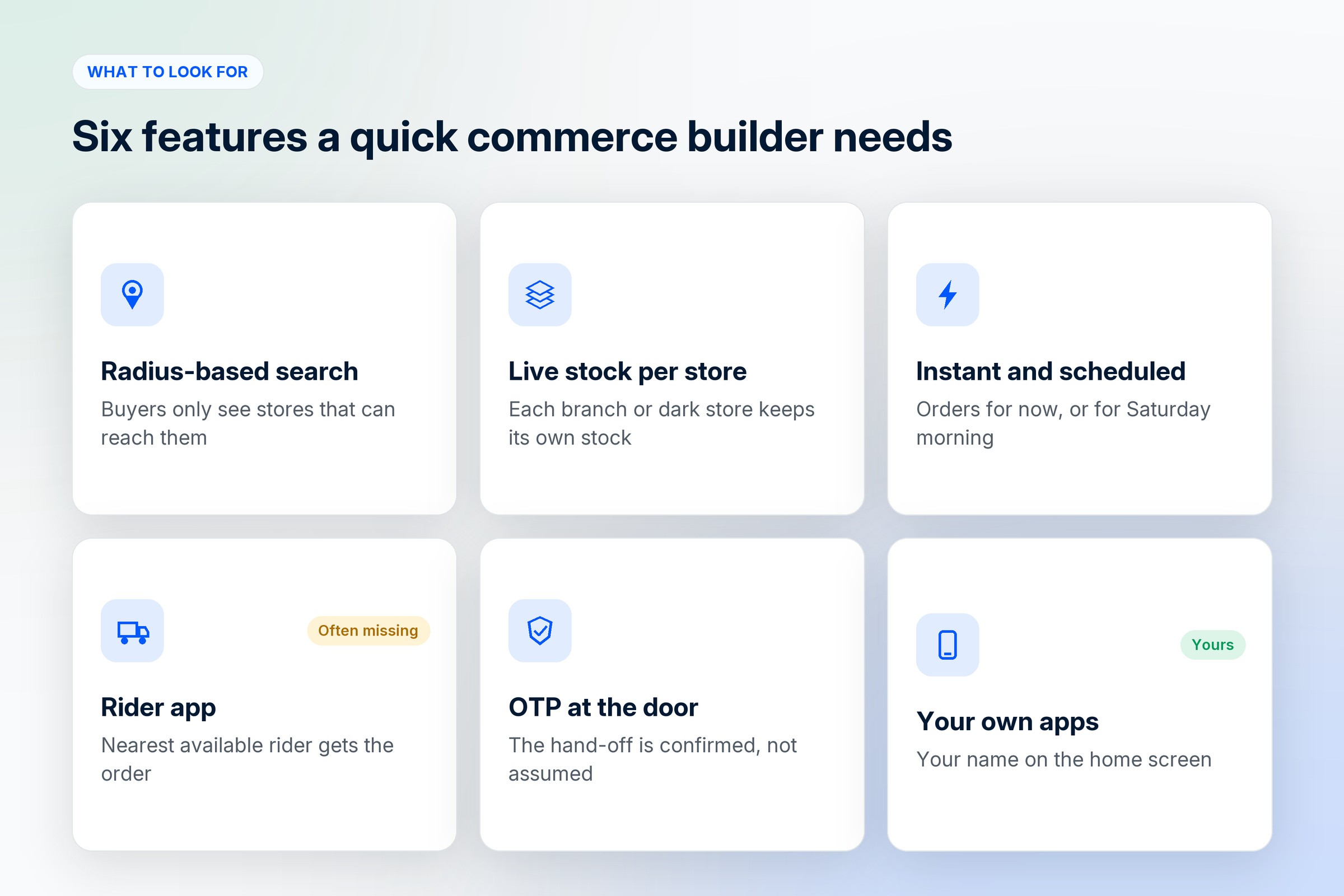
Most ecommerce website builders were made for shipping parcels. Before you choose one for quick commerce, check that it handles the things above. These are the features that matter most.
Location-based store and product search
The customer opens the app, shares their location, and sees only the stores and products within delivery range. On 1D2C this is a radius you set in the admin panel, so a store in one area never shows up for a customer it cannot reach.
Multiple stores and warehouses
If you have more than one branch or dark store, each needs its own stock and its own orders. Check that the builder supports several warehouses under one brand rather than making you run a separate store for each.
Instant and scheduled orders
Not every order is a “now” order. People book a cake for Saturday or a weekly vegetable box. A good quick commerce platform lets you switch on instant orders, scheduled orders or both.
A delivery app for riders
This is the part most website builders do not have at all. Your riders need an app that shows new orders, assigns each one to an available rider near the store, shares their location while they deliver and confirms the drop-off. On 1D2C the rider app assigns orders within a search radius you set, and the customer gives the rider an OTP at the door to complete the delivery.
A seller or store app
Someone in the store has to accept the order, pack it and hand it over, fast. A store-side app with alerts for new orders is far quicker than a browser tab on a counter computer.
Your own branded website and apps
Customers order from the app on their home screen. If your store lives inside someone else’s app, it is one icon among hundreds. A white label ecommerce platform publishes the buyer app under your name and logo on the Play Store and App Store, next to your own website. Our ecommerce app builder page shows what that looks like.
Fast payments and messaging
UPI, cards and wallets in India, local methods elsewhere, plus cash on delivery where people still expect it. Order updates should go out on the channel people read, which in many countries is WhatsApp rather than email.
How to build a quick commerce app: step by step
1. Decide your delivery area and promise
Pick the radius each store can actually cover in the time you want to promise. Twenty or thirty minutes you can hit every time beats ten minutes you hit on a quiet Tuesday. Customers forgive a slower promise; they do not forgive a broken one.
2. Start with the products people reorder
Do not try to list everything on day one. Start with the few hundred items that make up most of your daily sales, with clear photos and correct prices. Use bulk upload from a spreadsheet so the catalogue does not take weeks.
3. Set up riders before you launch
Work out how many riders you need at your busiest hour, get them onto the delivery app and run test orders end to end: order placed, packed, assigned, picked up, delivered with OTP.
4. Launch to customers you already have
Your first quick commerce customers are the people who already walk into your shop. Put a QR code at the counter, a flyer in every bag and a message to your WhatsApp contacts. Local search and Google Business Profile come next, then small, tightly targeted ads around your delivery radius.
5. Watch the numbers that matter
Track delivery time, orders cancelled for stock, repeat rate and average basket. Those four tell you whether the store is working long before revenue does.
Should you build or use a quick commerce builder?
Building a quick commerce app from scratch means a customer app, a store app, a rider app, an admin panel, location logic, payments and push notifications, then keeping all of it working on new phone versions every year. That is a software company’s job. Unless technology is your product, a builder gets you live in days and leaves your time for stock, riders and customers.
1D2C is an all in one ecommerce platform that includes all of those pieces: your branded website, buyer app, seller app and delivery app, radius-based store and rider search, instant and scheduled orders, and no commission on orders. It runs as a single-store setup or as a multi vendor marketplace for a whole town. See the ecommerce website builder for the website side, or compare plans on the pricing page.
Frequently asked questions
What is a quick commerce website builder?
A quick commerce website builder is software for launching your own instant delivery store. It gives you a website and apps where nearby customers order and get items within minutes, plus the stock, rider and payment tools behind it, without writing code.
Why should a local store build its own quick commerce app?
Because the customers are already ordering on their phones. With your own app, those orders carry your name, you keep the customer’s details for the next order, and you do not pay a commission to an aggregator on each sale.
How does a quick commerce app work?
The customer shares their location and sees stores and products within delivery range. They order and pay, the nearest store packs it, the app assigns a rider nearby, and the rider delivers and confirms the hand-off, usually with an OTP.
Who can use a quick commerce platform?
Grocery stores, supermarkets, pharmacies, bakeries, dairies, pet shops, florists, regional chains and anyone who wants to run a marketplace of local shops. You need local stock and a way to deliver within a small area.
When is quick commerce the right model for a business?
When customers buy the same items often and want them the same day, and when you can keep stock close to them. For products people plan to buy, such as furniture, standard ecommerce with courier delivery is usually the better fit.
Where should I start with quick commerce?
Start in the area around one store you already run. Set a delivery radius you can cover reliably, list the products people reorder most, sign up your first riders and launch to your existing customers before you spend on ads.
How much does it cost to build a quick commerce app?
Custom development of the customer, store and rider apps plus an admin panel is a large one-off project with ongoing maintenance. A quick commerce builder replaces that with a monthly plan. 1D2C’s plans and what each includes are on the pricing page, with prices shown for your region.
What is the difference between quick commerce and hyperlocal delivery?
Hyperlocal delivery means delivering from shops within a small area, at any speed. Quick commerce is a form of hyperlocal delivery with a promise of minutes, which usually needs dedicated stock, packing and riders.
Keep reading
New to selling online? Start with what ecommerce is and how it works, then read how to choose an ecommerce website builder. For why buyer, seller and delivery apps belong on one system, see why your business needs buyer, seller and delivery apps.


