


What makes a brand D2C is who it sells to. Lipstick, mattresses, coffee and dog food can all be D2C, as long as the brand sells to you directly.
D2C brands are brands that sell their products directly to consumers through their own website, app, social media or stores, without a distributor, wholesaler or retailer in between. D2C stands for direct to consumer, and it is also written DTC. D2C brands come in several types, from brands that were born online to old brands that started selling direct, and they cover almost every product category, from skincare to mattresses.
This guide sorts D2C brands two ways: by business model, which is how they reach you, and by product category, which is what they sell. Each type comes with examples of D2C brands in India and abroad. If you want the basics of how direct-to-consumer selling works first, read our explainer on what D2C means.
What is D2C? A quick definition
D2C (direct to consumer) is a business model where the company that makes or designs a product sells it straight to the person who uses it. In the traditional route, a product passes through a distributor, a wholesaler and a shop before a buyer sees it, and each one takes a share of the price. A D2C brand skips them.
D2C full form: direct to consumer. DTC means the same thing.
D2C meaning in practice: the brand owns the sale, the price, the customer data and the relationship with the buyer.
D2C vs B2C: B2C covers any business selling to consumers, including retailers selling other companies’ products. D2C is the part of B2C where the brand itself does the selling.
D2C business model: the brand earns the full retail price instead of a wholesale price, and spends part of that margin on marketing, delivery and customer service.
Types of D2C brands by business model
The first way to group D2C brands is by how they reach buyers. Most D2C companies fit one of these eight types, and many mix two or three.
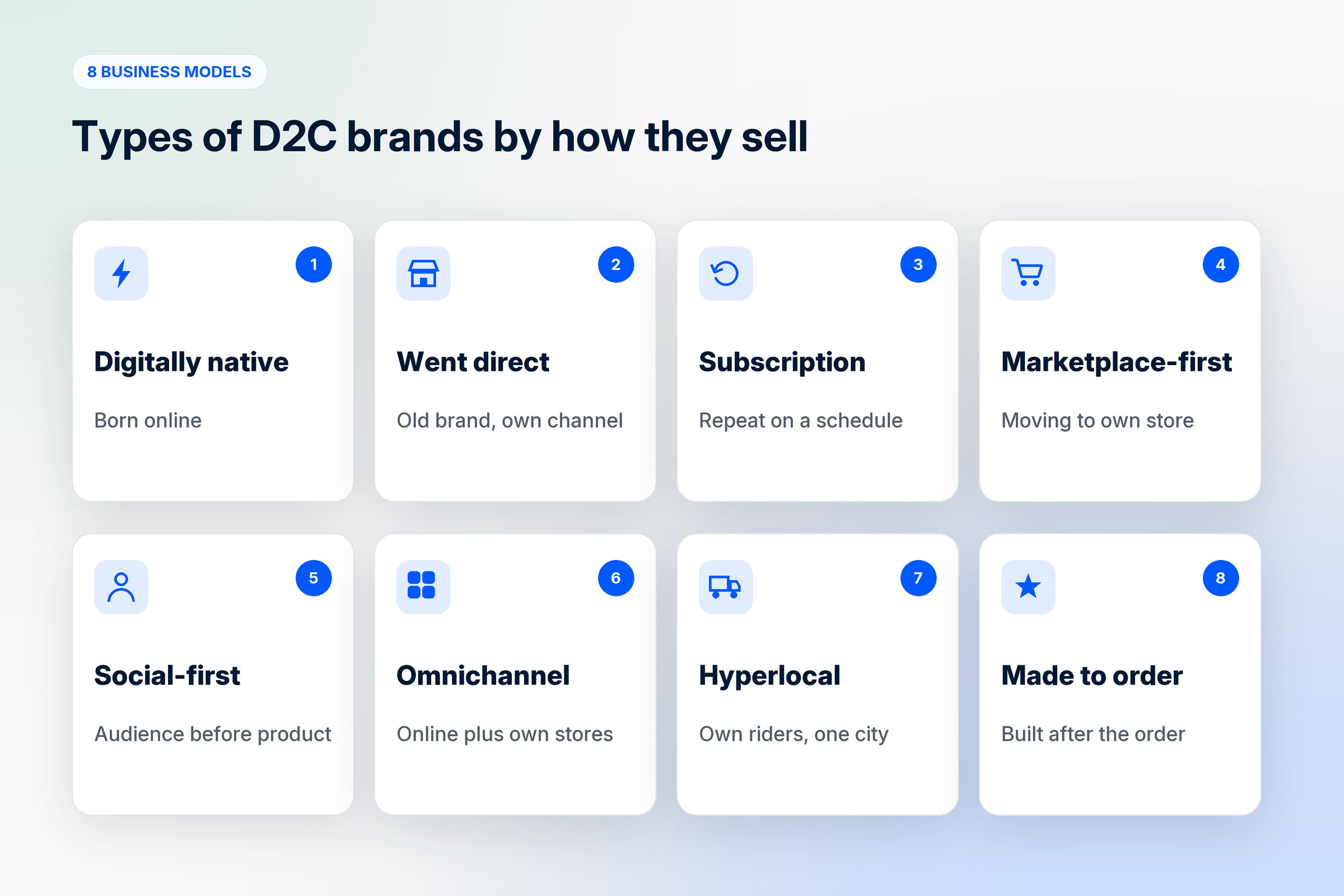
1. Digitally native brands
Brands that were born online and sold through their own website from day one, often called digitally native vertical brands. Warby Parker in eyewear, Allbirds in shoes and Mamaearth in personal care all started this way, and many of them later opened physical stores.
2. Traditional brands that went direct
Established brands that used to sell only through shops and added their own website, app or stores. Nike is the best-known example: it cut many wholesale partners from 2017 to push its own stores and website, then went back to retailers such as Macy’s and DSW (Retail Dive). Most legacy brands now run a D2C channel alongside retail rather than instead of it.
3. Subscription D2C brands
Brands that sell on a repeat schedule: razors, coffee, pet food, supplements, contact lenses. Dollar Shave Club built its business on online razor subscriptions and was bought by Unilever for $1 billion in 2016. Subscriptions suit products people run out of, because the second order costs far less to win than the first.
4. Marketplace-first brands moving to their own store
Brands that started on Amazon, Flipkart, Myntra or Meesho and are building their own website and app to own the customer. In India this is one of the most common paths, because marketplaces bring early sales while commissions and ad costs squeeze the margin. Our post on why selling only on marketplaces is dangerous explains the risk.
5. Social-first and creator-led brands
Brands built around a founder, creator or community on Instagram or YouTube, where the audience comes before the product. Their first sales often happen in DMs and on WhatsApp before there is a full store.
6. Omnichannel D2C brands
Brands that sell directly through their website, app and their own physical stores together, with one stock count and one customer record. Lenskart in India is a well-known example, with an app, a website and its own stores.
7. Local and hyperlocal D2C brands
Bakeries, meat and fish brands, dairies, grocers and restaurants that sell through their own app and deliver with their own riders within a city. Licious, which sells meat and seafood through its own app, is one example. Speed and freshness matter more here than reach.
8. Made-to-order and custom D2C brands
Brands that make each product after the order: custom furniture, tailored clothing, personalised gifts, printed products. Selling direct lets them take the customer’s measurements or choices without a middleman getting them wrong.
Types of D2C brands by product category
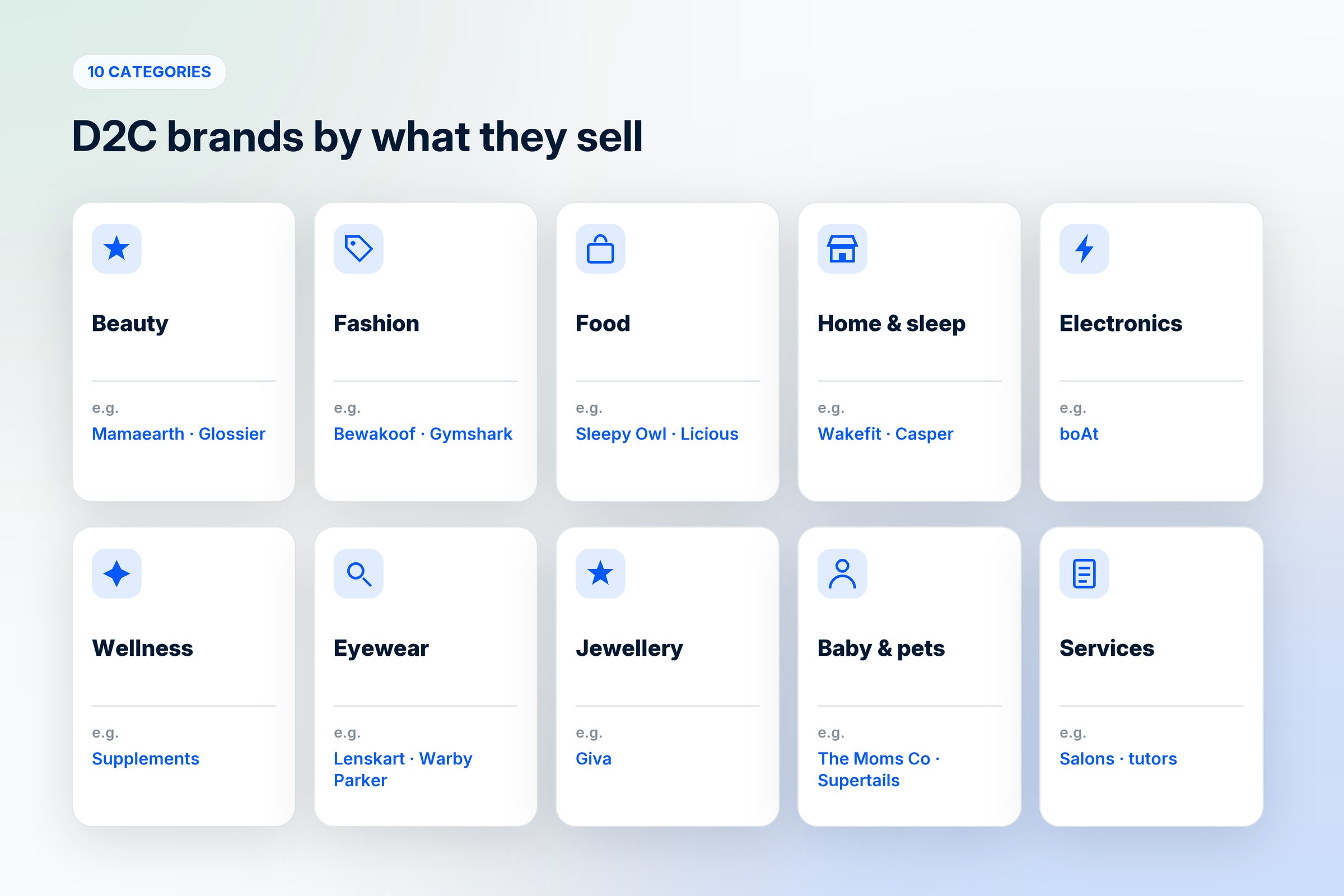
The second way to sort the types of D2C brands is by what they sell. These are the categories where D2C companies are most common, with examples of D2C brands in India and around the world.
Beauty and personal care
Skincare, haircare, makeup and grooming are the classic D2C category: small products, high repeat purchase and buyers who want to learn about ingredients. Examples: Mamaearth, Sugar Cosmetics and Bombay Shaving Company in India; Glossier abroad.
Fashion and footwear
Clothing, ethnic wear, activewear and shoes, where design and brand story set the price. Examples: Bewakoof in India; Gymshark and Allbirds abroad.
Food and beverages
Coffee, tea, snacks, spices, health food and meat. Examples: Sleepy Owl and The Whole Truth in India, and Licious for meat and seafood. Food brands need registration, such as FSSAI in India, and packaging that survives a courier.
Home, furniture and sleep
Mattresses, furniture, home decor and kitchenware. Examples: Wakefit in India and Casper abroad, both of which sold mattresses online before most people thought anyone would buy a bed without lying on it.
Consumer electronics
Earphones, speakers, smartwatches, chargers and small appliances. boAt is the best-known Indian example, built online and selling through its own website as well as marketplaces.
Health, wellness and nutrition
Supplements, protein, Ayurvedic products and wellness devices, often sold on subscription. Health claims are tightly regulated in most countries, so these brands live or die on trust.
Eyewear and accessories
Glasses, sunglasses, bags, watches and wallets. Examples: Lenskart in India and Warby Parker in the US, both of which combined online sales with their own stores.
Jewellery
Silver, gold-plated and fine jewellery, where photos, reviews and a clear returns policy replace the jeweller’s counter. Giva, which sells silver jewellery online, is one Indian example.
Baby, kids and pets
Baby care, toys, kids’ clothing, pet food and pet accessories, bought by parents and pet owners who research hard and reorder often. Examples: The Moms Co for mothers and babies, and Supertails for pets, both in India.
Services sold direct
Salons, tutors, home services and fitness studios can run on the same model, selling bookings instead of products through their own app. The principle is the same: the business owns the customer instead of renting them from a platform.
How to tell whether a brand is D2C
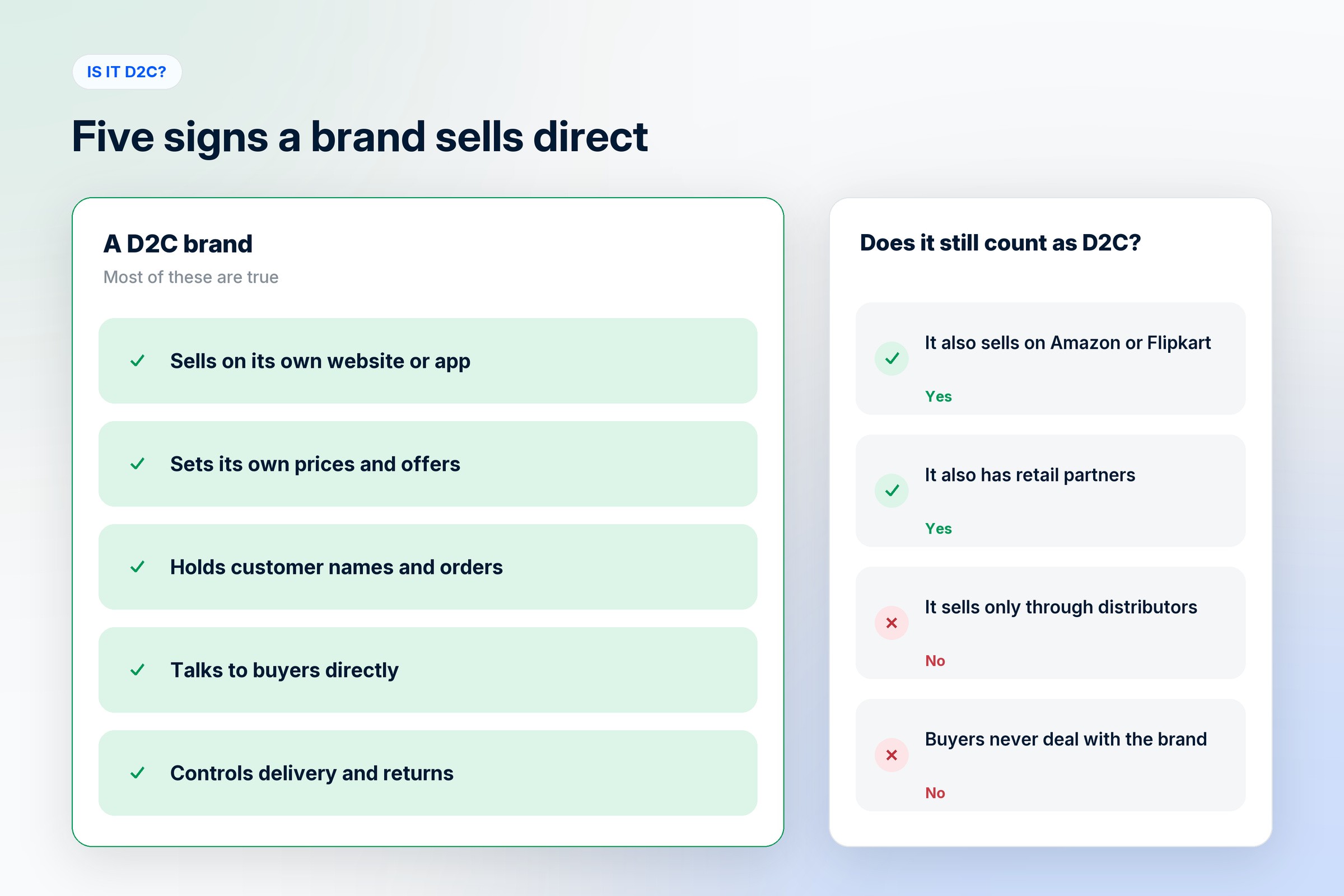
Many brands sell through several channels at once, so the label can be blurry. A brand is running a D2C business if most of these are true.
It sells on its own website or app, where you pay the brand rather than a reseller.
It sets its own prices and runs its own offers.
It holds the customer’s name, number and order history.
It talks to buyers directly, through social media, email or WhatsApp.
It handles, or directly controls, delivery, returns and support.
Selling on marketplaces as well does not stop a brand being D2C. Most D2C brands in India sell on Amazon or Flipkart too. What matters is that the brand also has its own direct channel and owns those customers.
Which type of D2C brand should you start?
Pick the model that fits the product and how often people buy it.
Something people run out of every month (coffee, skincare, pet food): a subscription D2C brand.
Something people need to see or try (furniture, eyewear, jewellery): an online brand with strong photos and easy returns, adding stores later if it grows.
Something perishable or needed today (food, groceries, meat): a local D2C brand with its own delivery.
Something you already sell on a marketplace: keep the marketplace for discovery and build your own store for repeat buyers.
For the groundwork before launch, see our list of things to do before you start an ecommerce brand, and for product ideas, our list of ecommerce business ideas.
Frequently asked questions
What are D2C brands?
D2C brands are brands that sell their products directly to consumers through their own website, app, social media or stores, without a distributor, wholesaler or retailer in between.
What is the full form of D2C?
D2C stands for direct to consumer. It is also written DTC.
What are the types of D2C brands?
By business model: digitally native brands, traditional brands that went direct, subscription brands, marketplace-first brands moving to their own store, social-first and creator-led brands, omnichannel brands, local and hyperlocal brands, and made-to-order brands.
Why do brands choose the D2C model?
To keep the margin that distributors and retailers would take, to own customer data, to control how the brand is presented, and to learn from buyers directly.
How do D2C brands make money?
They sell at the full retail price instead of a wholesale price and keep the difference, after paying for marketing, delivery, returns and customer service. Repeat purchases make the model work, because a returning buyer costs much less to win than a new one.
Who can start a D2C brand?
Anyone with a product and a way to reach buyers, from a home baker to an established manufacturer. Many D2C brands start with one product, sell through Instagram and WhatsApp, and add a website and app as orders grow.
When does a brand count as D2C?
When it sells to consumers through a channel it owns, such as its own website, app or store, and keeps the customer relationship. Selling on marketplaces as well does not change that.
Where do D2C brands sell?
On their own website and app, on Instagram and WhatsApp, in their own stores, and often on marketplaces such as Amazon and Flipkart as an extra channel.
What are some examples of D2C brands in India?
Mamaearth and Sugar Cosmetics in beauty, Bombay Shaving Company in grooming, boAt in electronics, Lenskart in eyewear, Wakefit in mattresses, Licious in meat and seafood, Sleepy Owl in coffee and Giva in jewellery.
Where to go from here
If you are deciding whether to go direct, start with what D2C means and why selling only on marketplaces is dangerous. When you are ready to build, our post on the D2C ecommerce builder covers what to look for. 1D2C gives D2C brands their own website and Android and iOS apps, with no commission on any order. Plans are on the pricing page.


