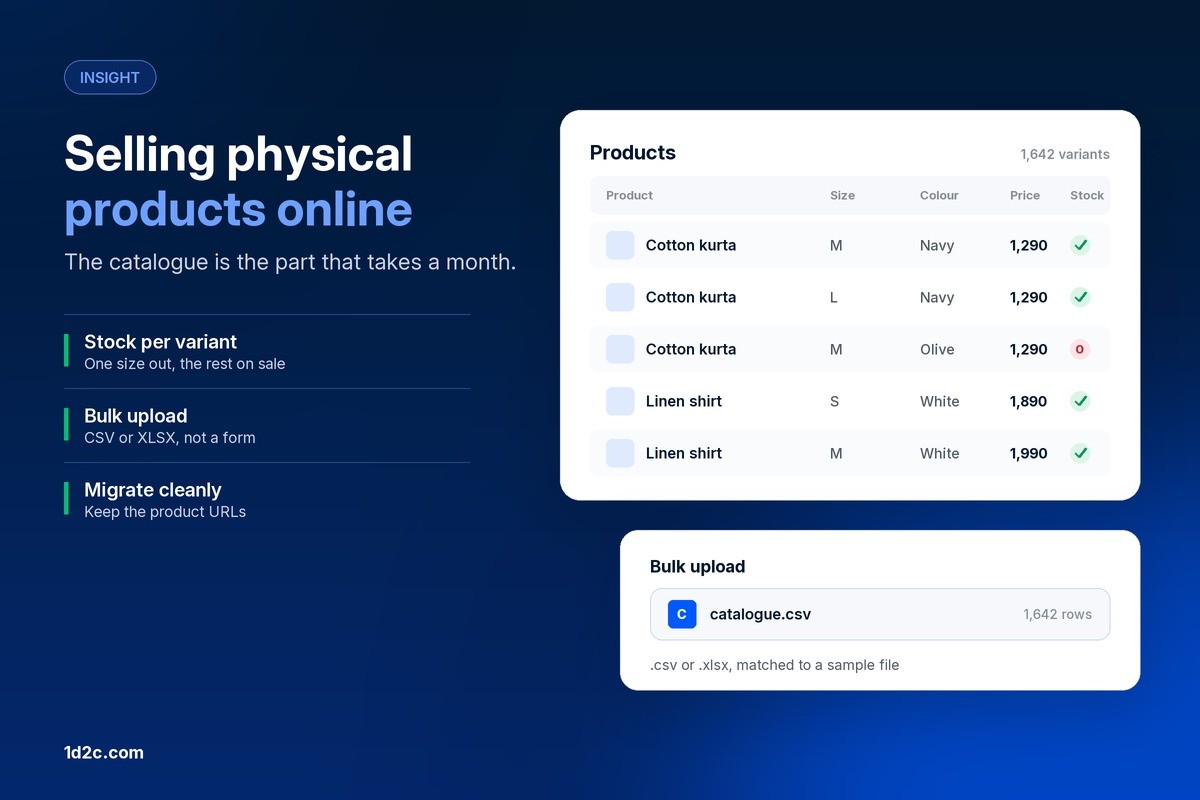


A marketplace will rent you its customers for as long as you keep paying. It never hands them over.
Depending 100% on marketplaces means every sale your brand makes passes through a platform that decides who sees your products, what you pay to sell, which competitors sit next to you and who owns the customer. Amazon, Flipkart, Myntra, Ajio and Meesho are good places to sell. They are dangerous places to sell only.
Picture a kurta label in Jaipur that does well on two fashion marketplaces. Sales are steady, the dashboard looks healthy, and the founder has never needed a website. Then three things happen in one quarter. A fee update arrives by email. A big sale event asks sellers to fund a deeper discount to stay in the featured slots. And a near-identical kurta from a new seller appears, two hundred rupees cheaper, right under her listing.
She has thousands of past buyers and no way to reach a single one of them. That is what 100% marketplace dependence looks like when it bites.
Why marketplaces are so tempting
It is worth being fair to them, because the pull is real. A marketplace gives a new brand traffic on day one, a checkout people already trust, delivery to most pin codes and a returns process buyers know. Myntra, for example, says it has more than 70 million monthly active users. No new website starts with anything close to that.
So the real question is what happens when a marketplace becomes your only channel.
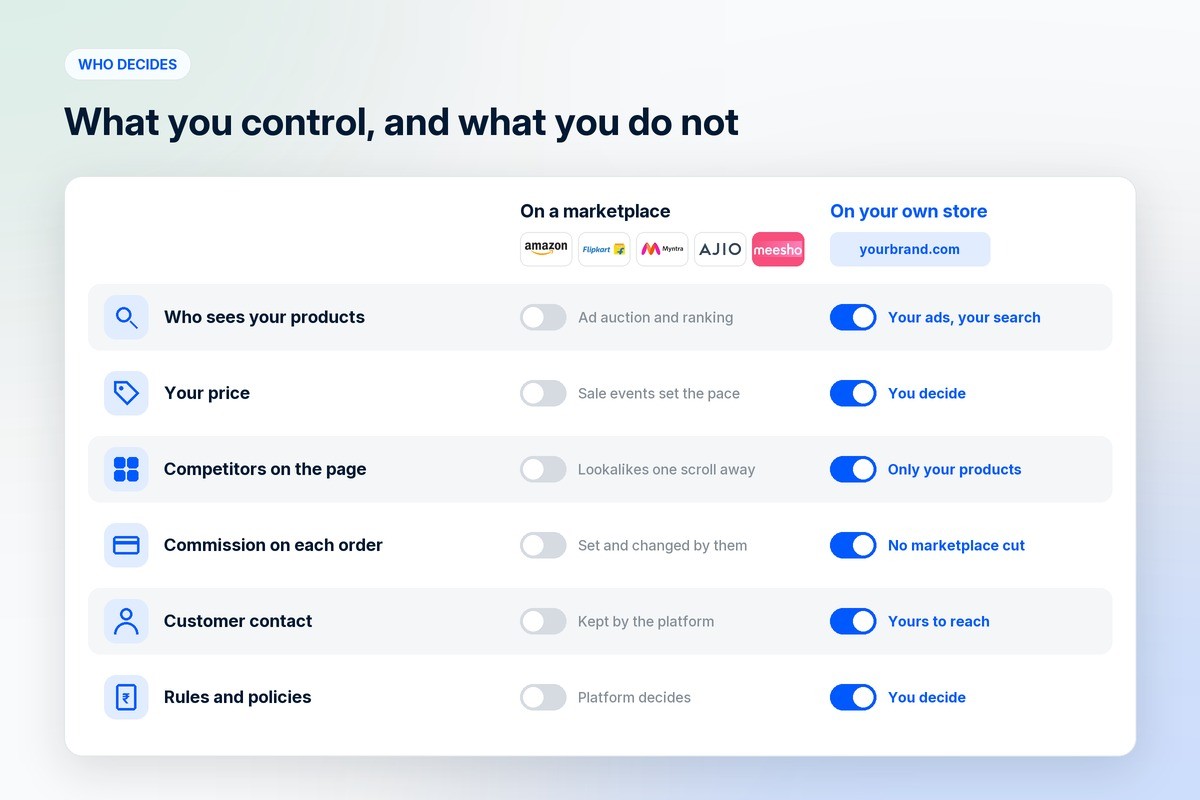
What you do not control on a marketplace
Who sees your products
On a marketplace, the platform decides the order of the search results. More and more of the best positions are paid. Studying Amazon’s US marketplace, Marketplace Pulse found that advertising is not optional for sellers, because most of the best-converting screen space goes to ads. Your audience arrives through the platform’s search, the platform’s recommendations and the platform’s ad auction. Stop paying, and the flow slows down.
Your price
Sale events, discount campaigns and competing sellers on the same or similar listings all push your price in one direction. You can opt out, but the products that stay at full price during a sale usually lose their place in it. Over time the marketplace trains its buyers to wait for the next sale, and they buy you only when you are cheap.
Who you compete with
In a shop, your product sits on a shelf someone chose for it. On a marketplace, the cheaper lookalike is one scroll away, on the same page, often with your keywords in its title. Many platforms also run their own in-house labels in the categories they sell. You are competing with everyone the platform lets in, and sometimes with the platform itself.
What you pay
Commission, fulfilment, shipping, storage, returns and ads all have rates set by someone else, and those rates change. Sometimes they fall: Amazon India removed referral fees on products under ₹300 in 2025. Myntra launched zero commission for new homegrown D2C brands in January 2026, “during their early growth phase”. Both are good news for sellers. Both are also reminders that the fee is a lever the platform pulls when it suits the platform.
The direction is not always kind. Marketplace Pulse found that in 2022 Amazon’s average cut of a US seller’s revenue passed 50% for the first time, up from 40% five years earlier, once referral fees, fulfilment fees and advertising were added together.
Who owns the customer
When someone buys from you on a marketplace, the platform gets a customer and you get an order to ship. You usually cannot email them, message them about a restock, or invite them to a new collection, and the platform’s rules limit how you can contact them at all. The reviews you earn belong to the listing. If you leave, none of it comes with you.
The rules
Return windows, payment cycles, listing policies and account health scores are all set by the platform and can change with a notice period you did not negotiate. When all your revenue runs through one account, a policy change or a suspended listing is a business problem overnight.
How dependence turns into a trap
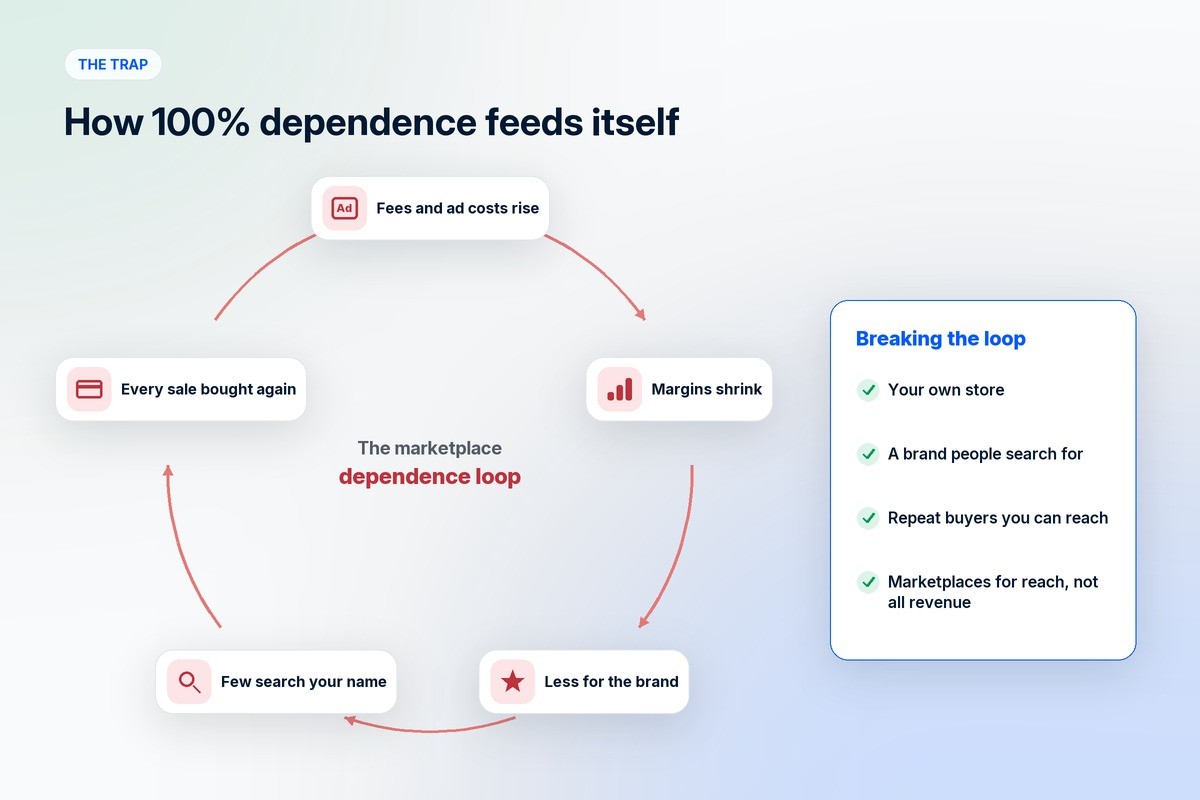
None of these problems is fatal on its own. Together they form a loop. Fees and ad costs rise, so margins shrink. Thin margins leave nothing to spend on building a brand. Without a brand, nobody searches for you by name, so every sale has to be bought again through marketplace ads. That raises the costs again.
D2C coach Shripal Gandhi described the same pattern in a recent Instagram post: brands with good products stall because they have no system to bring customers back, put ad money in with no retention underneath, and lean too hard on Amazon and Flipkart. He called them “systems problems”, and that is the right word. Under the same post, one seller replied that a marketplace had raised their commission, their margins had suffered, and they were moving to their own store.
Why your own store matters
Your own website and app are the one channel where you set the rules. A shopper who finds you there sees your products with no lookalike underneath, at the price you chose. Every order gives you a name, a number and a purchase history, which is what makes a second order possible without paying for the same customer twice.
It is also where your brand gets built. On a marketplace, buyers remember the platform. On your own store, with your packaging and your messages, they remember you. We wrote about why that matters in why branding is important, and it is the core of ecommerce branding: people who search for your name are traffic you own rather than rent.
Building one well takes some care, and we listed the common mistakes in why an online store is important. If selling direct is new to you, start with what D2C means.
An own store has costs too. You pay for traffic, handle payments and delivery, and earn trust from zero. Those costs buy something a marketplace cannot sell you, which is a relationship with your customers.
Marketplaces and your own store can work together
The goal is balance. Most healthy brands use marketplaces for reach and their own store for relationships. A buyer discovers you on Myntra, likes the product, sees your name on the box, follows you on Instagram and buys the next one from your website.
Read each marketplace’s seller policies before you try to move buyers across. Most restrict inserts and messages that send customers off the platform. Strong branding, consistent packaging and a presence people can find on their own are allowed everywhere, and they do most of the work.
How to reduce marketplace dependence
You do not have to leave any marketplace to make your ecommerce business safer. Start here:
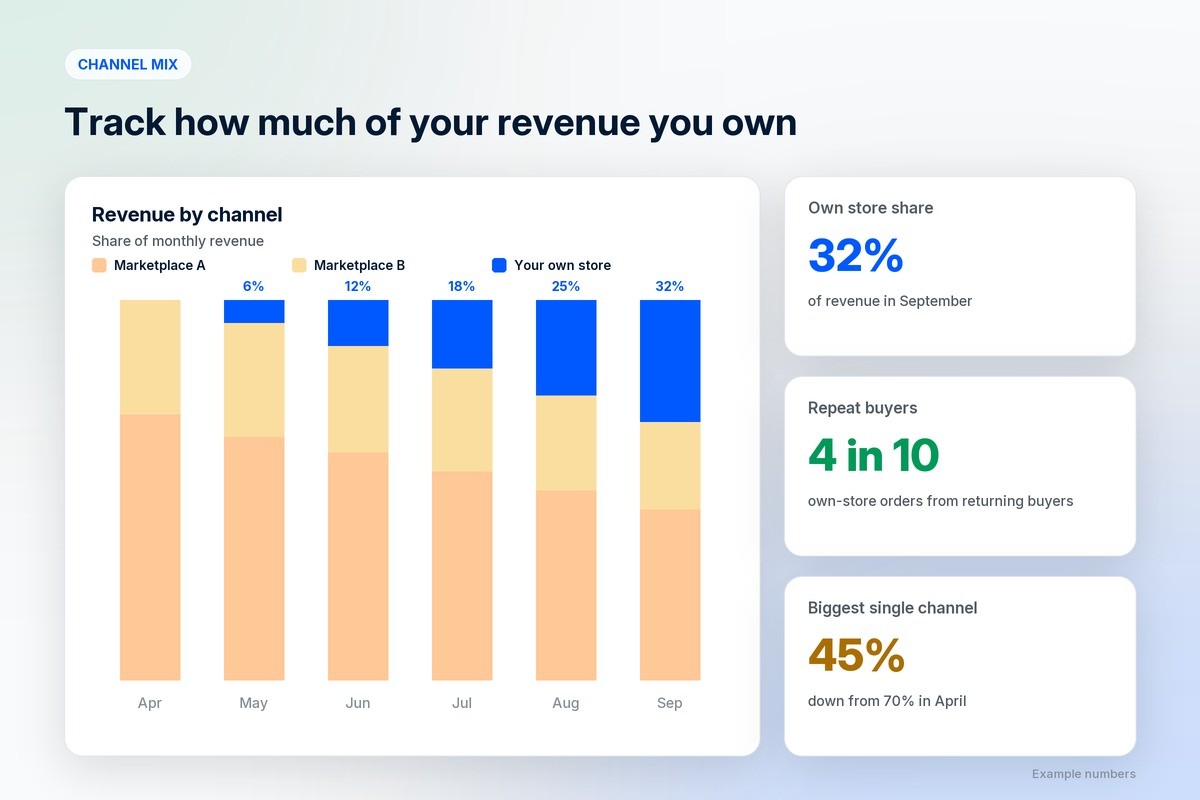
Measure your channel mix every month: what share of revenue, and of profit, comes from each marketplace and from your own store.
Build your own online store with the full catalogue, clear delivery dates and an easy returns policy.
Give people a reason to buy direct: exclusive colours or bundles, early access to new drops, faster support. It does not have to be the lowest price.
Collect first-party relationships on your own channel: WhatsApp opt-ins, email and app installs. Our guide to WhatsApp for ecommerce brands covers how to do this without spamming people.
Point your own online advertising at your own store, and measure repeat purchase there, not only first orders.
Keep marketplaces for reach, and spread across more than one, so no single platform’s decision can stop your business.
How 1D2C helps
1D2C builds a brand’s own website and buyer app, with seller and delivery apps to run the operation behind them. No commission is taken on any order, on any plan, so the margin a marketplace would keep stays with you. Marketing and WhatsApp plans add a team that runs your posts, reels, ads and WhatsApp campaigns to bring buyers to your own store and back again. Plans are on the pricing page.
Frequently asked questions
What is marketplace dependence?
When most or all of a brand’s sales come through platforms such as Amazon, Flipkart, Myntra, Ajio or Meesho, so the platform’s fees, search ranking and rules decide how the business performs.
Is it bad to sell on Amazon, Myntra or Meesho?
No. Marketplaces are a good way to reach buyers who would never find a new brand otherwise. The risk comes from relying on them for all of your revenue, because the platform controls your visibility, your fees and your access to customers.
Why are margins so low for marketplace sellers?
Commission, fulfilment and shipping fees, paid ads to stay visible, returns, and discounts during sale events all come out of the selling price. Each one is reasonable on its own. Together they can leave very little.
Can I contact my marketplace customers directly?
Usually not. Marketplaces generally keep buyers’ contact details and limit messages to order-related communication inside the platform. Check each marketplace’s seller policy before you contact a buyer or add an insert to a parcel.
Should I sell on marketplaces or on my own website?
Both, with your own website as the base. Use marketplaces for reach and your own store for repeat buyers, pricing control and customer relationships.
How do I reduce my dependence on marketplaces?
Track how much of your revenue each channel brings, launch your own store, give buyers a reason to buy direct, collect WhatsApp and email opt-ins, and spend part of your ad budget sending people to your own store instead of your marketplace listings.
Who is most at risk from depending on marketplaces?
Brands selling products that shoppers compare side by side, such as clothing, accessories and home goods, where a cheaper lookalike is one scroll away. Brands whose margins are already thin after commission, fulfilment and ads have the least room when terms change.
When should a marketplace seller start their own store?
Before it feels urgent. An own store takes months to build traffic and repeat buyers, so starting while marketplace sales are healthy gives it time to grow before a fee change or a policy update forces the move.
Where should I send my ad traffic, to my listing or my own store?
Send at least part of it to your own store. Ads that point at a marketplace listing grow the marketplace’s customer base. Ads that point at your own store grow a list of buyers you can reach again.
Where to go from here
If you are setting up your own channel for the first time, start with what ecommerce is and the Meta ads guide for D2C brands. If you want the store, the apps and the marketing built as one, plans are on the pricing page.