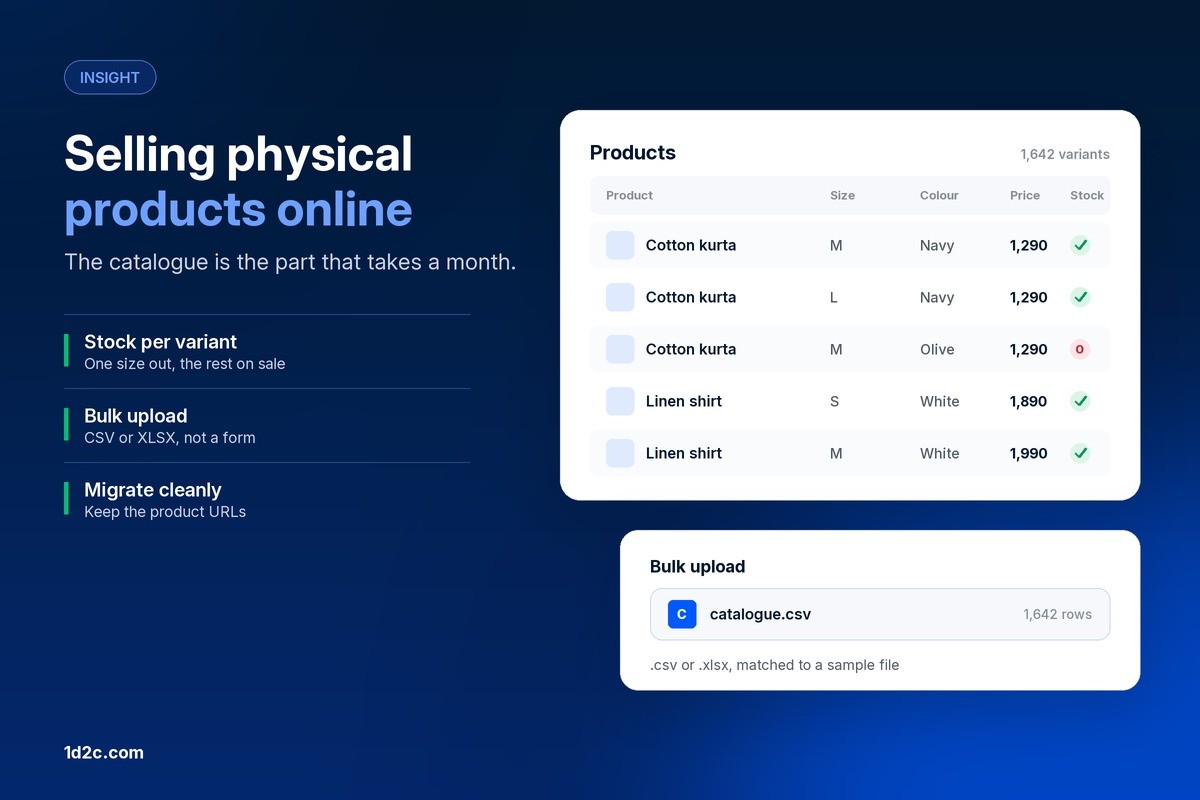


Going direct gives you the margin and the customer. It also hands you every job the retailer used to do.
D2C, short for direct to consumer, is when a brand sells its products straight to the people who use them, through its own website, app or social channels, with no distributor or retailer in between. You will also see it written as DTC.
Picture a family business in Kochi that has made spice blends for twenty years. Every packet travels the same road: from the factory to a distributor, then a wholesaler, then a shop on the corner, and finally into somebody’s kitchen. The family decides the recipe. Almost everything after that is decided by other people: which shelf the packet sits on, what discount it carries, what the buyer pays.
Then the founder’s daughter puts the range on a website and an Instagram page. In the first month she ships forty orders. Small numbers. But for the first time the business knows who bought, what they paid and whether they came back. That shift, from selling to shops to knowing your buyers, is what D2C really means.
What D2C means
In a traditional supply chain a product changes hands three or four times before anyone uses it. Each step takes a margin, and each step stands between the maker and the buyer. D2C removes those steps. The brand makes or sources the product, sets the price, takes the order, ships it and handles the return.
D2C is about who sells. The channel can vary: a brand’s own ecommerce store, a mobile app, WhatsApp, Instagram, a pop-up at a weekend market, even its own shop on a high street. What makes it D2C is that the brand owns the sale and the relationship with the customer.
It is one of the business models we covered in our guide to what ecommerce is, next to B2C, B2B and marketplaces. In practice the lines blur. Most D2C brands are also B2C, since they sell to the public, and plenty of them sell on marketplaces as well.
D2C vs the traditional retail route
The difference shows up in four places.
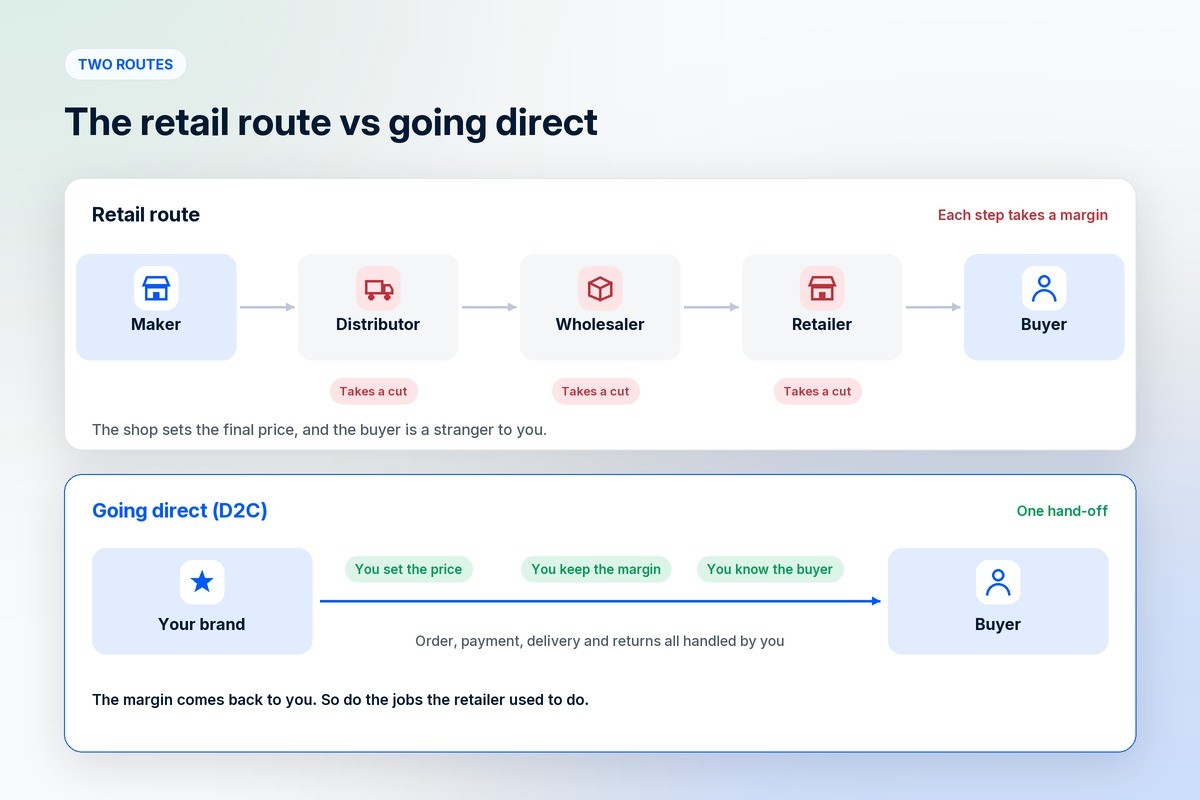
Price. In retail, the shop decides the final price and the discount. When you sell direct, you do.
Margin. The distributor’s and the retailer’s cut disappears, although shipping, payment fees and advertising take its place.
Customer data. A retailer knows who bought your product, and you usually do not. Selling direct, every order arrives with a name, a phone number and an address.
Feedback. A complaint at a shop counter rarely reaches the factory. A review on your own product page reaches you the same day.
What D2C ecommerce looks like in practice
D2C ecommerce is the online form of going direct: a brand-owned ecommerce store, usually backed by an app, social media and messaging. Most brands end up with a mix like this:
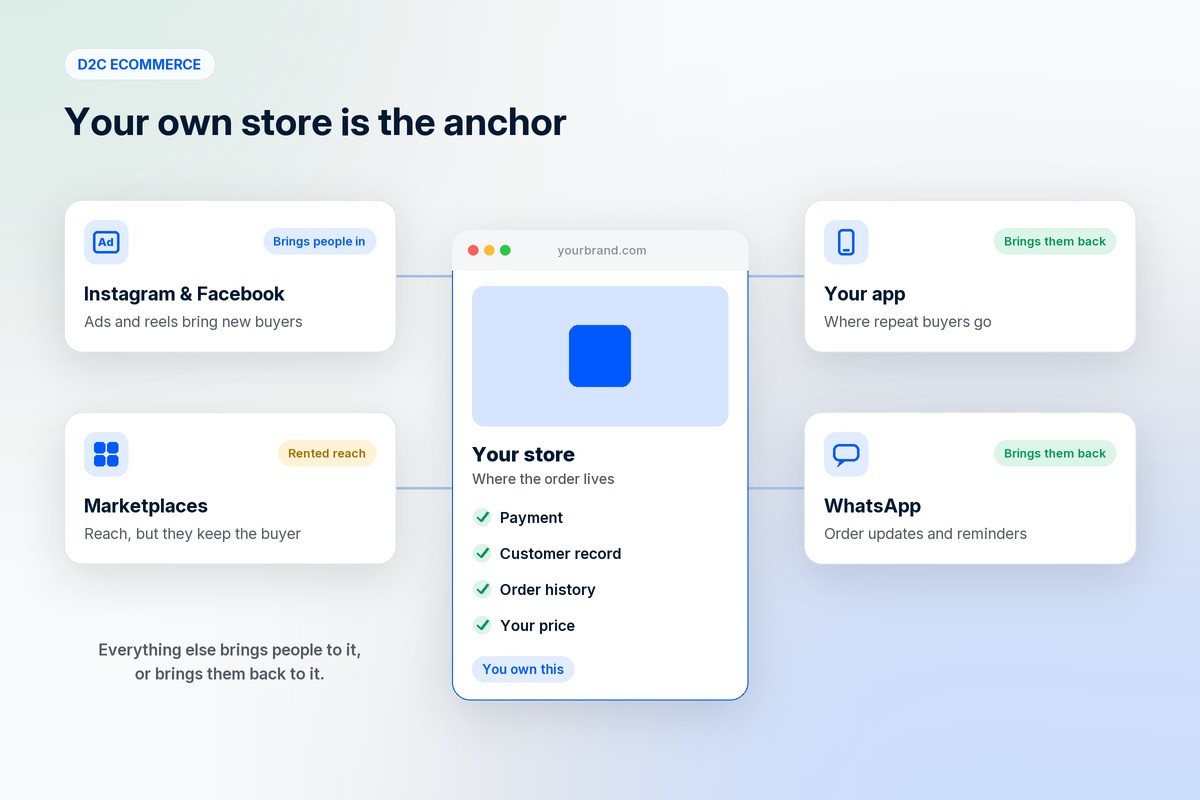
Your own website, where the order, the payment and the customer record live.
An ecommerce mobile app, which starts to matter once people buy from you more than twice, because an icon on a home screen is a shortcut a website never gets.
Instagram and Facebook, where new buyers find you, usually through paid ads and reels. We collected seven tactics in D2C social media marketing.
WhatsApp, for order updates, cart reminders and answering questions before someone buys. We wrote about WhatsApp for ecommerce brands in detail.
Marketplaces, used deliberately for reach, with your own store as the place you want repeat buyers to end up. We wrote about the risks of selling only on marketplaces separately.
The website is the anchor. Everything else either brings people to it or brings them back to it.
Why brands go direct
You keep more of each sale
The margin a distributor and a retailer would have taken stays with the brand. Not all of it turns into profit, as the next section explains, but it gives you room to spend on better product and packaging.
You own the customer
Every order gives you contact details and a purchase history. That is what lets you send a restock reminder to the right person, launch a new flavour to the people who bought the old one, and see whether a customer comes back.
You control the brand
Your photographs, your price, your packaging, your return policy. Nobody puts your product next to a cheaper copy on the same shelf. We wrote about why that matters in why branding is important, and ecommerce branding is most of what a D2C brand is actually selling.
You learn faster
Reviews and support chats come straight to you. A sizing problem shows up in a week instead of a season.
The challenges of D2C
Going direct moves every job the retailer used to do onto your desk. That is the part that catches founders out.
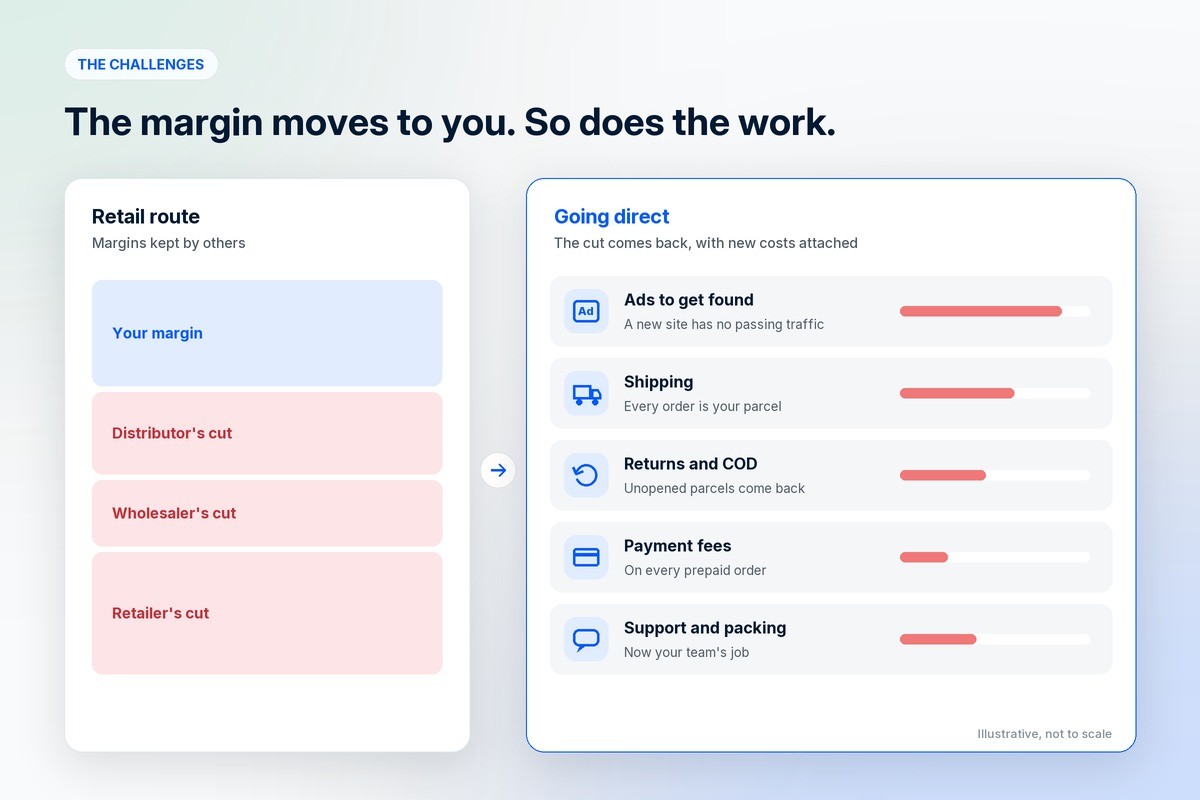
Getting found costs money
A shop gives you passing traffic. A new website gives you none. Most D2C brands pay for attention through online advertising on Meta and Google, and those costs climb as a category gets crowded. A brand whose only growth lever is ads is renting its customers one click at a time. Our guide to setting up Meta ads for D2C brands starts with tracking for exactly this reason.
Shipping, returns and cash on delivery
Every order is now your parcel. Courier rates, failed deliveries and returns come out of your margin. Where buyers prefer to pay at the door, cash on delivery adds another layer: some parcels come back unopened, and the money for the rest sits with the courier for days.
Trust starts at zero
A shopper who has never heard of you is sending money to a website on a promise. Reviews, clear delivery dates, a support number that answers and consistent branding do the work that a familiar shop front used to do.
The operations load
Customer support, packing, stock, payments, invoices and refunds all become your job. Small teams feel it first, usually when orders pick up and the spreadsheet stops being enough.
Going direct alone rarely lasts
Some of the best-known D2C brands ended up back in shops. Dollar Shave Club built its business on online razor subscriptions and was bought by Unilever for $1 billion in 2016. By the time Unilever sold a majority stake in 2023, the brand had also signed deals with Walmart and Target. Nike cut many of its wholesale partners from 2017 to push its own stores and website, then went back to retailers such as Macy’s and DSW.
The lesson is balance. Your own channel is where the margin and the relationship live. Other channels can feed it.
What D2C means for your business
Going direct changes what kind of company you are. A manufacturer that sold to distributors now also runs a shop, a marketing team, a customer service desk and a small logistics operation. That is the real cost of D2C, and it is why the brands that do well run their store, apps and marketing as one system instead of a pile of separate tools.
It also changes what you measure. A wholesale business watches volume per distributor. A D2C business watches what it costs to win a customer, how many come back, and what a customer is worth over a year. A first order that loses money can still be a good order if the second and third follow.
Is D2C right for your product?
Direct selling suits some products far better than others. It tends to work when:
People buy it again, so the cost of winning a customer is spread over several orders.
The margin leaves room for shipping, payment fees and ads.
There is a story or a difference worth explaining, which a crowded shelf never gives you space for.
The product survives a courier box.
It is harder for cheap, heavy or fragile goods, and for categories where buyers want to touch the product before they pay. Brands in those categories often start with a few hero products online and keep retail for the rest.
How to start a D2C brand
If you want to start an e commerce business as a D2C brand, the order you do things in matters more than the platform you pick.
Pick a narrow first range: two or three products you can make well, photograph well and ship reliably.
Choose a name you can live with for years, and check the domain first. Our guide to choosing a brand name covers how.
Build your own online store with payments, delivery tracking and a clear returns policy before you spend anything on traffic.
Put tracking in place, then start with one or two ad campaigns alongside regular posts and reels.
Add WhatsApp for order updates and cart reminders, and an app once repeat buyers make up a real share of your orders.
Watch repeat purchase from the first month. It says more about the health of a D2C brand than any single month of sales.
How 1D2C helps D2C brands
1D2C builds a brand’s own website and buyer app, plus seller and delivery apps for running the operation behind them, so the store, the orders and the deliveries live in one place. Marketing and WhatsApp plans add a team that runs your posts, reels, ads and WhatsApp campaigns. No commission is taken on any order, on any plan. Plans and prices are on the pricing page.
Frequently asked questions
What is D2C in simple terms?
A brand selling its own products straight to the people who use them, through its own website, app or social channels, without a distributor or retailer in between.
Why do brands sell direct to consumers?
To keep the margin a distributor and a retailer would take, to own the relationship with their customers, to control their price and presentation, and to hear feedback in days instead of seasons.
What is the difference between D2C and B2C?
B2C describes the buyer: a business selling to the public. D2C describes the seller: the brand that makes the product, selling it itself. A supermarket is B2C but not D2C. A skincare brand selling on its own website is both.
What is D2C ecommerce?
Selling direct to consumers online, through a brand-owned ecommerce store, app, social media and messaging, with the brand handling payment and delivery itself.
What are some examples of D2C brands?
Dollar Shave Club, which started by selling razor subscriptions online, is one of the best known. Many skincare, clothing, food and footwear brands now sell direct through their own websites and apps alongside retail.
What are the biggest challenges for D2C brands?
The cost of winning customers, shipping and returns, building trust as an unknown brand, and the extra work of running sales and delivery yourself.
Can a D2C brand also sell on marketplaces?
Yes, and many do for reach. The usual approach is to use marketplaces for discovery and keep your own store as the place where repeat customers buy and where you hold their details.
How do I start a D2C brand?
Start with a narrow range you can make, photograph and ship reliably. Choose a name and check the domain, build your own online store with payments, delivery tracking and a clear returns policy, then add ads, WhatsApp and an app as orders grow.
Who is D2C a good fit for?
Brands whose products people buy again, whose margins leave room for shipping, payment fees and ads, and that have a story worth telling. Cheap, heavy or fragile goods are harder to sell direct.
When should a brand start selling direct?
As soon as it can ship reliably. A brand that collects its own customers from the first year has a list to sell to later. One that waits until marketplace fees start to hurt begins from zero.
Where do D2C brands sell?
On their own website and app first, then through Instagram, Facebook and WhatsApp, and often on marketplaces for reach. What keeps it D2C is that the brand owns the sale and the customer.
Where to go from here
If you are earlier in the journey, start with what ecommerce is. For paid growth, our guide to Meta ads for D2C brands covers the tracking to set up before you spend. And if you want the store, the apps and the marketing built as one thing, plans are on the pricing page.