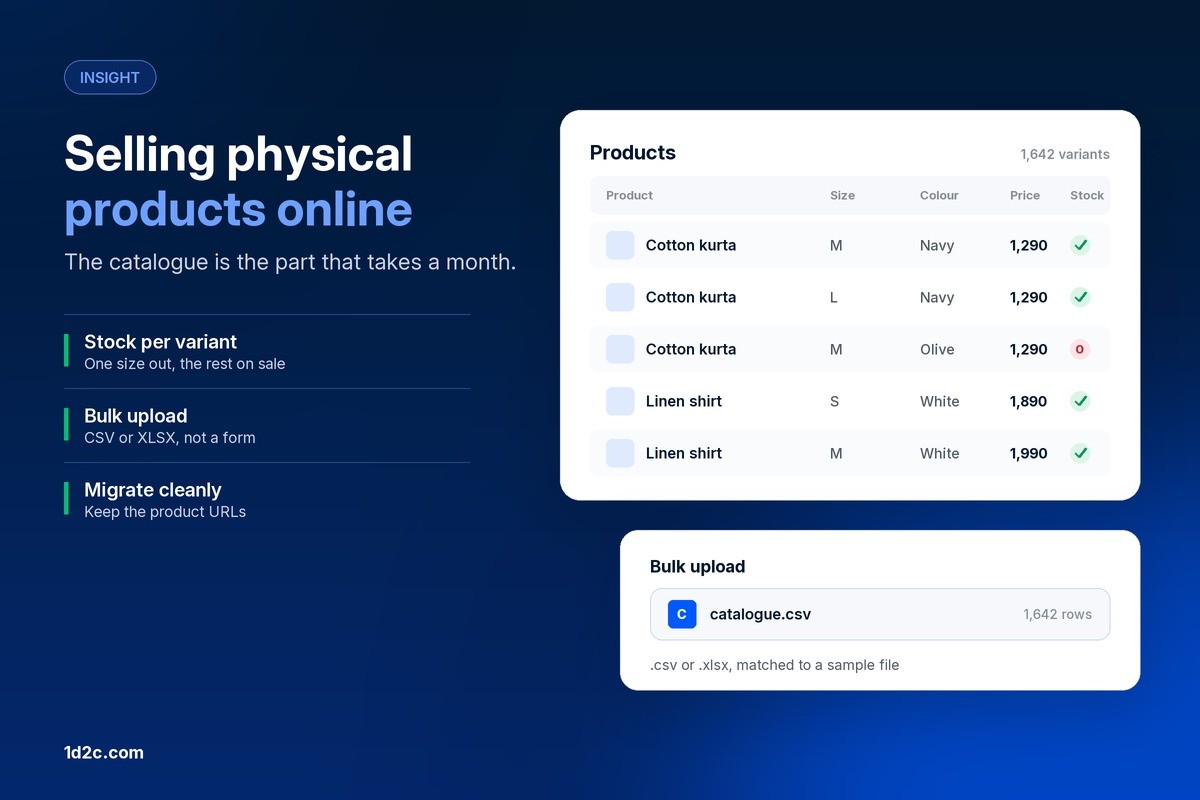


Social media, marketplaces and chat apps all belong to someone else, and they can change the rules overnight. Your online store is the one sales channel you own outright.
A woman who makes soy candles in Leeds ran her whole business from Instagram for two years. Orders came in by DM. She replied between pours, sent bank details by hand, and kept a notebook of who had paid. Then one December her account was locked for a week. Her busiest week. There was nowhere else for buyers to go, so they went somewhere else.
An online store is a website (and often an app) where customers can browse your products, pay and track their order without needing you to be awake. It is the one sales channel you own outright. Social media, marketplaces and chat apps are useful, but they all belong to someone else, and they can change the rules on you overnight.
This post covers why an online store matters for almost any ecommerce business, and the six pitfalls we see most often when people build online store setups for the first time.
Why an online store is important
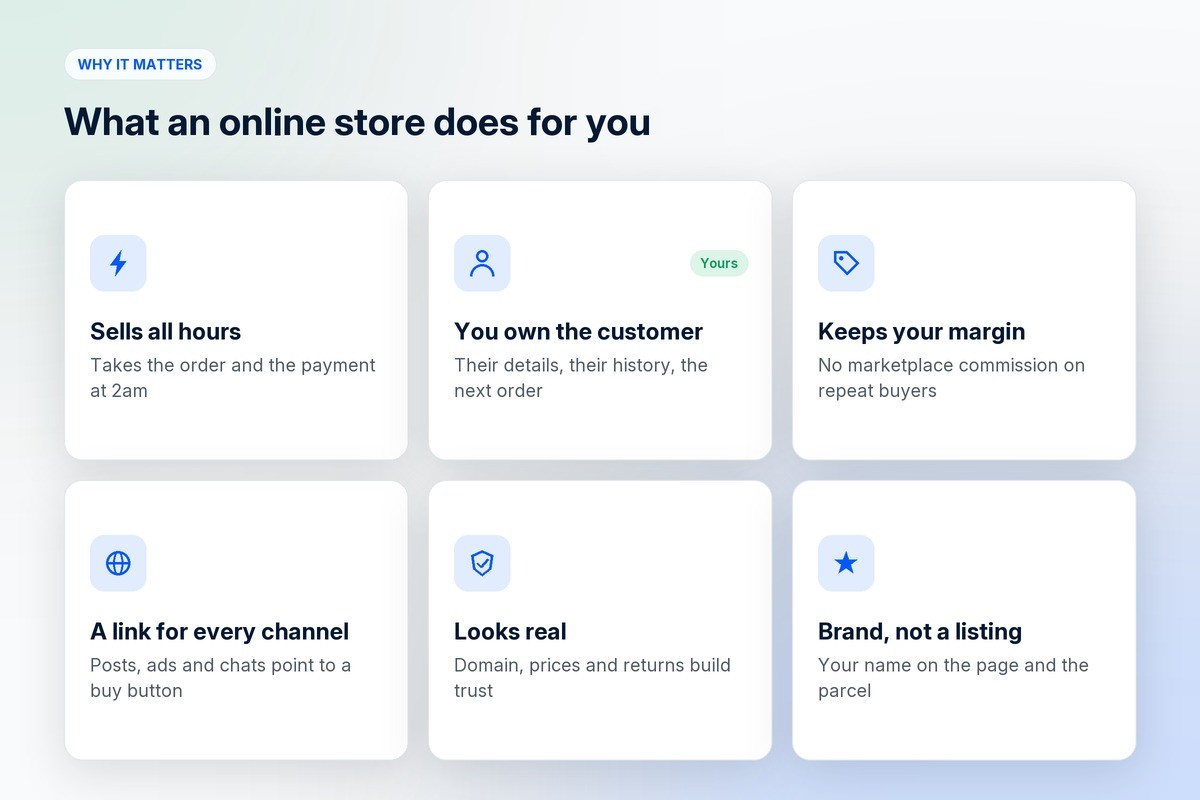
It sells while you sleep
A shop with a door closes at night. A store run from DMs closes whenever you put the phone down. An e commerce online store takes the order at 2am, collects the payment and sends the confirmation, and you see it with your morning coffee. Most small sellers do not realise how many orders they were losing to “I’ll message them tomorrow” until checkout runs on its own.
You own the customer
When someone buys from you on a marketplace, the marketplace keeps the buyer. You often get a name and a delivery address, and that is it. On your own ecommerce store you get their email or phone number, their order history and, with permission, the right to message them again. The second order is where small brands make their money, and you cannot ask for a second order from someone you cannot reach.
Your margin stays yours
Marketplaces charge a commission on every sale, and many charge again to rank you above the seller next to you. That is a fair price for traffic you could not get yourself. It is a poor price for a customer who already knows your name and would have found you anyway.
Every other channel needs somewhere to point
Instagram posts, Meta ads, Google search, a WhatsApp broadcast, the card in the parcel: each one needs a link. If that link goes to a DM inbox, you are asking the buyer to wait for you. If it goes to a product page with a buy button, they can finish the job in under a minute. Your store is what turns attention into orders, which is why we treat it as the base of digital marketing rather than a separate project.
It makes you look real
A buyer who has never heard of you is deciding, in a few seconds, whether you will take their money and disappear. A proper domain, clear prices, a returns page and a working checkout answer that question before they ask it. We wrote more about this in why branding is important.
6 pitfalls to avoid when you build your own online store
None of these are technical failures. The store loads, the payment gateway works, the products are listed. They are decisions that look small on launch day and cost orders every week after.
1. Launching and waiting for traffic
This is the most common one by a distance. A new store has no search history, no backlinks and no audience. Google does not know it exists yet. Launching it is like opening a shop on a street with no signs and no footpath.
Plan where the first few hundred visitors will come from before you launch. For most brands that means people who already know you (customers, followers, your WhatsApp contacts), a small paid budget, and content that answers the questions your buyers type into Google. Search traffic compounds, but it takes months, so start it early and do not rely on it alone.
2. Designing for a laptop when buyers shop on phones
Most people building a store look at it on a laptop. Most people buying from it are on a phone, often on a slow connection, scrolling with one thumb. The large hero image that looks beautiful on a 27-inch screen takes four seconds to load on a bus.
Check every page on a mid-range phone before launch. Can you read the price without zooming? Is the add-to-cart button reachable with a thumb? Do the photos load before the buyer gives up? If you sell to repeat customers, a proper mobile app is worth a look too. It sits on their home screen, which is a better place to be than a browser tab they closed last week.
3. Surprises at checkout
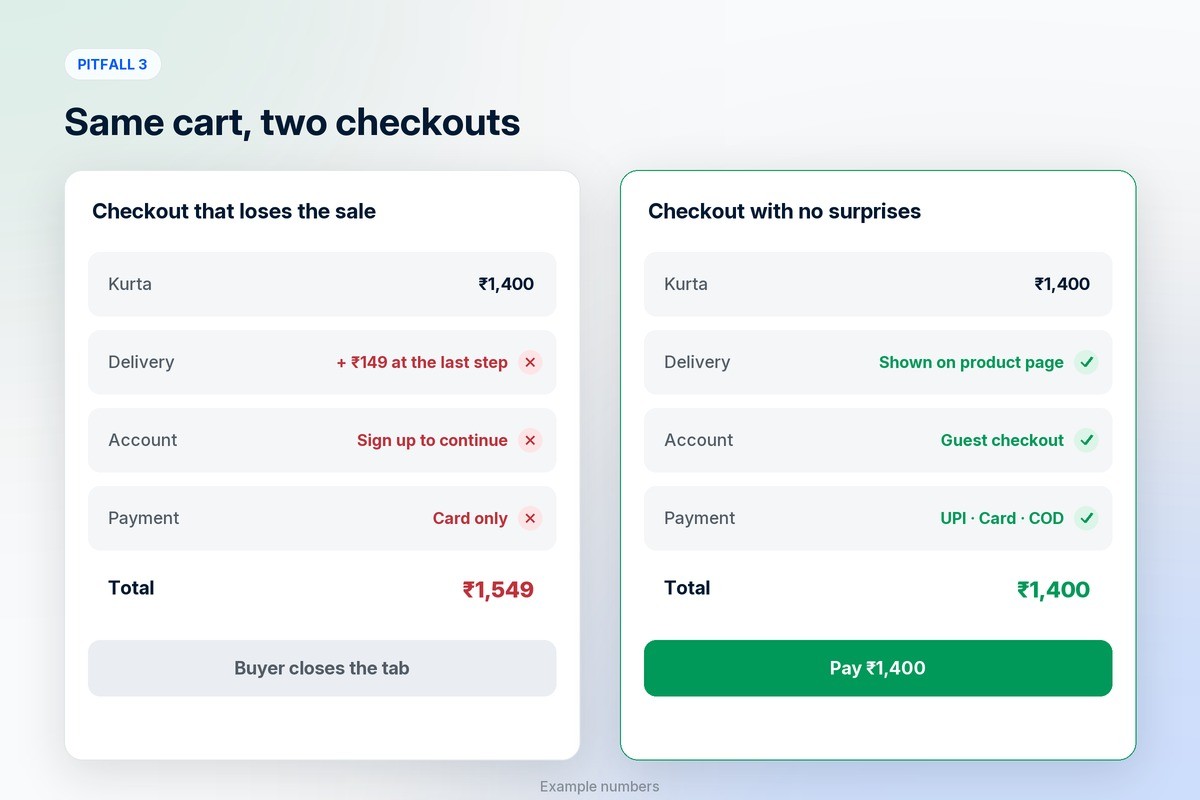
A buyer adds a ₹1,400 kurta to the cart, reaches the last step and sees a delivery fee nobody mentioned. Or a tax line appears out of nowhere. Or they are forced to create an account before they can pay. Each of these is a reason to close the tab, and many of them do.
Show delivery charges and delivery dates on the product page. Let people check out as guests. Offer the payment methods your buyers actually use, which differ a lot by country: cards and wallets in one market, UPI and cash on delivery in India, bank transfers in parts of Europe. The total at the end should match what the buyer expected when they started.
4. Product pages that do not answer questions
In a shop, the buyer can pick the thing up, turn it over and ask you about it. Online, the product page has to do all of that. Two photos and a line of copy pasted from the supplier will not.
Write down the questions customers ask you in person or on chat, and answer them on the page. Size and fit, material, what is in the box, how long delivery takes to their city, and what happens if it is wrong. Show the product from several angles and in use. One honest photo of a kurta on a real person sells more than three studio shots on white.
5. Not tracking where orders come from
Plenty of stores spend on ads for months without knowing which ad produced which sale. The Meta dashboard says one thing, Google says another, and the bank account says something else. Without tracking, you end up cutting the campaign that was working and doubling the one that was not.
Set up analytics, the Meta pixel and Conversions API, and Google’s tag before you spend money on ads, not after. Make sure a purchase is recorded once, with the right value. Our guide on setting up Meta ads for D2C brands walks through the tracking that has to come first.
6. Forgetting the customer after the sale
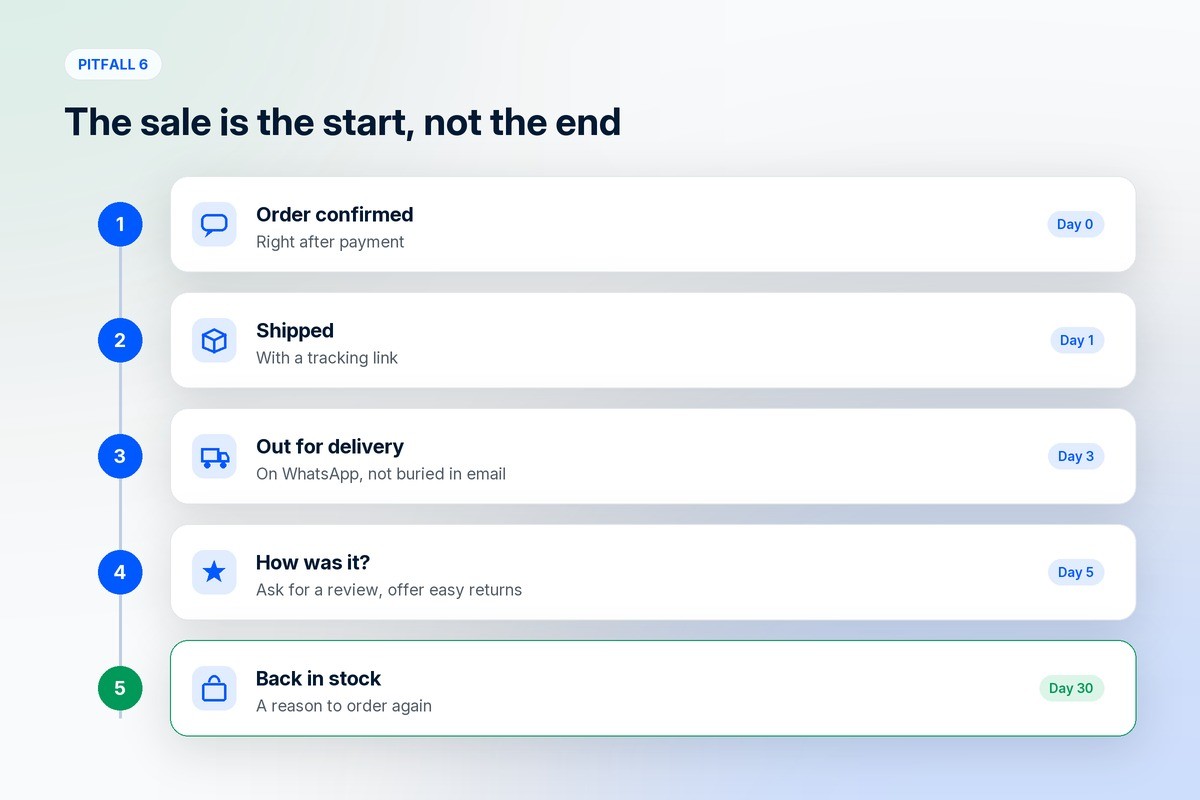
The order is placed, the parcel ships, and the store goes quiet. No update when it is out for delivery. No easy way to start a return. No message a month later when the buyer might want another one. That buyer was the most expensive thing you paid for, and you let them go.
Send order updates on the channel people read. In many countries that is WhatsApp rather than email. Make returns simple enough that people trust you with the first order. Then give them a reason to come back: a restock, a new range, a thank-you discount on the second order. A store that remembers its customers is cheaper to run than one that keeps paying to find new ones.
Online store builder or a full platform?
An online store builder or ecommerce website builder gets you a website quickly, and for a small catalogue that may be all you need. The trouble starts when you grow. You add an app for reviews, another for WhatsApp, another for delivery partners, another for a mobile app, and each one sends its own monthly bill and keeps its own copy of your customers.
The other route is a platform that comes with the website, the apps and the marketing tools together. That is what we built 1D2C to be: your own branded website plus buyer, seller and delivery apps, with no commission on orders, and a team that can run your Meta and Google campaigns if you would rather not. We compared the two approaches honestly in 1D2C vs Shopify. Whichever you pick, the six pitfalls above still apply. Software will not fix a checkout that hides the delivery fee.
Frequently asked questions
What is an online store?
A website or app where your business sells directly to buyers, with its own product pages, checkout and order records. It belongs to you, unlike a marketplace listing or a social media shop.
Why is an online store important for a business?
It is the one channel where you set the price, keep the customer’s details and decide how your brand looks. Social media and marketplaces bring people to you. Your own store is where they come back to buy again.
Do I need an online store if I already sell on Instagram?
Yes, if you want to keep selling when Instagram changes its algorithm or locks your account. Instagram is good for being found. An online store is where buyers can pay without waiting for your reply, and where you keep their details for the next order.
How much does it cost to build an online store?
It ranges from a small monthly fee for a basic store builder to a large one-off cost for custom development. On 1D2C, India pricing starts at ₹1,199 a month for a single-vendor store, with no commission on orders. Prices differ by country, so check the pricing page for yours.
Should I sell on a marketplace or on my own ecommerce store?
Many brands do both. A marketplace brings buyers who have never heard of you, at the cost of commission and of not owning the customer. Your own store is where repeat buyers should end up. Use the marketplace for discovery and give marketplace buyers a reason to order direct next time.
How long does it take to start an e commerce business online?
The store itself can be live in days. Getting the first steady stream of orders usually takes a few months, because traffic, reviews and repeat buyers take time to build. Plan your marketing for the months after launch, not only the launch itself.
What is the biggest mistake new online stores make?
Expecting buyers to turn up on their own. A new store has no traffic. Decide where your first visitors will come from before you launch, and track which source produces orders so you know where to spend next.
Who needs an online store?
Any business that wants repeat customers: brands selling on Instagram or WhatsApp, sellers who rely on marketplaces, and local shops that deliver nearby.
How do I build my own online store?
Choose a platform, add your catalogue with clear photos and prices, set up payments and delivery, write an honest returns policy, then install tracking before you spend on traffic.
Where to start
If you are still working out what kind of ecommerce business you want to run, start with our explainer on what ecommerce is and how it works. If you are ready to build, write the six pitfalls on a sticky note and check your store against them before you spend anything on ads. And if you would like a store, apps and marketing in one place, the 1D2C plans are sized from a single shop to a marketplace with thousands of sellers. If the next question is whether you also need an app, see ecommerce mobile app builders. If your products are physical, the catalogue work is covered in how to sell physical products online.