


Website sales are four numbers multiplied together. Most brands only ever work on one of them, usually by buying more traffic.
To increase website sales, work on four numbers: how many of the right people visit, what share of them buy (your conversion rate), how much each order is worth (your average order value), and how often buyers come back. Sales are those four multiplied together, so a small gain in each adds up to a large gain overall.
Most brands that want to improve the sales of their website do one thing: spend more on ads. That raises only the first number, and it gets more expensive every month. This guide covers 15 ways to increase website sales across all four, starting with how to find which one is holding you back.
The four numbers behind your website sales
Every sale on your website comes from the same simple sum:
Visitors: people who arrive on your website, ideally ones who might buy what you sell.
Conversion rate: the share of those visitors who place an order.
Average order value: how much each order is worth.
Repeat orders: how many times a buyer comes back in a year.
Because the numbers multiply, improving each by a modest amount grows sales more than doubling any single one. It is also cheaper. Getting a visitor who already came to buy is far easier than paying for a new one.

Find which number is holding your website sales back
Before you change anything, look at your analytics and your order data for the last three months.
Few visitors and a decent conversion rate: you have a traffic problem. Start with the first group of ideas below.
Plenty of visitors, few orders: you have a conversion problem. The product page, delivery information and checkout are the usual causes.
Steady orders but small baskets: work on order value with bundles and a free delivery threshold.
Lots of first orders and few second ones: work on repeat orders. This is often the cheapest sales you will ever get.
Bring in visitors who are ready to buy
1. Write product pages in the words buyers search
Name products the way people search for them, such as “linen kurta for women” rather than “Aria 02”, and use the same words in the page title, description and image alt text. Search traffic arrives with intent and costs nothing per click.
2. Send ad clicks to a product page, not your home page
Someone who taps an ad for a specific product should land on that product, with the price and a buy button in view. Sending them to the home page makes them search again, and many will not. Our guide to setting up Meta ads for D2C brands covers the tracking to set up first.
3. Post content that links to products
Social posts, reels and stories that show a product in use and link straight to it turn followers into visitors who already like what they saw. See D2C social media marketing for the tactics that sell.
4. Message the people who already know you
Past buyers and subscribers on WhatsApp and email are the warmest traffic you have. A new arrival, a restock or a short offer sent to them will usually convert better than any cold audience.
Turn more of your visitors into buyers
Conversion is where most websites lose the most sales. Our post on where buyers drop off in the D2C user journey goes through each stage in detail. These five fixes matter most.
5. Make every page fast on a phone
For most online stores, the majority of visitors arrive on a phone, often on a mobile network. Compress images, cut heavy pop-ups and test your store on an ordinary phone, not your office laptop.
6. Make the product page answer every question
Clear photos from several angles and one in use, the price, sizes with a size guide, what it is made of, the delivery date and the returns policy, all on the page. Every question a buyer has to ask on WhatsApp is a chance for them to leave.
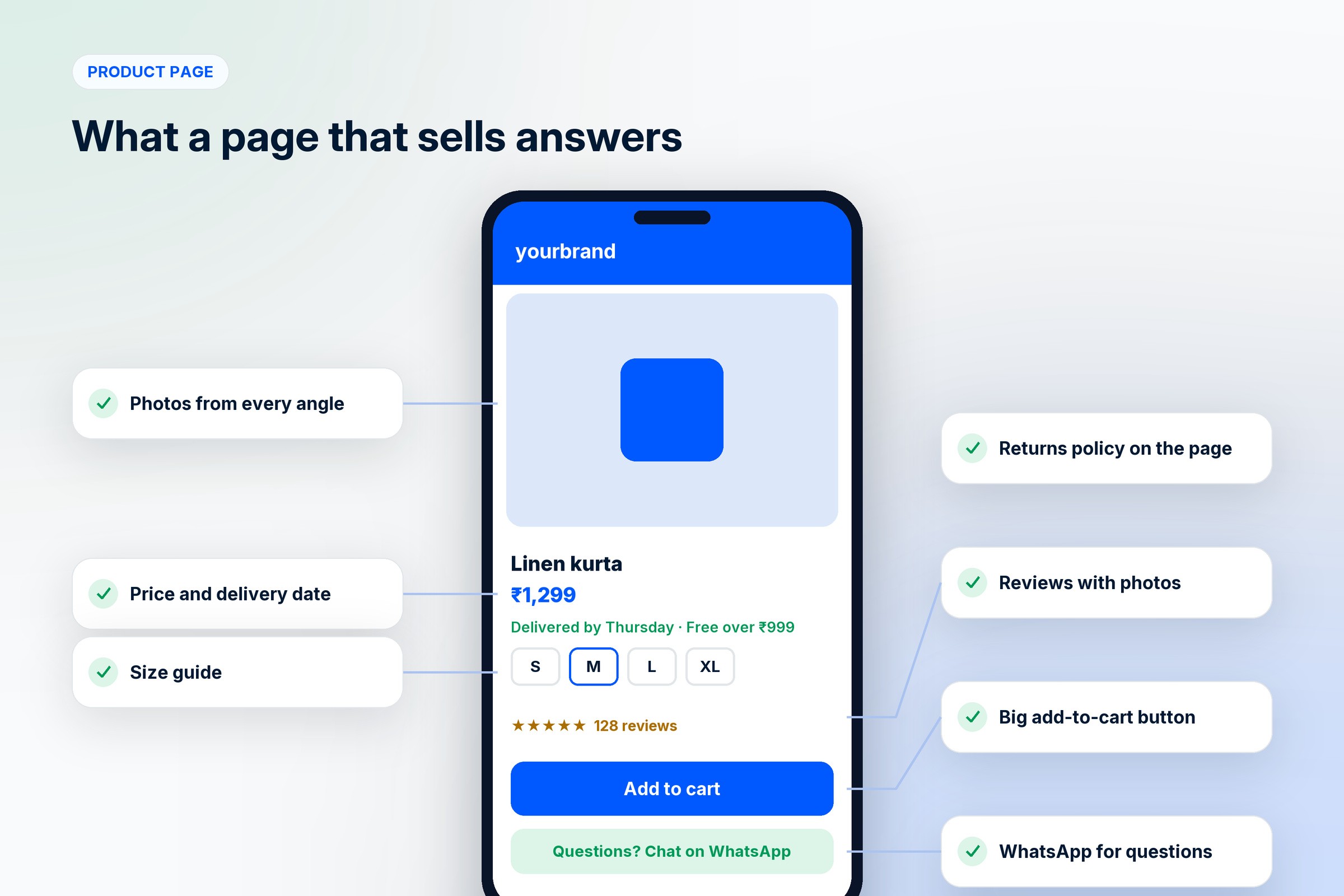
7. Show delivery cost and date early
Extra costs such as shipping, tax and fees are the most common reason shoppers give for abandoning a cart at checkout, according to Baymard Institute’s research. Show the delivery charge on the product page or in a banner, and say when the order will arrive.
8. Keep checkout short and offer the payments people use
Let people check out without creating an account, ask only for what you need, and offer the payment methods your buyers expect, such as UPI, cards and cash on delivery in India.
9. Show that you are real
Reviews with photos, a phone number or WhatsApp button, clear policies and an About page with real people. A new buyer is deciding whether to trust you with their money, and these are what they check. Our post on why branding is important covers the trust gap in more depth.
Raise the value of each order
10. Offer bundles
Group products that go together, such as a skincare routine, a set of three kurtas or a coffee and grinder kit, at a price below buying them separately. Bundles lift the order value and move slower items alongside best sellers.
11. Set a free delivery threshold
Offer free delivery above an amount a little higher than your current average order. Many buyers will add one more item to reach it, and the extra margin covers the delivery.
12. Suggest the next item at the right moment
When someone adds a product to the cart, suggest one thing that completes it: a dupatta with the kurta, a refill with the starter kit. One relevant suggestion works better than a carousel of twenty.
Bring buyers back for more
13. Follow up on abandoned carts
A reminder with the product and a link back to the cart recovers some of the buyers who left at checkout. In markets such as India, where buyers already spend their day on WhatsApp, a reminder there is hard to miss. See WhatsApp integration for ecommerce for how they work.
14. Give repeat buyers an app
A branded shopping app puts your store on the buyer’s home screen, keeps their details saved and lets you send push notifications about restocks and offers. It turns the second and third order into a few taps.
15. Remind people before they run out
For products people use up, such as coffee, skincare or pet food, send a reorder reminder when the last order is likely to be finishing, and make reordering one tap.

Track your website sales numbers every week
Pick a day each week and write down the same numbers, so you can see which change moved sales.
Visitors, and where they came from.
Conversion rate: orders divided by visitors.
Average order value: revenue divided by orders.
Cart abandonment: carts started but not completed.
Repeat buyers: the share of orders from people who bought before.
Change one thing at a time where you can, and give it at least two weeks before you judge it.
Mistakes that hold website sales back
Buying more traffic for a website that does not convert. Fix the leak before you pour more in.
Discounting everything to lift sales. It trains buyers to wait for the next sale and cuts your margin.
Judging the website on a laptop when most buyers use a phone.
Ignoring buyers after the first order, then paying again to win them back.
Changing five things at once, so you never learn which one worked.
How 1D2C helps you increase website sales
1D2C runs your website and your own Android and iOS apps on one system, so buyers can move between them with the same cart, account and order history. WhatsApp plans add order updates, cart reminders and campaigns to past buyers, and the app lets you send push notifications. You can set sale prices per variant, change your store design in EditCanvas and run your own delivery. There is no commission on any order, on any plan. Plans are on the pricing page.
Frequently asked questions
What is a website conversion rate?
The share of visitors who place an order. If 1,000 people visit your store and 20 buy, your conversion rate is 2%.
Why is my website not getting sales?
Usually one of four things: too few of the right visitors, a product page or checkout that loses them, small baskets, or buyers who never come back. Look at your visitors, conversion rate, order value and repeat orders to find which.
How can I increase sales on my website quickly?
Message past buyers on WhatsApp or email, show delivery costs and dates on the product page, follow up on abandoned carts and add a free delivery threshold. These work on visitors you already have, so they show results faster than new traffic.
How do I increase the average order value?
Offer bundles, set a free delivery threshold slightly above your current average order, and suggest one item that completes the product a buyer has just added to the cart.
Who should work on improving website sales?
In a small brand, the founder or whoever owns the store and the marketing, because traffic, the product page and follow-up messages all affect the same sale.
When will changes to my website show in sales?
Fixes to delivery information, checkout and follow-ups can show within a few weeks. Search traffic and repeat-buyer habits take longer, often a few months.
Where do most website sales come from?
For most small brands, from returning buyers and people who already follow the brand on social media or WhatsApp, followed by search and paid ads. That is why bringing buyers back matters as much as finding new ones.
Does a mobile app increase online sales?
For brands with repeat buyers, it can. An app keeps your store on the buyer’s home screen, saves their details and lets you send push notifications, which makes the next order easier.
Where to go from here
To see exactly where your buyers leave, read the D2C user journey: where buyers drop off. To make sure you are marketing to the right people, see how to create a user persona. And for the basics of selling online, read how to sell online.


