


The big apps sell a bit of everything in ten minutes. A local quick commerce business wins by selling one thing better, fresher or closer than they can.
Quick commerce, also called q-commerce, is ecommerce built around delivery in minutes instead of days: orders are packed at a nearby store or dark store and delivered by riders within a few kilometres, usually in 10 to 30 minutes. The best quick commerce business ideas in India are products people buy often, need urgently and want from someone close by.
Blinkit, Zepto and Swiggy Instamart have made ten-minute delivery normal in India’s big cities. They stock a bit of everything, which leaves room for local businesses that do one category better: fresher produce, a butcher people trust, a pharmacy that answers at midnight, a bakery that delivers a cake within the hour. This guide covers 12 of the most promising quick commerce business ideas, how to judge them and what the numbers on each order need to look like. If you are new to the model, start with what quick commerce is and how it works.
Why quick commerce in India is open to small businesses
Buyers have learnt to expect fast delivery, so a local shop that offers it no longer looks unusual.
Big apps compete on range. A specialist can compete on freshness, quality, advice and trust in one category.
Many tier-2 and tier-3 neighbourhoods have the demand but fewer dark stores, so a local business can get there first.
Local shops already have stock, space and regular customers, which are the hardest parts of a quick commerce business to build from scratch.
How to judge a quick commerce business idea
Every idea in this list passes five tests. Run your own idea through them before you spend on stock or riders.
Bought often: daily or weekly purchases bring repeat orders without new marketing.
Needed now: the buyer cares about getting it in the next hour more than about the lowest price.
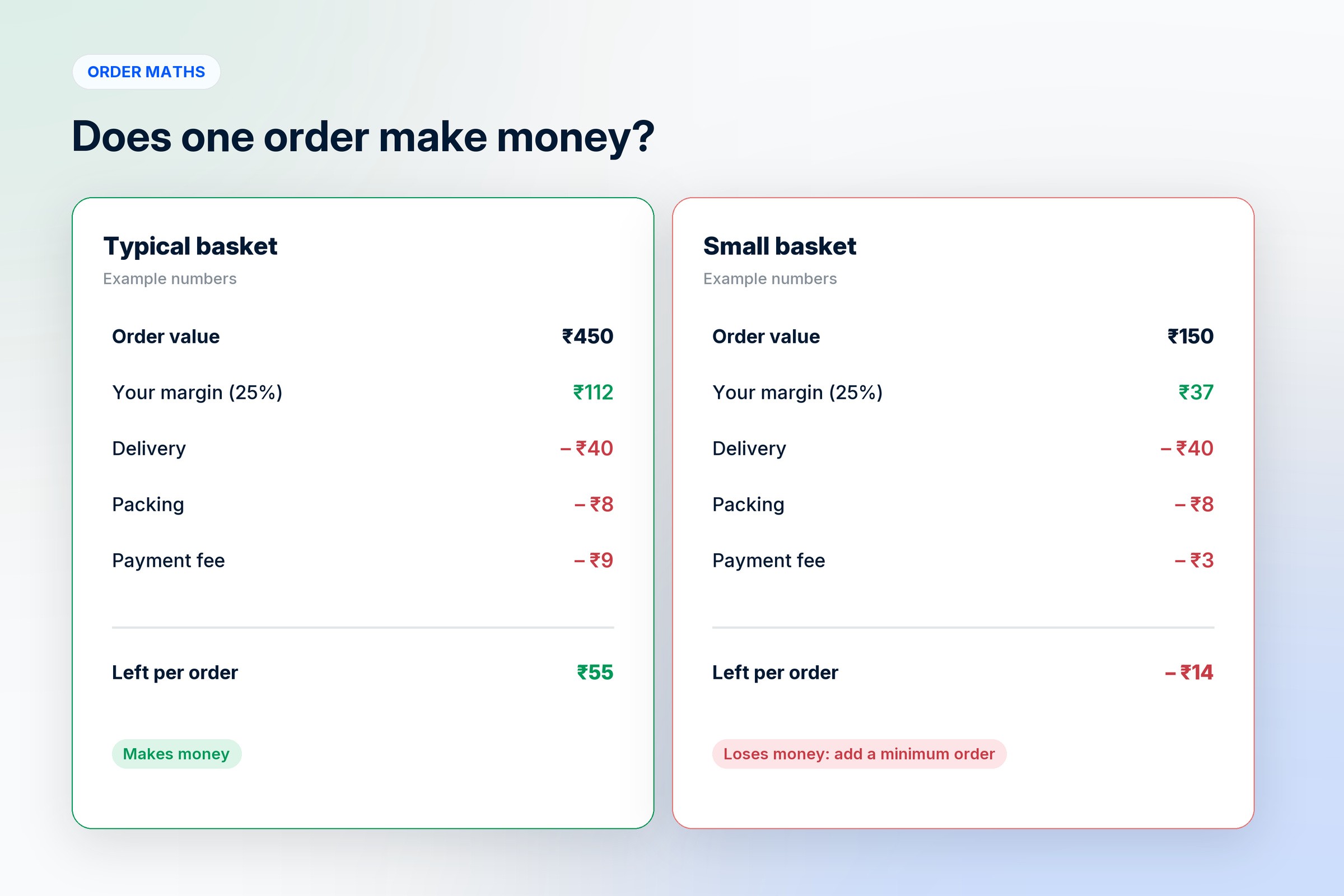
Basket covers delivery: the margin on a typical order is more than the cost of delivering it.
Stockable nearby: you can hold enough of it within a few kilometres of your buyers.
Your edge: you can do it fresher, better or with more trust than a general app.

12 most promising quick commerce business ideas in India
These quick commerce ideas suit local shops, brands and first-time founders. Each one notes what you need and what to watch out for.

1. Neighbourhood grocery and daily essentials
The most natural quick commerce business in India: a kirana or supermarket that already has the stock, the shelf space and the trust of the colony, now taking orders on its own app and delivering in 15 to 30 minutes.
What you need: live stock counts, a delivery area of a few kilometres and one or two riders at peak hours.
Watch out for: small baskets. Set a minimum order or a small delivery fee below a certain amount, so a ₹60 order of bread does not cost more to deliver than it earns.
2. Fresh fruits and vegetables
Produce is bought every day or two, and buyers care about freshness more than about price. A local seller who sources from the mandi each morning can beat a dark store that restocks less often.
What you need: a daily buying routine, cool storage, careful packing and photos that match what arrives.
Watch out for: wastage. Order by demand, sell yesterday’s stock first at a lower price, and keep the range tight.
3. Milk, bread and breakfast essentials
Milk, eggs, bread, curd and paneer are bought almost daily and often first thing in the morning. A business that offers both a fixed morning slot and instant orders through the day gets the habit and the top-ups.
What you need: a cold chain from the dairy or bakery, early riders and a simple way for buyers to pause or change daily orders.
Watch out for: very low order values. Bundle breakfast items and encourage weekly plans rather than single packets.
4. Fresh meat, chicken and fish
Freshly cut meat and fish are hard to do well from a general dark store, and buyers in India are loyal to a butcher they trust. Cutting to order and delivering within the hour is a real advantage.
What you need: FSSAI registration, a hygienic cutting and cold-storage setup, insulated delivery bags and riders who can keep to time.
Watch out for: local rules on licences and waste disposal, and returns if the product arrives warm. Hygiene photos and videos build trust fast.
5. Pharmacy and health essentials
Medicines are the clearest case for quick commerce: when someone has a fever at night, delivery in 20 minutes matters more than any discount. Health essentials such as thermometers, ORS and first-aid kits fill out the basket.
What you need: a drug licence from your state’s drug controller, a registered pharmacist and a way to collect and check prescriptions before dispatch.
Watch out for: regulation. Prescription medicines need a valid prescription, and online sale of drugs is closely watched in India. Check the current rules with a local expert before you launch.
6. Baby care essentials
Parents run out of diapers, wipes and formula at the worst possible moment, and they will pay a little more to get them now. Repeat purchase is high and the brands are well known, so trust in the product is already there.
What you need: stock of the leading sizes and brands, fast delivery in family-heavy neighbourhoods and reminders when it is time to reorder.
Watch out for: expiry dates on formula and baby food, and the range of sizes you have to carry. Start with the fastest movers.
7. Pet food and supplies
Pet owners buy food, litter and treats on a cycle, and running out is not an option. A specialist can carry the brands and sizes a general app does not, and give advice the big apps cannot.
What you need: a focused range for dogs and cats, storage for heavy bags and a way to remember each customer’s brand and pack size.
Watch out for: bulky, heavy orders that are harder to deliver by two-wheeler. Price delivery for weight, not only distance.
8. Cakes, flowers and last-minute gifts
Birthdays, anniversaries and festivals create urgent demand, often late in the evening. A bakery or florist that delivers within the hour wins the customer who just remembered.
What you need: a menu of ready items alongside made-to-order ones, careful packing and riders who can carry cakes upright.
Watch out for: damage in transit and peak days such as Valentine’s Day and Diwali, when orders spike. Cap orders per slot instead of overpromising.
9. Home-cooked meals and tiffins
Office workers, students and families want homestyle food delivered quickly, and a home kitchen or small cloud kitchen can serve a neighbourhood well. Subscriptions for daily tiffins give steady orders.
What you need: FSSAI registration, a consistent menu, packaging that keeps food warm and a fixed delivery radius.
Watch out for: food safety and consistency. One bad meal costs a regular customer. Keep the menu short and the kitchen clean.
10. Puja and festival supplies
Puja samagri, flowers, diyas, rangoli colours and festival decor are needed on specific days, often at short notice. A store that bundles everything for a puja into one kit saves buyers a trip to the market.
What you need: ready-made kits for common pujas and festivals, fresh flowers on festival days and extra riders around Diwali, Ganesh Chaturthi and Navratri.
Watch out for: very seasonal demand. Plan stock by the festival calendar and add everyday items so the business runs all year.
11. Stationery, printing and exam supplies
Students and offices need pens, notebooks, chart paper, printouts and project material urgently, especially the night before a deadline. A stationery shop near colleges and offices can turn that into steady quick commerce orders.
What you need: a range for schools, colleges and offices, a printer that takes uploaded files and delivery to hostels and office parks.
Watch out for: seasonality around exams and the start of the school year, and low order values. Combine printing with supplies to lift the basket.
12. Phone and electronics accessories
A broken charger, a lost cable or dead earphones are small emergencies people want fixed today. Accessories are light, easy to deliver and carry good margins.
What you need: stock of chargers, cables, power banks and earphones for the most common phones, plus a clear returns policy.
Watch out for: counterfeit products. Buy from trusted distributors and say so, because buyers worry about fakes in this category.
What it takes to run a quick commerce business
Whatever you sell, a quick commerce business runs on the same few things.
A small delivery area: a few kilometres around your store or dark store, so riders can keep the time you promise.
Live stock: buyers see only what is actually on the shelf, or orders get cancelled and trust goes with them.
Riders: your own riders, a delivery partner, or both, with orders assigned to whoever is nearest.
Instant and scheduled orders: instant for emergencies, scheduled slots for planned shopping such as morning milk.
Your own app and website: so repeat buyers order from you directly instead of through an app that charges you a commission.
Then check the maths for one typical order before you launch. If the margin on an average basket does not cover delivery, packing and payment fees, more orders only mean bigger losses. A minimum order value or a small delivery fee on small baskets usually fixes it.
Sell on the big apps or run your own quick commerce store?
Brands can list on Blinkit, Zepto or Instamart to reach their buyers, and many do. But those buyers belong to the app, and the app decides your placement and fees. Running your own quick commerce store means you keep the customer, the data and the margin, and you can still list on the big apps as an extra channel.
1D2C gives local businesses their own branded quick commerce website and Android and iOS apps. Buyers see products from the stores nearest to them, can order instantly or book a slot, and orders go to your riders through a delivery app that assigns the nearest available rider. There is no commission on any order. Our guide to the quick commerce website builder walks through setting it up step by step, and plans are on the pricing page.
Frequently asked questions
What is quick commerce?
Quick commerce, or q-commerce, is ecommerce built around delivery in minutes, usually 10 to 30, from a store or dark store a few kilometres from the buyer.
Which quick commerce business is most profitable?
There is no single answer, but ideas where people order often and the typical basket is large enough to cover delivery tend to do best, such as groceries with a minimum order, meat and fish, pharmacy and pet supplies.
Why start a quick commerce business instead of a regular online store?
Because some products are only worth buying online if they arrive now: medicines, milk, fresh meat, a forgotten birthday cake. For those, speed is what the buyer pays for, and a local business is closer to the buyer than anyone else.
How do I start a quick commerce business in India?
Pick a category that passes the five tests in this guide, decide your delivery area, get the licences your category needs, set up riders, and launch your own app and website to the customers you already have before spending on ads.
Who can start a quick commerce business?
Kirana and supermarket owners, pharmacies, bakeries, butchers, florists, home kitchens and D2C brands with local stock. Anyone who can hold stock close to buyers and deliver within a few kilometres can run one.
When does quick commerce make sense for a business?
When enough buyers live within a few kilometres of your stock, when they buy often, and when the typical order is large enough to cover delivery. If orders are rare or the area is spread out, scheduled delivery is usually the better model.
Where does quick commerce work best in India?
In dense neighbourhoods of metros and growing tier-2 cities, near housing societies, colleges and office areas, where many buyers live or work within a short ride of a store.
Do I need a licence to start a quick commerce business in India?
It depends on what you sell. Most businesses need GST registration and a shop and establishment licence, food businesses need FSSAI registration, and pharmacies need a drug licence and a registered pharmacist. Check the rules for your state and category before you launch.
Where to go from here
For more product ideas beyond quick commerce, see our list of ecommerce business ideas. When you are ready to launch, the quick commerce website builder guide covers the features and steps, building quick commerce: 6 things to check first covers what to sort out before launch, and how to sell online covers the basics of payments, delivery and marketing.


