


Online shopping makes it easy for a buyer to try a new store. That also makes it easy for them to leave yours.
A retired teacher in Lisbon bought her first pair of shoes online last winter. Her granddaughter set up the app, saved her card, and showed her where the size guide was. The shoes arrived two days later, fitted, and she has since ordered a kettle, a phone case and a birthday present for the same granddaughter. She still likes the shoe shop on her street. She just does not need to go there every time.
Online shopping is buying products or services over the internet, through a website or app, and paying for them online or on delivery. The shopper browses a digital catalogue, adds items to a cart, checks out, and the order is delivered to their door, sent to a pickup point or, for digital products, downloaded straight away.
This guide explains how online shopping works, why so many people now prefer to shop online, what makes them trust one online store over another, and what all of that means if you sell products yourself.
What is online shopping?
Online shopping is the part of ecommerce that the customer sees. Behind it sit the online store, the payment system, the warehouse and the delivery partner. In front of it is a person on a phone or laptop deciding whether to buy.
People shop online for almost everything now: clothes, groceries, electronics, furniture, medicines, books, tickets, courses and services like a plumber or a salon booking. They do it in a few different places:
A brand’s own website or app, such as an ecommerce store run by the company that makes the product
Marketplaces, where many sellers list products in one place
Social media, through shops on Instagram or Facebook and links in posts
Messaging apps, where buyers order on WhatsApp from a catalogue or a chat
Quick commerce apps that deliver everyday items in minutes
For a wider look at how these channels and business models fit together, see our guide to what ecommerce is.
How does online shopping work?
From the shopper’s side, every online purchase goes through the same few steps, whatever the product.
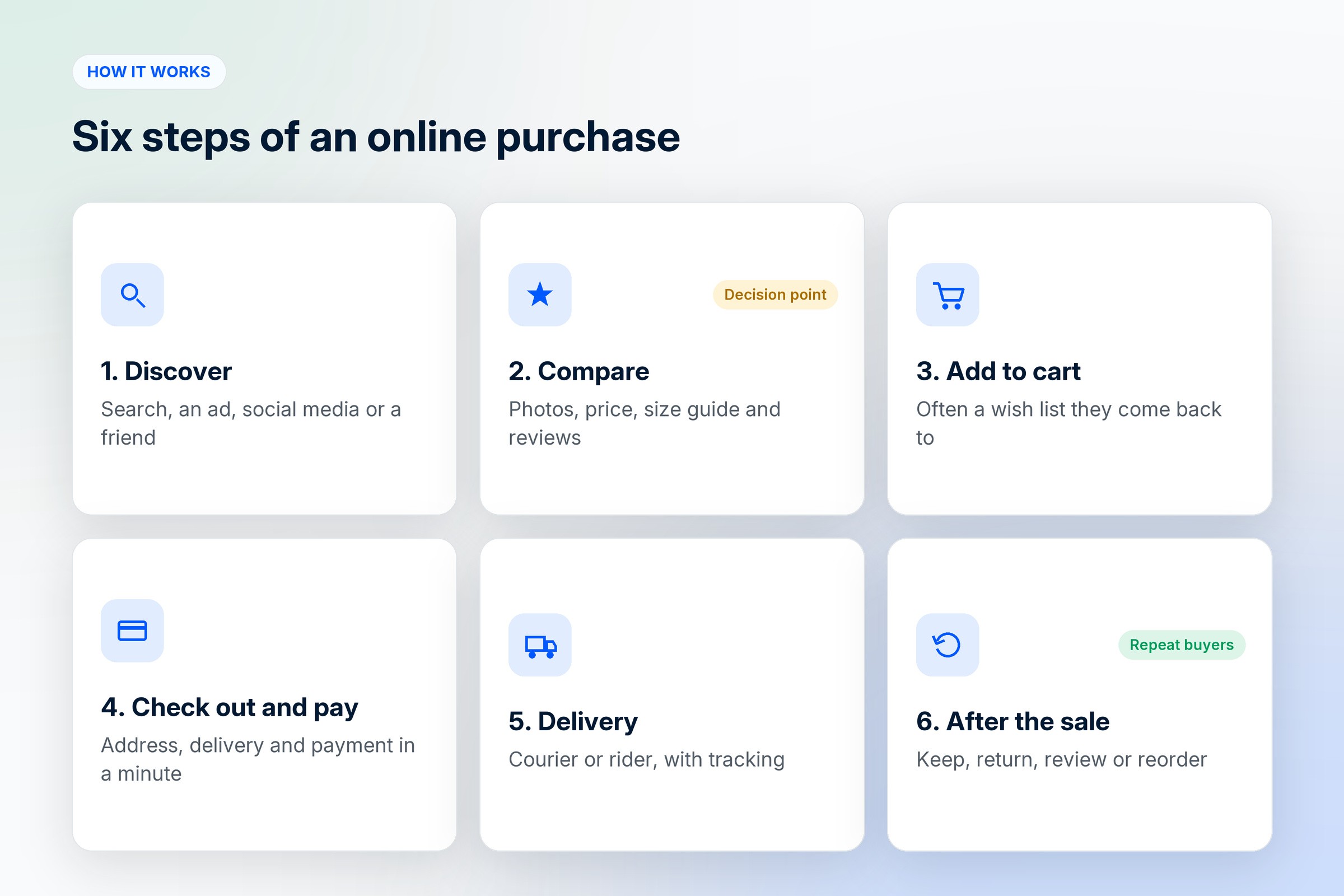
1. Discovery
The shopper finds the product through a Google search, an ad, a social media post, a friend’s recommendation or by browsing a store they already know. Most journeys start on a phone.
2. Comparing and deciding
They look at photos, read the description, check the size guide, scroll to the reviews and compare the price with one or two other online shopping sites. This is where most of the decision is made, and where many shoppers leave.
3. The cart
The product goes into the cart. Many shoppers use the cart as a wish list and come back to it later, which is why stores send reminders by email or WhatsApp.
4. Checkout and payment
The shopper enters an address, picks delivery, and pays by card, wallet, bank transfer, UPI in India or cash on delivery where it is offered. A good checkout takes under a minute. A bad one, with surprise charges or forced sign-up, loses the sale.
5. Delivery
The store packs the order and hands it to a courier or its own delivery rider. The shopper gets a confirmation and a tracking link. Depending on the store, delivery takes anywhere from minutes for quick commerce to a week or more for international orders.
6. After the purchase
The shopper receives the product, decides whether to keep it, and may return it, leave a review or order again. That last step decides whether the store has a customer or only a sale.
Why people shop online
The reasons have not changed much since online shopping began. They have just become easier to act on as phones, payments and delivery improved.
Convenience
An online store is open at midnight, on Sunday and during the monsoon. Shoppers order on the bus, in a queue or in bed, without travelling to a shop or waiting for opening hours.
Choice
A physical shop holds what fits on its shelves. Online, a shopper can see every size and colour, and products from brands that have no shop in their city or even their country.
Comparing is easy
Prices, reviews and specifications for several products sit a few taps apart. Shoppers feel more confident when they can check that the price is fair.
Delivery to the door
Heavy, bulky or awkward things arrive at home. For people who cannot easily get to shops, because of age, health, distance or small children, that matters most of all.
Reviews from other buyers
In a shop you can ask the person behind the counter. Online, you can read what hundreds of other buyers thought, including the ones who were unhappy.
What makes shoppers trust an online store
A shopper who has never heard of a store is deciding in a few seconds whether it will take their money and disappear. These are the things they look for, often without realising it.
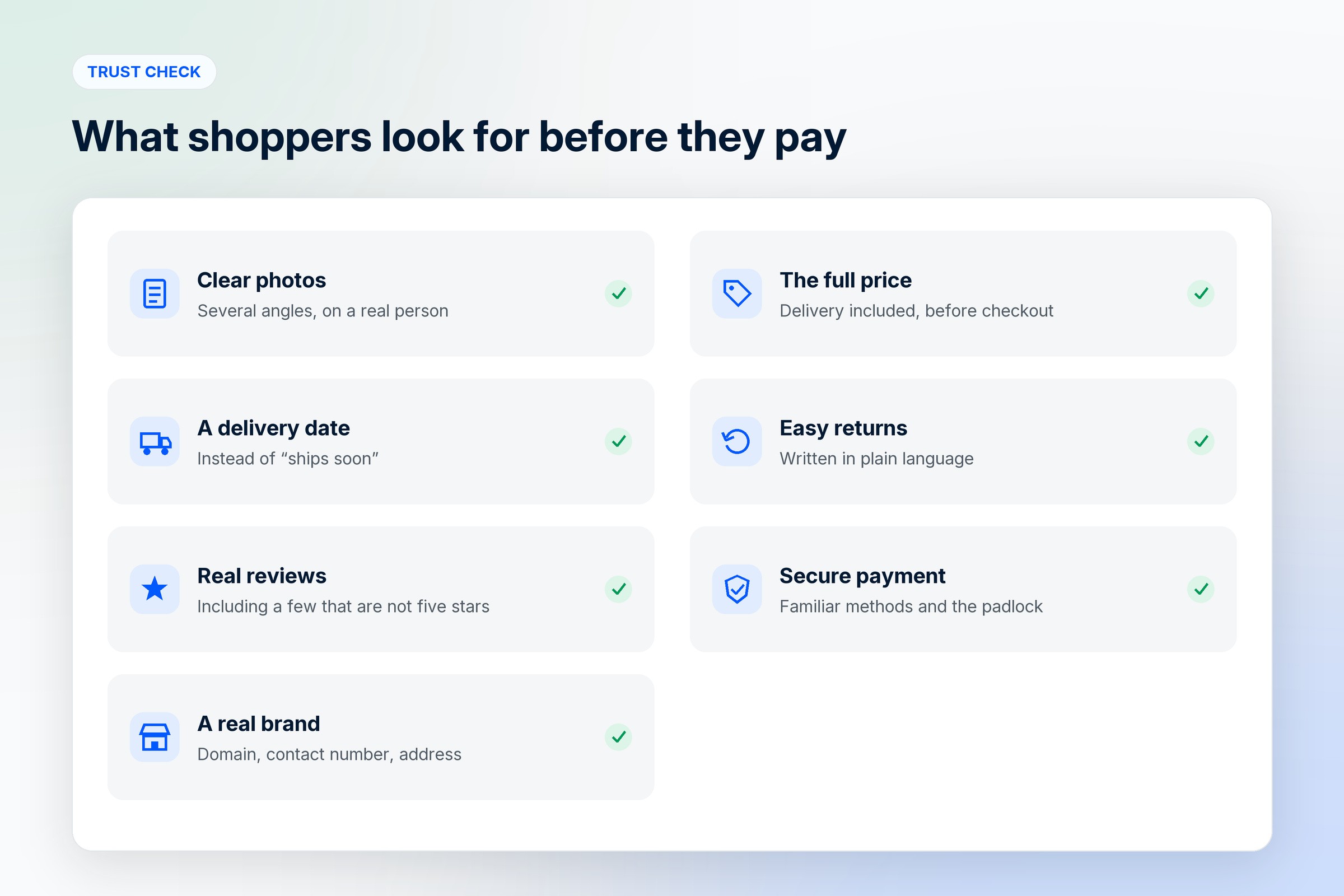
Clear photos from several angles, ideally on a real person or in a real room
The full price, including delivery, shown before checkout
An actual delivery date instead of “ships soon”
A returns policy written in plain language
Reviews, including a few that are not five stars
Familiar, secure payment methods and the padlock in the browser
A real brand behind it: a proper domain, a contact number, an address, a social media presence
We wrote more about the last point in why branding is important. It is the difference between a store people buy from once and one they return to.
Why shoppers leave without buying
Most visitors to any online store leave without ordering. Some were only browsing. Many wanted to buy and something stopped them.

The usual reasons are an unexpected delivery fee at the last step, being forced to create an account, a page that loads slowly on a phone, a returns policy they cannot find, the payment method they use not being offered, and a delivery date that is later than they need. Each one is fixable, and each one costs sales every day it is left alone. Our post on why an online store is important covers six of these pitfalls in more detail.
Online shopping safety tips for buyers
Online shopping is safe on reputable sites, but it is worth a few habits:
Check the web address before entering card details, and look for https and the padlock.
Be wary of prices that look far too low, especially from stores you found through an unfamiliar ad.
Pay with a card, wallet or a payment method that offers buyer protection, rather than a direct bank transfer to a stranger.
Never share an OTP or password with anyone who calls or messages claiming to be from the store or bank.
Read the returns policy before you buy, not after.
Keep the order confirmation until the item has arrived and you are happy with it.
What online shopping means for sellers
If people shop online, your business needs to be where they shop. For most sellers that means three things.
First, an online store of your own, alongside any marketplace listings. Marketplaces bring traffic, but they keep the customer and take a commission on every order. We explain the trade-off in the risks of selling only on marketplaces.
Second, a store built for phones. Much of online shopping now happens on a phone, and repeat buyers increasingly prefer an app on their home screen to a website they have to find again.
Third, a way to bring shoppers back: order updates, WhatsApp messages, offers for the second order. Online shopping makes it easy for a buyer to try a new store, which also makes it easy for them to leave yours.
1D2C is built for exactly this. It gives you a branded website and shopping app, plus seller and delivery apps, payments, WhatsApp messaging and no commission on your orders. You can see what that looks like on our ecommerce website builder page, or compare plans on the pricing page.
Frequently asked questions
What is online shopping?
Online shopping is buying products or services over the internet through a website or app. The shopper browses, adds items to a cart, pays online or on delivery, and the order is delivered, collected from a pickup point or downloaded.
Why do people prefer online shopping?
Mainly for convenience, choice and delivery to the door. Online stores are always open, show far more products than a physical shop, and make it easy to compare prices and read reviews from other buyers.
How does online shopping work?
The shopper finds a product, compares it, adds it to the cart and checks out by entering an address and paying. The store packs the order and sends it by courier or its own rider, and the shopper tracks it until it arrives.
Who shops online?
Almost every age group now. Older buyers, people in smaller towns and people who find it hard to travel to shops have taken to online shopping too, usually starting on a phone.
When is the best time to shop online?
For buyers, sale periods and festival seasons bring the biggest discounts, though popular items sell out and delivery can be slower. For everyday items, any time works, and quick commerce apps deliver within minutes.
Where can I shop online safely?
On a brand’s own website or app, on well-known marketplaces, and on any store with a secure checkout, clear contact details, a real returns policy and genuine reviews. Be careful with unfamiliar stores found through ads with unusually low prices.
Is online shopping safe?
Yes, on reputable sites with secure payment. The main risks are fake stores and scam calls or messages asking for OTPs. Check the web address, pay with a protected method and never share an OTP.
What are the disadvantages of online shopping?
You cannot touch or try the product, delivery takes time, and returns can be a hassle. Delivery fees can also cancel out a lower price. Good stores reduce these with clear photos, size guides, honest delivery dates and simple returns.
How can I start selling to online shoppers?
Set up your own online store with clear photos, honest prices and easy checkout, then bring shoppers to it through social media, search and ads. A platform like 1D2C gives you a branded website and app without building them yourself.
Keep reading
If you sell physical products, our guide on how to sell physical products online covers the practical side. For everyday items delivered in minutes, read what quick commerce is and how it works.


