


The word hides five different projects. Pick the wrong one and you spend a month building the thing you needed third.
People who search "create ecommerce" are not all trying to do the same thing. Some want a storefront by Friday. Some are three months into a brand and need an app. One of them is about to build a marketplace and has not realised it yet.
The word hides five different projects with different costs, different timelines and a different first step. Pick the wrong one and you spend a month building the thing you needed third.
This is a map rather than a tutorial. Each section says what you are actually creating, what it takes, and which guide covers it properly.
"Create ecommerce" means five different things
Create an ecommerce store. The catalogue, the prices, the stock and the checkout. The commercial engine, whatever it is displayed on.
Create an ecommerce website. The public thing with your domain on it, where most first orders happen.
Create an ecommerce app. Native iOS and Android, which mostly serves people who already buy from you.
Create an ecommerce business. The company, the payments, the tax, the supply and the brand. Software is a fraction of this.
Create an ecommerce marketplace. Many sellers on one platform, which is a different product with seller accounts, commissions and payouts.
Most people need the first two now, the third later, the fourth in parallel and the fifth only if they are hosting other sellers. If the category itself is new to you, start with what ecommerce is before any of this.
Create an ecommerce store: start with the catalogue
The store is the catalogue plus the checkout, and the catalogue is where the work actually lives.
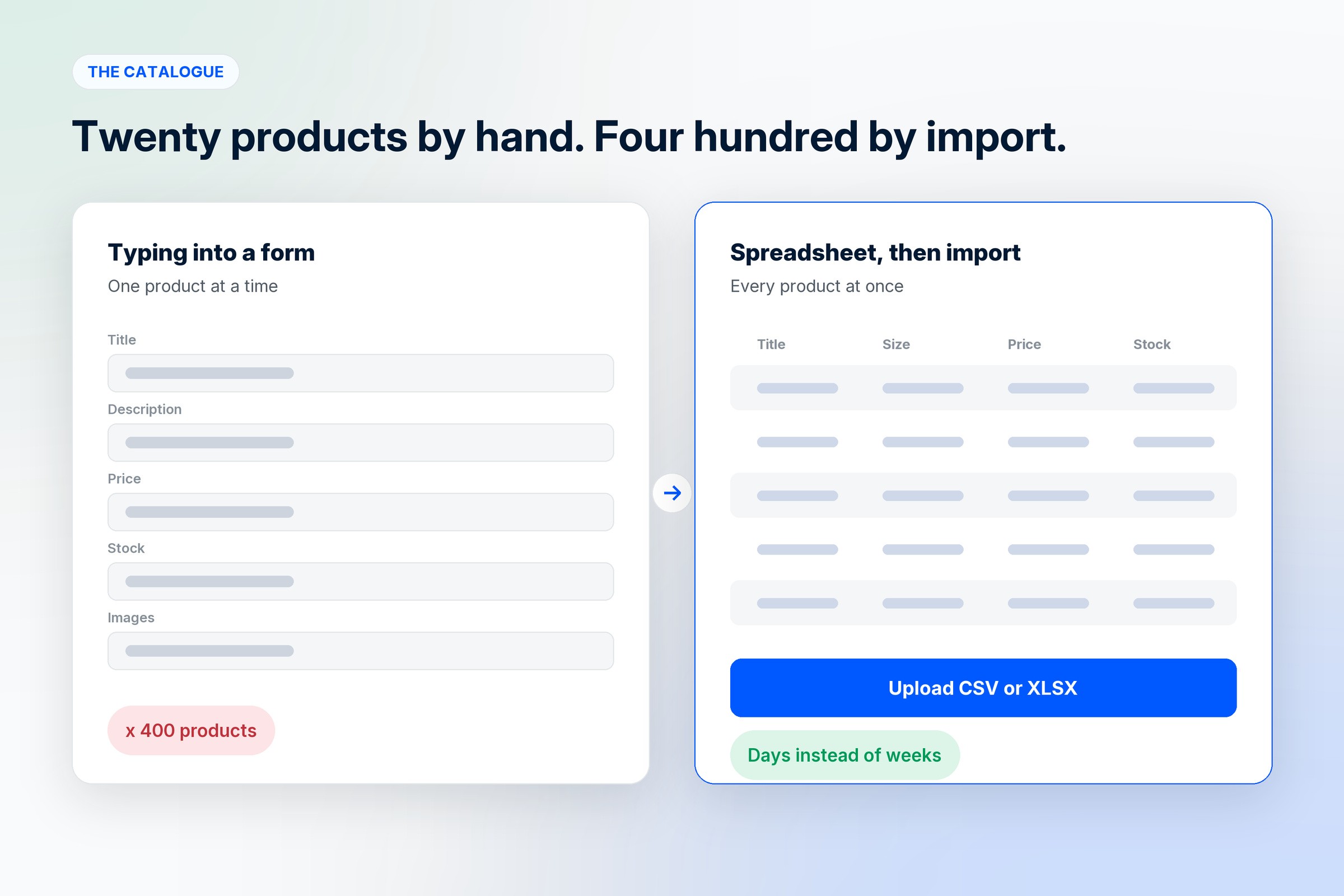
Each product needs photographs, a title people search for, a description that answers the obvious question, a price, and stock. Then each version of it needs its own price and its own stock, because one shirt in four sizes and five colours is twenty things to track rather than one.
Past about twenty products, stop typing into forms. Build the catalogue in a spreadsheet and import it. In 1D2C that is a CSV or XLSX upload with a sample file to match your columns to, and a separate path for updating products you have already loaded, which is the one you use before every sale.
The detail, including what breaks in an import and how to move a catalogue you already have, is in our guide to selling physical products online.
Create an ecommerce website
This is the fastest part and the one people over-think.
You need a domain, a storefront with your branding, product pages generated from the catalogue, a cart and checkout, and the four pages nobody enjoys writing: shipping, returns, contact and privacy. The last four do more for conversion than another theme, because they are what a cautious buyer checks before paying a brand they have not heard of.
A brand with its photography and copy ready can create an ecommerce website in days. The time goes into the catalogue, not the design. If you are comparing tools, our guide on choosing an ecommerce website builder covers the category and the trade-offs.
Create an ecommerce app
An app is not a bigger website, and it is rarely the right thing to create first.
It earns its place on repeat purchases, because it gives you a home screen icon and push notifications, which is the only free channel you own outright. If most customers buy once a year, build the website properly and spend the rest on getting customers.
Two things to know before you start. Store fees are fixed and public: Apple charges a $99 annual Developer Program membership and Google charges a US$25 one-time Play Console registration fee. And Apple's guidelines require an app built from a commercial template or app generation service to be submitted by the brand itself, so the listing belongs in your own developer account wherever you build it. The full version is in our guide to ecommerce mobile app builders.
Create an ecommerce business
The software is the part that takes days. This is the part that takes the rest of the year.
A name you can actually own, with a domain to match, which is worth settling before anything is printed. Our guide on choosing a brand name covers the checks.
A company, a bank account and a payment gateway. 1D2C supports Razorpay and Cashfree, and tax can be set flat or per product with the buyer's GST number captured where that applies.
Supply. Making it, having it made, buying wholesale, or print on demand, each with a different margin and a different risk.
Delivery and returns, priced before you set a free shipping threshold rather than after.
A reason to buy from you rather than the marketplace selling something similar for less, which is brand work and is slower than all of the above.
Create an ecommerce marketplace
If other sellers will list on your platform, you are building a different product.
A marketplace needs seller accounts, seller-specific pricing, commissions, separate payouts, and a way for each seller to run their own orders. Retrofitting that onto a single-vendor store is a migration rather than a setting.
1D2C runs both shapes from one platform, with seller-specific pricing, a seller app for vendors, radius-based search so buyers see nearby sellers, and radius-based rider assignment for your own delivery team. Before you commit to the model, the risks of selling only on marketplaces is worth reading from the other side of the table.
The order that works, whichever one you are creating
Decide what you sell and to whom. Everything downstream is cheaper once this is written down.
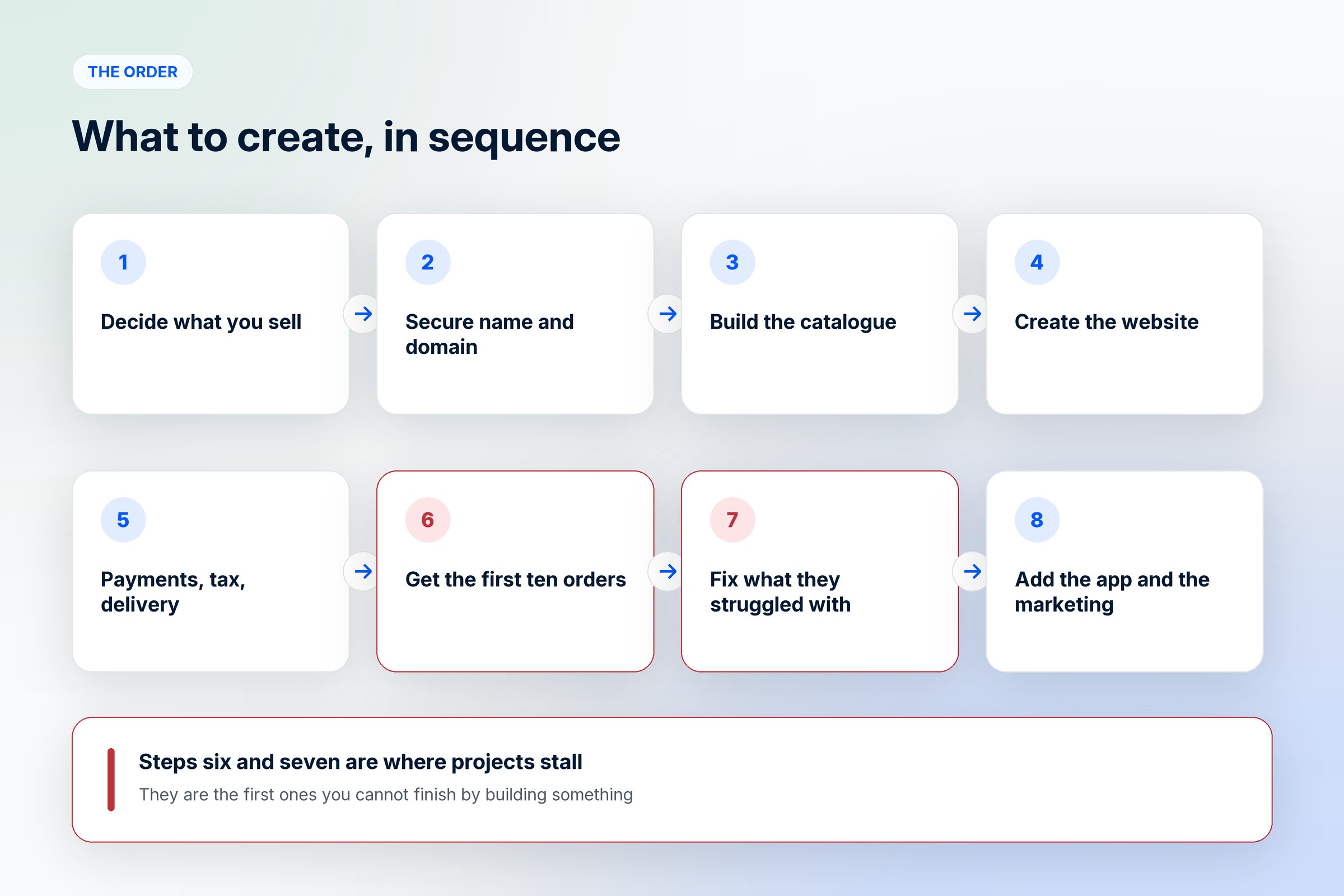
Secure the name and the domain together.
Build the catalogue. Spreadsheet first, import second.
Create the ecommerce website on top of that catalogue.
Connect payments, tax, delivery and returns, then place a real order yourself and refund it.
Get the first ten orders from people you can talk to. Fix what they struggled with.
Add the app once people are coming back.
Add marketing properly: pixel and app events so purchases reach your ad account, WhatsApp for the conversations that close sales, push notifications for repeat orders.
Steps six and seven are where most projects stall, because they are the first ones that cannot be completed by building something.
What it costs to create ecommerce
Four lines, and the software is usually the smallest.
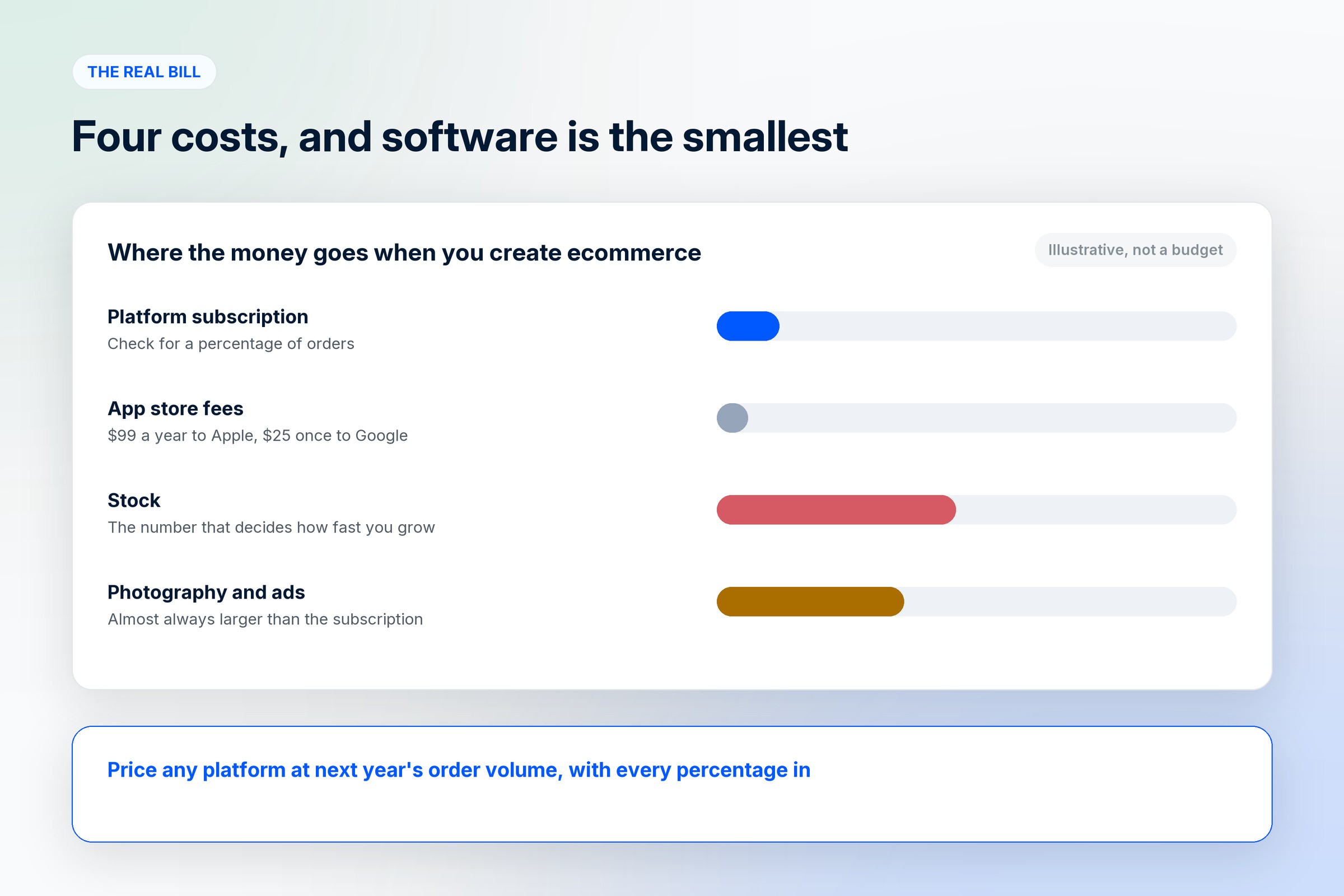
The platform subscription. Check whether it also takes a percentage of your orders, which many do. No 1D2C plan takes a percentage.
Store fees if you publish apps: the Apple and Google figures above, paid to them rather than to your platform.
Stock, which is the real number for a physical product, and the one that decides how fast you can grow.
Photography, and the ads to get the first customers, which are almost always larger than the subscription.
Plans and current regional pricing are on the pricing page. Price any platform at the order volume you expect in a year, with every percentage and add-on included.
How long it takes
The website is days. The catalogue is weeks. The app adds store review, which is slower on a first submission than on updates because the account, the privacy declarations and the screenshots are all being checked for the first time.
The business is the long one. Supply, cash flow and the first repeat customers run on their own schedule, and none of them are accelerated by choosing a different platform.
Mistakes people make when they create ecommerce
Creating the app first. It is the most exciting part and the least useful at the start.
Creating a catalogue by hand. Twenty products is fine. Four hundred is a month of your life and a dozen wrong prices.
Launching without a test order. Place one, pay for it, cancel it and refund it before anyone else does.
Skipping shipping and returns pages. The nervous buyer reads them, and the nervous buyer is most of your traffic in month one.
Creating everything before showing anyone. Ten real orders teach you more than another fortnight of building.
Frequently asked questions
What does it mean to create ecommerce?
It usually means one of five projects: creating an ecommerce store (the catalogue and checkout), an ecommerce website, an ecommerce app, an ecommerce business, or a marketplace with multiple sellers. They have different timelines and different first steps, so it is worth being specific about which one you are starting.
How do I create an ecommerce store?
Decide what you are selling, build the catalogue in a spreadsheet and import it rather than typing it in, put a storefront on top with your domain and branding, connect payments, tax and delivery, then place and refund a test order before you launch.
Why create your own ecommerce store instead of selling on a marketplace?
Because the marketplace keeps the customer. On your own store you own the buyer's details, the repeat order and the margin, and you are not competing on price inside somebody else's search results. Many brands run both, using the marketplace for discovery.
Who should create an ecommerce website first, and who should create an app first?
Almost everyone should create the website first, because it is one tap from an ad or a search result and needs no installation. Create the app once you have customers who come back, since its value is push notifications to people who already buy.
When is the right time to create an ecommerce business?
Once you can answer what you sell, to whom, at what margin, and how it reaches them. The software can be created in days at any point, so it is never the thing holding a launch back.
Where do I create an ecommerce store without coding?
On an ecommerce platform or builder, which gives you the storefront, catalogue, checkout and admin without development. The differences between them are customer data ownership, apps, percentage fees and what happens when you want to leave.
Which is better to create: an ecommerce website, an app, or both?
Both eventually, website first. A platform that creates them from one catalogue avoids keeping two systems in sync, which is manageable at twenty products and painful at a thousand.
Can I create an ecommerce store for free?
You can create one on a free trial, but selling involves unavoidable costs: a domain, a payment gateway's transaction fees, and stock. Free plans usually cost you elsewhere, in a percentage of orders or in your brand on somebody else's subdomain.
Is it hard to create ecommerce from scratch?
Creating the software is easy now. Creating demand is not, and that is where the work moved. Treat the build as the short first phase and plan for the marketing and supply that follow it.
Where to go from here
For the selling steps alongside the build, there is our ten-step guide to selling online. To choose the platform underneath it, read about choosing a D2C ecommerce builder, and for the app side, ecommerce mobile app builders.
1D2C creates the whole set from one catalogue: a branded ecommerce website, native buyer, seller and delivery apps under your own name, bulk product import, payments and tax, WhatsApp and push notifications, and marketing plans that run the campaigns alongside the platform. Plans and regional pricing are on the pricing page.
The Apple Developer Program fee, the Google Play registration fee and Apple's template rule were checked on Apple's and Google's own pages in October 2026. Platform capabilities are 1D2C's as of the same month.


